REVIEW · PARIS
Normandy D-Day Small-Group Day Trip with Omaha Beach, Cemetery & Cider Tasting
Book on Viator →Operated by Blue Fox Travel - Blue Bike Tours - Paris · Bookable on Viator
D-Day hits harder when it is personal. This small-group Normandy day trip from Paris strings together the key WWII sites—Omaha Beach, Pointe du Hoc, and the American cemetery—plus a Normandy cider tasting to keep the day human, not just heavy. I like that the tour is limited to just eight people, which makes the long travel days feel manageable. I also like that you get guided access at the places that need context, instead of only random stops.
One thing to consider: it is a very long day (about 12 to 13 hours), and how tightly the guide keeps things moving can change your overall experience—especially if you were hoping for a deeper, stop-by-stop narration at every site.
In This Review
- Key highlights worth your time
- A small group D-Day day from Paris that actually feels human
- Morning logistics: starting at 7:00 am and riding north
- Omaha Beach: walking the landing sands without getting lost in the noise
- Operation Overlord Museum: the equipment stops being abstract
- Batterie Allemande de Longues-sur-Mer: the day gets its Axis viewpoint
- Pointe du Hoc cliffs and bomb craters: the view that explains the mission
- The Normandy American Cemetery at Colleville-sur-Mer: where the day slows down
- Lunch near the coast: what’s included and what you’ll need to pay
- Cider at Ferme de la Sapinière: Normandy’s sweet reset
- Price and value: what $320.46 buys you in a long, structured day
- Who should book this Normandy D-Day day trip
- Should you book this tour or shop around?
- FAQ
- How many people are on the small-group tour?
- How long is the trip from Paris to Normandy?
- Where does the tour start and when?
- Is lunch included?
- What’s included in the tour price besides transport?
- Which sites do you visit during the day?
- What language is the tour offered in?
- Can I cancel for free?
Key highlights worth your time
- Eight-person max group for easier listening and fewer bottlenecks at WWII sites
- Omaha Beach + American cemetery as a strong emotional arc, not a checklist
- Operation Overlord Museum entry included (and skip-the-line access here)
- Axis perspective at Batterie Allemande de Longues-sur-Mer, including the command bunker area
- Pointe du Hoc gives you the cliff-and-craters view where the mission mattered
- Ferme de la Sapinière cider tasting as a real Normandy pause in the middle of history
A small group D-Day day from Paris that actually feels human
If you’ve ever looked at WWII maps and thought, Okay, but where exactly were people standing, this is the tour style that helps. You start in central Paris, then ride north in an air-conditioned minivan. Along the way, the guide builds the story so the places stop being labeled dots on a screen.
The small group cap matters more than it sounds. With eight people, you can hear explanations without constantly turning your head, and it is easier for the guide to answer questions. It also helps that several stops are physical—walk the sands at Omaha, move along the Pointe du Hoc area, and spend time among the headstones at Colleville-sur-Mer.
And yes, the day is long. Still, it is structured so you are not stuck in transit without payoff. The itinerary lays out a clear flow: landing beach → the big equipment museum → German coastal defenses → Pointe du Hoc → the cemetery → cider to reset your senses.
You can also read our reviews of more food & drink experiences in Paris


Morning logistics: starting at 7:00 am and riding north
This trip starts early, with a 7:00 am departure from 6 Av. de Wagram in the 8th arrondissement. You make your own way to the meeting point in the center of Paris, then you step into the minibus and begin the drive to Normandy.
Expect the rhythm of a day trip: long road time, planned stops, and a lunch stop you choose from on your own (more on that later). The good news is the tour uses a small, comfortable minivan, so you are not balancing a crowded bus. Also, the tour operates in all weather conditions, so pack layers and wear shoes that handle wet ground and uneven surfaces.
If you are the kind of traveler who wants to control the pace, you might feel slightly boxed in by the schedule. But if you’d rather spend your energy on the sites instead of figuring out trains, parking, and connections, the set itinerary is a win.
Omaha Beach: walking the landing sands without getting lost in the noise

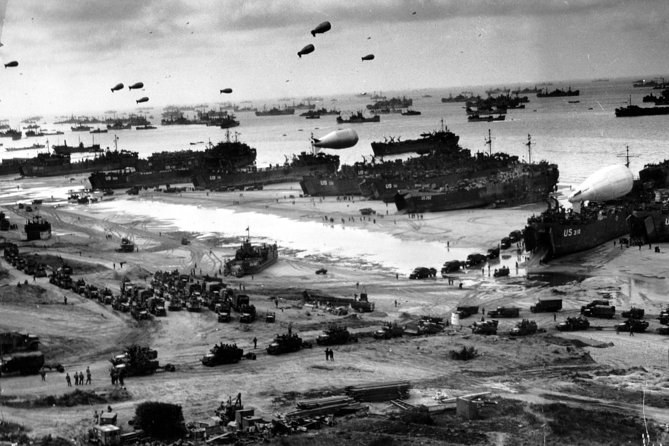
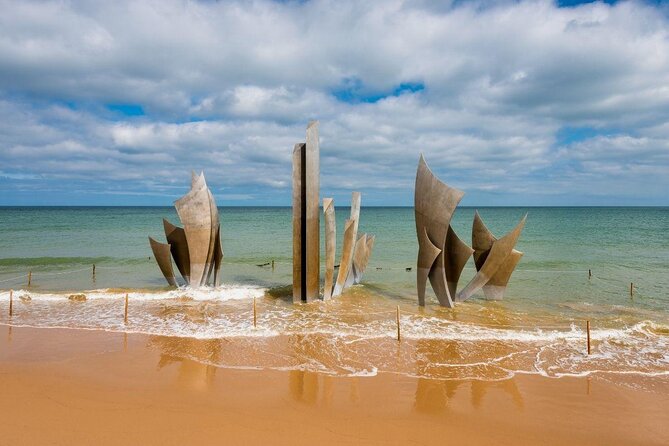
Omaha Beach is where the day becomes real. Omaha was known as the most difficult objective during the planning stages of the Normandy invasion, and Allied planners assigned it to American forces. You walk on the same sands where the landings happened, and your guide connects the ground to the decisions and chaos of June 6, 1944.
Here is what makes this stop powerful: you are not just looking at scenery. You are standing in a coastal shape that helped determine how the first hours unfolded—waterline, beach width, and the climb up from sand to ground. Even if you’ve read about it before, being there changes your mental scale fast.
How much you get out of Omaha can depend on the guide’s storytelling style and the time you are given to walk. If the pace feels too quick later in the day (a complaint that shows up in some feedback), it can help to show up at Omaha ready to slow down. Take a few minutes to step away from the group and orient yourself.
Operation Overlord Museum: the equipment stops being abstract
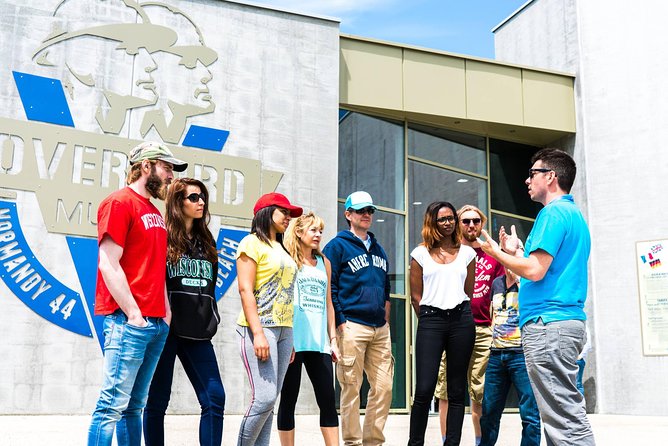
Next comes the Operation Overlord Museum, and this is where the day turns from “place” to “mechanism.” Operation Overlord was the code name for the Allied invasion of northwest Europe. The museum is built around a large collection of military hardware used to defend or attack the Normandy coast.
The details matter here. You may see an authentic Higgins boat, with the front flap down, plus tanks such as Sherman and Panzer models. This is the sort of stop that helps you picture the battle in terms of tools and constraints, not just names and dates.
The museum admission is included, and you are set up with guaranteed skip-the-line access here. That is a practical benefit on a day when you are already starting at 7:00 am.
A fair note: museums work best when you have enough time to look at what grabs you. If you are pressed for time, focus on the objects that match what you saw at the beach and the coastal defenses. In other words, let the museum explain the same story your earlier stops started.
Batterie Allemande de Longues-sur-Mer: the day gets its Axis viewpoint
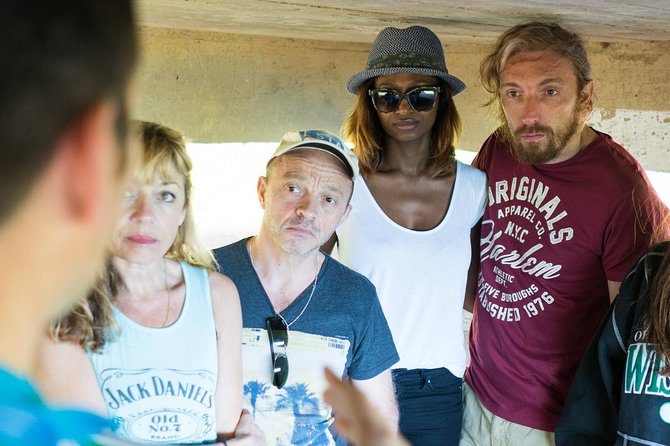
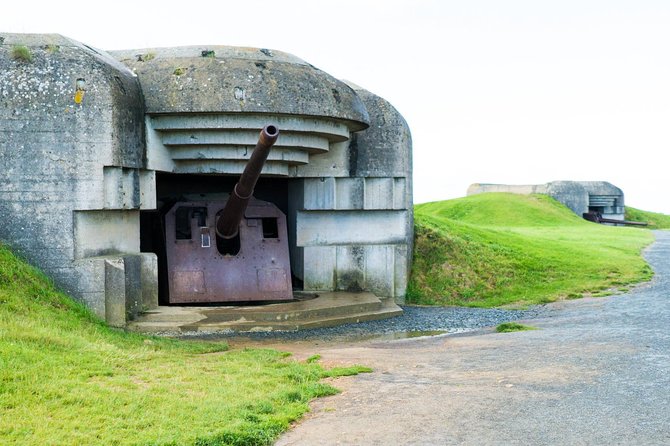
Then you shift perspectives at the German battery of Longues-sur-Mer. This is one of the more unusual elements of the itinerary because you are not only hearing Allied-side narratives. You go inside and around bunkers that were used in the coastal defense system, with an on-site guide explaining what happened from the German point of view.
What you get here is hands-on, physically inside the site. There is a fully intact command bunker plus three other bunkers still armed with huge 150 mm guns. You climb inside and learn about Rommel’s defensive network often referred to as the Atlantic Wall.
This stop can be emotionally different. Standing in the command spaces and seeing the scale of the artillery makes you understand that D-Day was not one-sided in its planning. It also helps explain why the landings faced such stubborn resistance. The goal is not to blur right and wrong—it is to show how the battle was fought across both planning desks.
Give yourself permission to linger. Even if your group is moving, you’ll learn more if you pause and look through openings, check positions, and connect them back to Omaha and the coastline.
You can also read our reviews of more tours and experiences in Paris





Pointe du Hoc cliffs and bomb craters: the view that explains the mission
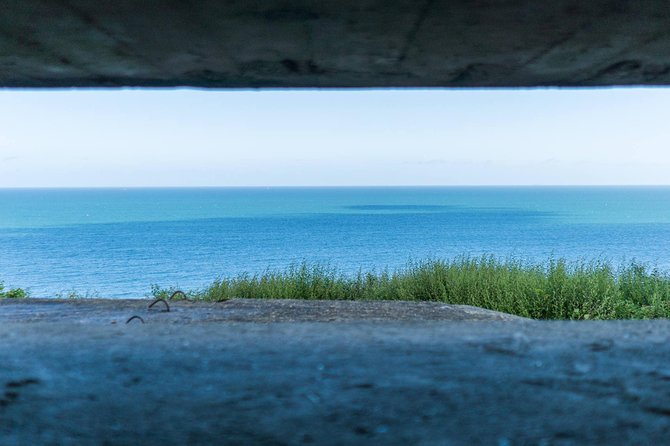
Pointe du Hoc is built to be stared at for a while. This strategic German defensive point had guns aimed toward both Omaha and Utah beaches. On D-Day, capturing it became a top priority.
You walk around huge bomb craters and head toward the edge of a cliff, where you can see the coastal drop-off and the fighting geography that mattered. The cliff is about 110 feet tall, and the story includes how the Rangers climbed it with rocket-powered grappling hooks and bayonets.
This is the stop that often sticks in people’s memory because it is dramatic even now, with erosion and weather doing their slow work. And it is also one of the best places to picture the training and the risk involved in the assault.
One practical tip for you: this is a spot where windy, cold, or damp weather can change how long you want to stand. If you feel rushed here, remember that the learning comes not only from hearing the story but from seeing how the landscape channels movement.
The Normandy American Cemetery at Colleville-sur-Mer: where the day slows down

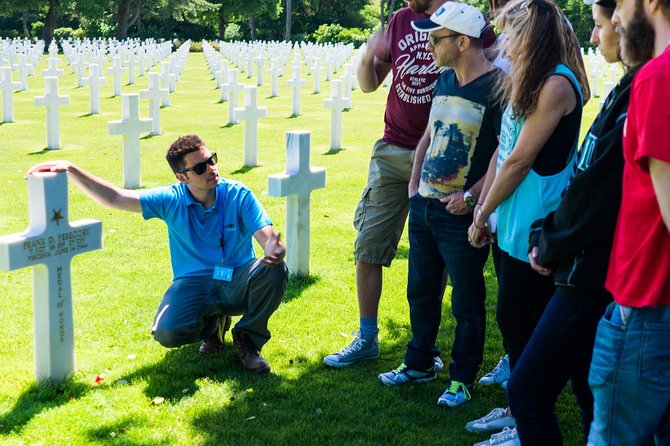
If Omaha is the landing, the Normandy American Cemetery is the meaning. Here you see 9,388 white marble tombs arranged in perfectly straight lines. You walk among the crosses and Stars of David, and your guide provides context that turns rows of names into lived sacrifice.
You may also hear stories connected to Medal of Honor winners, plus the Niland brothers, whose real-life experience inspired Saving Private Ryan. This is the kind of detail that helps you understand why the site keeps showing up in films, writing, and family memories.
The most important thing: approach this stop with your body and your brain in pause mode. This is not a place for rushing. Even when the guide gives a short introduction, you will get more if you give yourself quiet space to look—name by name, row by row.
Some tour days are timed to coincide with ceremonies at the cemetery, including a flag lowering moment and the playing of Taps. If your schedule lines up, that timing can hit hard—in the best way.
Lunch near the coast: what’s included and what you’ll need to pay
Lunch is on your own. The tour stops for a meal at a simple local restaurant—examples include places like l’Hostéière—where you might find salads, omelets, barbecued meats, and crepes. Budget about 10–20€, since lunch is not included in the tour price.
I like that this approach keeps you off the tourist-trap track. You are eating in the kind of coastal setting where locals actually show up. The down side is obvious: you have to pick something and pay for it yourself.
If you’re hungry after a morning that starts early and includes long walks, treat lunch as fuel, not just a break. Then you’ll have the energy to handle the later cemetery time, which is emotionally draining even when the weather is nice.
Cider at Ferme de la Sapinière: Normandy’s sweet reset
After all that history, the final stop gives your day a human rhythm change. At Ferme de la Sapinière, the guide takes you into the orchard side of Normandy. Before the war, there were apple trees to tend, and that tradition still drives the region’s flavors.
You get Normandy tastings—apple juice and hard cider are included. Your group also visits as the day comes to a close, with the tasting being paid as part of the tour.
This is one of those “why this matters” moments. The cider stop is not a distraction from WWII. It is a reminder that this region didn’t stop functioning after 1944. Normandy keeps farming, pressing apples, and producing something you can actually bring home in your memory (and sometimes, if there is time and you choose to, in your bag).
Also, some guides seem to lean into the culture side here. In feedback, specific guides praised for attention and local flavor made the cider portion a standout, not a quick afterthought.
Price and value: what $320.46 buys you in a long, structured day
At $320.46 per person, this is not the cheapest way to reach Normandy. So you should judge it on what is built into the plan.
You are paying for:
- Transport in an air-conditioned minivan
- A small group (eight max)
- An expert guide
- Overlord Museum entrance, with guaranteed skip-the-line access
- Cider/juice tastings in Normandy
- A guided route across multiple key sites that would be hard to stitch together smoothly on your own
The real value is time and cohesion. Doing Omaha, Overlord Museum, a German battery, Pointe du Hoc, and the cemetery in one day requires more logistics than it sounds like. This itinerary compresses that work for you, so you spend the day learning instead of navigating.
Still, there is a potential mismatch to watch for. Some feedback complains about guides keeping things more hands-off, with short introductions and lots of wandering time. If you want an ongoing, constant flow of interpretation at every stop, this tour may feel uneven depending on your guide and the day’s pace.
This is where the small group can help—but only if your guide uses it well. Names that show up positively in feedback include Bryn, Augustin, Will, Bruno, Cesar, Julian, Etienne, Matthew, and HB. When the guide is a strong storyteller, the whole day feels tied together, not like separate excursions on a route.
Who should book this Normandy D-Day day trip
Book it if you:
- Want a single-day, guided structure for Omaha Beach and the Normandy American Cemetery
- Prefer a small group over large crowds
- Plan to travel with kids 7 and up (minimum age is 7 years old)
- Care about seeing both Allied and German coastal perspectives (Longues-sur-Mer brings Axis context)
- Like pairing history with a real regional food moment (the cider tasting lands well)
Consider a different approach if:
- You strongly need nonstop narration at every site to feel satisfied
- You hate early starts and long driving days
- You want to spend extra time only at the cemetery or only at Pointe du Hoc (this is a multi-stop day)
Also, if you like the idea of catching the cemetery ceremony moments like flag lowering and Taps, go in with realistic expectations. Timing can align, but it’s not guaranteed in the data you have. Either way, the cemetery itself is the emotional core.
Should you book this tour or shop around?
I’d book it if your top priority is a well-organized route with small-group comfort, plus included museum access and the cider tasting. For many people, Omaha Beach and the cemetery alone make the trip worthwhile—and the additional stops (Overlord Museum, Longues-sur-Mer, Pointe du Hoc) give the day texture instead of turning it into a single-photo day.
But I’d think twice if you are the type who expects the guide to do a full deep commentary at every stop with no downtime. The itinerary has walking time and site exploration built into it. If your dream version is constant guided narration, pay attention to guide performance on your specific day—or balance your expectations by planning to take breaks and read at your own pace when needed.
If you are ready for a long, respectful day that blends beach, bunkers, cliffs, and cider, this is a strong pick.
FAQ
How many people are on the small-group tour?
The tour is limited to a maximum of eight travelers.
How long is the trip from Paris to Normandy?
It runs about 12 to 13 hours.
Where does the tour start and when?
The meeting point is 6 Av. de Wagram, 75008 Paris, and the start time is 7:00 am. The tour ends back at the same meeting point.
Is lunch included?
No. Lunch is not included, and you pay for it at a local restaurant. You should plan on spending about 10–20€.
What’s included in the tour price besides transport?
You get Normandy apple juice and hard cider tastings, transport by air-conditioned minivan, an expert guide, and entrance to the Overlord Museum with guaranteed skip-the-line.
Which sites do you visit during the day?
You visit Omaha Beach, the Overlord Museum, Batterie Allemande de Longues-sur-Mer, Pointe du Hoc, the Cimetiere Americain de Colleville-sur-Mer, and Ferme de la Sapinière for cider tasting.
What language is the tour offered in?
The tour is offered in English.
Can I cancel for free?
Yes, you can cancel for a full refund if you cancel at least 24 hours before the experience’s start time.