REVIEW · PARIS
Guided Cruise The Old Paris on Canal Saint Martin
Book on Viator →Operated by France Tourisme · Bookable on Viator
A canal cruise that slows Paris down. I love the underground tunnel crossing and the live bilingual commentary that makes the lock system make sense in real time. One thing to keep in mind: sound quality can be uneven, so pick a spot where you can actually hear.
This is a 2h30 ride from Canauxrama at Port de l’Arsenal up through eastern Paris, ending near Bassin de la Villette. There’s also a bar on board, and you get more than just scenery: you watch real engineering, including swing bridges and multiple double locks. If you’re expecting a fast, monument-heavy sightseeing sprint, this one’s calmer.
In This Review
- Key things I’d circle before you go
- Why the Canal Saint-Martin feels like a different Paris
- Route overview: Port de l’Arsenal to Bassin de la Villette in about 2h30
- Port de l’Arsenal and the canal-world opening act
- The underground tunnel crossing near the Canal Saint-Martin: calm, then a sudden return to the city
- Écluse du Temple and the slow ballet of the lock system
- Canal Saint-Martin’s tree-lined banks and iron footbridges
- The first lock experience on the Villette side: watch the level change close up
- Canal de l’Ourcq: a quieter, more authentic Paris stretch
- Rue de Crimée and the working lift bridge moment
- Ending at Bassin de la Villette: local energy, then the ride’s calm landing
- Live commentary in English: what to expect and how to hear it
- Value check: does $38.55 make sense?
- Who should book this cruise, and who might want a different one
- Should you book Old Paris on the Canal Saint-Martin?
- FAQ
- How long is the Canal Saint-Martin cruise?
- Where does the cruise start?
- Where does the cruise end?
- Is there live commentary during the cruise?
- Is the tour offered in English?
- Are locks and bridges included in the itinerary?
- Is a bar available on board?
- Is breakfast included with the standard ticket?
- Is hotel pickup and drop-off included?
- What is the cancellation policy if the weather is bad?
Key things I’d circle before you go
- Underground tunnel segment: a vaulted passage under the city, with daylight peeking through openings above.
- Real lock choreography: four double locks and two swing bridges, where you can watch water levels change.
- Place de la Bastille contrast: emerge from quiet underground canals into lively historic square energy.
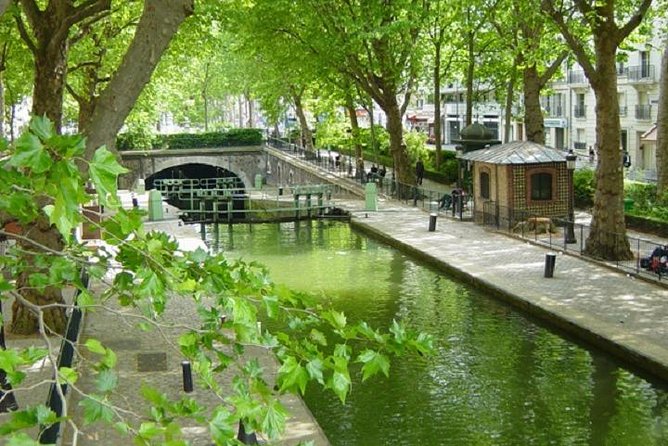
- Canal Saint-Martin character: tree-lined banks, elegant iron footbridges, and classic Paris river life.
- Rue de Crimée lift bridge: see one of the last operational lifting bridges in Paris move above the boat.
- Choose your viewing spot: sitting near the front can mean water spray and obstructed views.
Why the Canal Saint-Martin feels like a different Paris
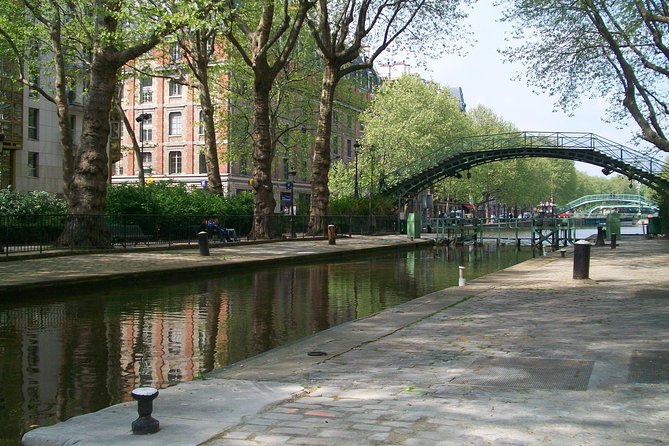
The Canal Saint-Martin isn’t the river with the postcard skyline. It’s a work-and-life canal in eastern Paris, where the pace changes the moment you’re off the street.
From the water, you get an up-close view of the city’s “in-between” side: tree-lined banks, residential stretches, and industrial details that don’t show up on the typical Seine cruise. Even better, the route uses the canal’s own ups and downs—so the scenery comes with motion, not just sitting and looking.
I also like that this cruise is timed around the canal’s rhythm. Locks slow everything down, so you can actually watch the system doing its job rather than treating it like a background detail.
You can also read our reviews of more boat tours in Paris
Route overview: Port de l’Arsenal to Bassin de la Villette in about 2h30
Your cruise starts at Canauxrama, 50 Bd de la Bastille (near metro Bastille). The journey ends at Canauxrama at Bassin de la Villette, 13 Quai de la Loire (near metro Jaurès). It’s not a loop where you return to the exact same dock—plan your last steps afterward.
The operator runs departures in the morning or afternoon, and the activity caps at a fairly large-but-not-massive group size (up to 149 people). You’ll get a mobile ticket, and the commentary is offered in English (with French as well).
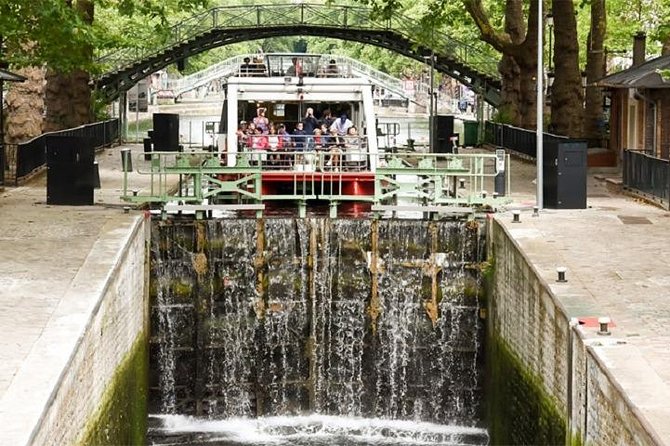
During the ride, you’ll pass through four double locks and two swing bridges, plus one lift bridge at rue de Crimée. That means you’re not only looking at architecture—you’re watching how water levels and transport links are managed across the city.
Port de l’Arsenal and the canal-world opening act
The cruise begins at Port de l’Arsenal, a marina that links the Canal Saint-Martin to the Seine network. This start matters because it sets the tone: you’re not immediately swallowed by tourist corridors. Instead, you transition into a canal world with its own streetscape and river logic.
Right after departure, you’re in a “now we’re actually on the canal” phase. It’s a good moment to settle in, figure out where sound carries best on your specific boat, and find your angle for photos before you hit the more dramatic sections.
If you’re sensitive to noise or have trouble hearing accents, this is where I’d position yourself strategically. Once you’re at the locks and tunnels, you’ll be busy watching the water, so choose your seat early.
The underground tunnel crossing near the Canal Saint-Martin: calm, then a sudden return to the city
One of the most memorable parts of this route is the long underground tunnel on the Canal Saint-Martin. It’s a vaulted passage beneath the city, and you get that strange-but-cool rhythm of daylight fading and then returning through openings above.
The tunnel changes how the cruise feels. Above-ground views are gone, and the boat moves like it’s in a different room—quiet, steady, and oddly calming. If you like atmospheric moments over landmark photos, this is the section to look forward to.
Then comes the payoff: you emerge near Place de la Bastille. The contrast is sharp. Underground canal stillness gives way to a lively square, and suddenly the cruise connects to the city you recognize on foot.
Practical tip: bring a light layer or small rain cover. Even on a dry day, tunnels, wind, and mist from locks can affect how cool you feel over 2h30.
Écluse du Temple and the slow ballet of the lock system
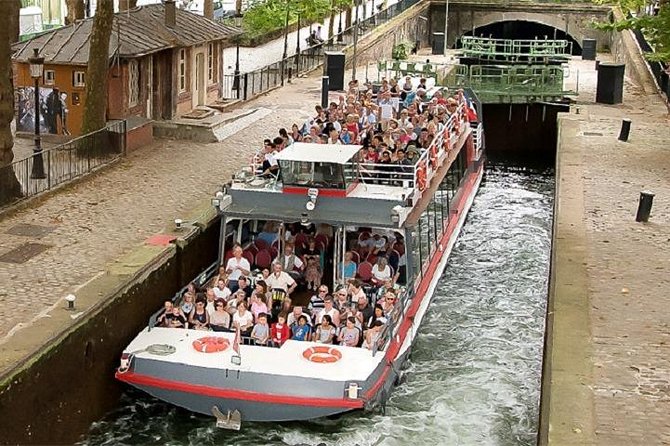
After you resurface near Bastille, the boat moves into the lock rhythm that defines the Canal Saint-Martin experience. One key stop is Écluse du Temple, where you’ll pass through another important lock.
Locks are slow by design. That’s part of the value here: you get time to watch the mechanics—gates, water flow, and the level change that raises or lowers the boat. It’s like a live engineering lesson, but in a laid-back way.
You’ll also pass Écluses des Morts, a series of locks with a name that carries a hint of mystery. The atmosphere is different here because you’re traveling past a stretch tied to the canal’s long story. Even if you don’t catch every detail from the narration, the setting feels like something with history behind it.
What to watch: during lock sequences, look at how the water line moves relative to the gates and the boat. It turns the ride from scenery into a process you can understand.
You can also read our reviews of more guided tours in Paris


Canal Saint-Martin’s tree-lined banks and iron footbridges
The heart of the cruise is the stretch of the Canal Saint-Martin known for its tree-lined banks and elegant iron footbridges. This is the part that many people describe as classic Paris along the water—romantic on the surface, but also very real in how locals use the space.
If you like streets where life happens quietly—families, walkers, small communities—this section delivers. And because you’re moving at canal speed, you don’t miss the details like you might on a faster sightseeing loop.
You’ll also see Bassin Louis Blanc, where the canal becomes calmer and more intimate as it blends with the neighborhood around it. This segment tends to feel like an exhale after the lock-and-bridge action.
Practical tip: if you care about unobstructed views, avoid clustering right at the rail near the boat’s most crowded spot. The front can get packed, and water spray during locks can reduce comfort.
The first lock experience on the Villette side: watch the level change close up
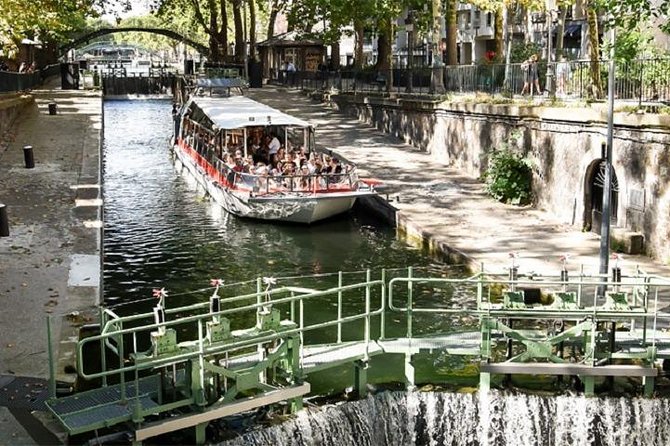
The cruise continues with the first lock experience as the boat passes through Écluse de la Villette. This is one of the moments where the canal engineering becomes very visual.
You’ll see the water rise or fall as the lock gates open and close. It’s a simple concept, but watching it happen in motion gives it a tangible feel that photos usually can’t replicate.
This part also tends to be where people pay attention to where they’re sitting. If you’re near the front, you can get hit with spray when the lock fills. It’s fun for some people and annoying for others—so if you’re picky about staying dry, choose your spot with that in mind.
Canal de l’Ourcq: a quieter, more authentic Paris stretch
After the core Canal Saint-Martin section, the route shifts toward Canal de l’Ourcq. This canal was originally built to supply Paris with fresh water, and the feel changes as well.
The canal’s edges show a mix: former warehouses and modern residential buildings. That mix matters because it makes the ride feel less like a theme and more like how the city actually grew and repurposed space.
It’s also the segment where you may feel the cruise becoming more “local.” You’re still in Paris, but you’re not staring at the same tourist faces or the same landmark angles. For many people, that’s exactly why this cruise works.
Rue de Crimée and the working lift bridge moment
One of the most fascinating things on the itinerary is sailing beneath the lift bridge of rue de Crimée, described as one of the last operational lifting bridges in Paris.
Here you’re watching the bridge rise above the boat, which turns the canal into something animated and functional instead of purely scenic. It’s also a rare chance to see living industrial heritage at close range—without the noise and crowds you’d expect from a major tourist attraction.
If you like quirky mechanics—geared systems, gates, water control—this section can be a highlight. And if you don’t usually care about bridges, watching it move can still make you pause and look up.
Ending at Bassin de la Villette: local energy, then the ride’s calm landing
The cruise reaches Bassin de la Villette, one of the largest open water basins in Paris. This is where the canal network’s story feels most connected to the surrounding urban neighborhoods.
The atmosphere here is lively but relaxed, with room to breathe after the moving locks and bridge action. You’ll finish your 2h30 journey at the basin area near Jaurès metro, which makes getting back into the rest of the city pretty straightforward.
Practical tip: give yourself a little buffer after the cruise. Even though the endpoint is transit-friendly, you’ll want a few minutes to shake off the cruise-warmth, regroup, and decide where to go next.
Live commentary in English: what to expect and how to hear it
The experience is built around live commentary in English and French. That’s a big reason this isn’t just a sit-and-stare canal ride.
The best versions of this cruise get narration right on target—explaining what a lock is doing, why the tunnel exists, and what the canal neighborhoods have in common. One guide named Mia is singled out in reviews as speaking easily in both English and French, which suggests she’s one of the better fits for clarity.
That said, not every run delivers the same audio experience. Some people report PA systems that are fuzzy, guides who can be hard to understand in English, or speakers that don’t work properly. This isn’t something you can fully control, so I’d treat it as a “try for the best listening spot” situation.
My seat advice: if you want to hear, avoid the most crowded front area. If you want to stay drier, also avoid the spray zone during locks. Sitting a bit back can improve both hearing and comfort.
Value check: does $38.55 make sense?
At $38.55 per person for about 2h30, this cruise can be a strong deal if you want something different from the standard Seine loop. You’re paying for guided interpretation plus multiple engineering moments: four double locks, two swing bridges, and a lift bridge.
This isn’t a high-speed tour of monuments. It’s slower and more process-focused. If that matches your style, the value feels excellent because the ride gives you a story you can understand as it happens.
Where value can drop for some people: expectations around audio and breakfast. The bar is on board, but breakfast is only included in the package labeled cruise + breakfast (described as 1 coffee and 1 croissant). If you assume breakfast is part of the base cruise, you can end up disappointed and missing what you planned at your hotel.
There are also occasional technical disruptions reported in feedback, including a cruise ending early due to engine issues. Those are rare, but they do mean the best mindset is to treat this as a calm activity—not a strict timed appointment.
Who should book this cruise, and who might want a different one
You should book if you like:
- calm travel that doesn’t rely on big crowds
- watching real canal systems work
- getting an eastern Paris perspective from the water
- a break from walking, with enough motion to keep it interesting
It’s also a good option if you’re curious about how Paris links neighborhoods through water. Even people who have been to Paris multiple times often find this route changes how they see the city.
You might choose something else if you need a fast pace and constant visual action. One downside I’ve seen people react to is how long locks can feel, especially if you expected more scenery and less waiting for gate cycles. Also, if you’re sensitive to noise or have a hard time hearing from boat-level PA systems, pick your seat carefully and don’t treat commentary as guaranteed perfect.
Should you book Old Paris on the Canal Saint-Martin?
Book this cruise if you want a quieter slice of Paris where the city’s engineering and neighborhoods take center stage. The combination of the underground tunnel, multiple locks, tree-lined Canal Saint-Martin views, and the rue de Crimée lift bridge gives you variety without rushing.
Skip it (or switch to a different cruise) if you’re mainly hunting for iconic monuments and want a louder, faster sightseeing show. Also think twice if you strongly dislike the idea of possible sound issues on a boat—this experience is guided, but audio quality can vary.
If your goal is to see a side of Paris most people miss, this is a smart add-on. It’s exactly the kind of “slow Paris” experience that makes a trip feel more lived-in than checklist-only.
FAQ
How long is the Canal Saint-Martin cruise?
The cruise lasts about 2 hours 30 minutes.
Where does the cruise start?
It starts at Canauxrama, 50 Bd de la Bastille, 75012 Paris.
Where does the cruise end?
It ends at Canauxrama, Bassin de la Villette, 13 Quai de la Loire, 75019 Paris (near metro Jaurès).
Is there live commentary during the cruise?
Yes, there is live commentary during the cruise, offered in English and French.
Is the tour offered in English?
Yes, English is available.
Are locks and bridges included in the itinerary?
Yes. The cruise includes passing through 4 double locks and 2 swing bridges.
Is a bar available on board?
Yes, there is a bar available on board.
Is breakfast included with the standard ticket?
Breakfast is only included in the package cruise + breakfast (1 coffee and 1 croissant). The base cruise does not include breakfast.
Is hotel pickup and drop-off included?
No. Hotel pickup and drop-off are not included.
What is the cancellation policy if the weather is bad?
The experience requires good weather. If it’s canceled due to poor weather, you’ll be offered a different date or a full refund.