REVIEW · PARIS
Paris by Night: Exclusive Segway night tour with a Local Guide
Book on Viator →Operated by Go Go Tours - Privat Segway Tours In Paris · Bookable on Viator
Segways at dusk turn Paris into a moving photo set. I like the clear, patient training and how the guide keeps the experience smooth even when you are new to riding, and I also like the small-group feel that makes it easier to ask questions. In about 90 minutes, you glide past major landmarks without doing the long, on-foot weaving that can eat up your evening.
The tradeoff is that you are still riding in a real urban environment. You may move through bike lanes and cross busy intersections, so comfort with the Segway controls matters, and you will want to dress for cold or rain since the ride stays outdoors.
In This Review
- Key things I would focus on before you book
- Why a nighttime Segway tour is a smart way to do Paris highlights
- Your 90-minute route: from Invalides to Eiffel Tower sparkle
- Stop at Musée de l’Armee des Invalides: Napoleon’s setting in the 7th
- Seine glamour at Pont Alexandre III (and why it is more than a pretty bridge)
- Petit Palais and Grand Palais: Paris built for the 1900 World Fair
- Place de la Concorde: a big square with a lot of layers
- The Louvre area at dusk: fortress origins to royal palace changes
- Musée d’Orsay: a former train station turned museum
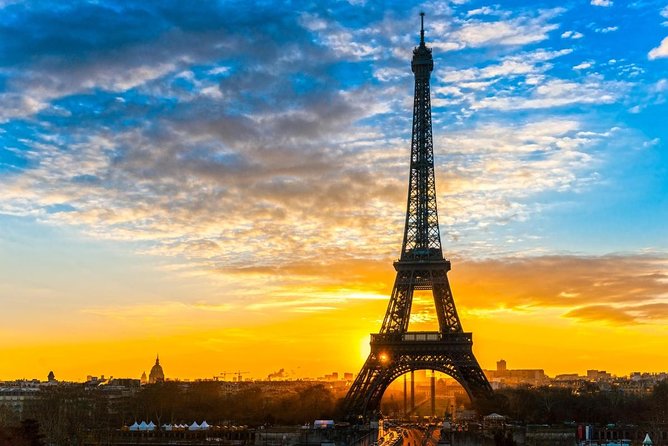
- Eiffel Tower time: the symbol that was not supposed to last
- How the Segway training and safety coaching really works
- Price and value: what you pay for, and what you get
- Who this tour fits best (and who should think twice)
- Quick practical tips to make the ride smoother
- Should you book this night Segway tour?
- FAQ
- How long is the Paris by Night Segway tour?
- Where does the tour start and where does it end?
- What time does the tour begin?
- Is the tour offered in English?
- What is included in the tour price?
- Are museum admission tickets included for stops like the Louvre and Orsay?
- Can I cancel if my plans change?
Key things I would focus on before you book
- Small group, capped at 15: more attention per rider and quicker adjustments to your comfort level
- Safety first, with helmet and training: the guides coach you before you roll into traffic zones
- A tight route that hits the big names: Invalides, the Seine bridges, the Louvre area, Orsay, and the Eiffel Tower
- Evening timing for Paris glow: sights look best when the light softens, and the Louvre area can feel extra special in summer
- Weather help included: raincoats and hats if it is cold
- English offered: most departures are in English, and you may get a multilingual guide
Why a nighttime Segway tour is a smart way to do Paris highlights
A Segway tour is one of those rare activities that feels like fun first, then history hits you while you are moving. At night, Paris changes texture. Buildings go from daytime landmarks to lit-up landmarks, and the streets feel less frantic than midday.
The big value here is time. You are not just seeing one museum exterior. You are getting a connected sweep of the city’s most iconic zones, plus context on what you are looking at. That matters if this is your first or second trip, or if you are trying to plan a tight schedule.
For me, the best part of an evening Segway tour is that it helps you get oriented fast. Afterward, you usually have a mental map of where things are and which neighborhoods you want to revisit in daylight.
You can also read our reviews of more guided tours in Paris



Your 90-minute route: from Invalides to Eiffel Tower sparkle
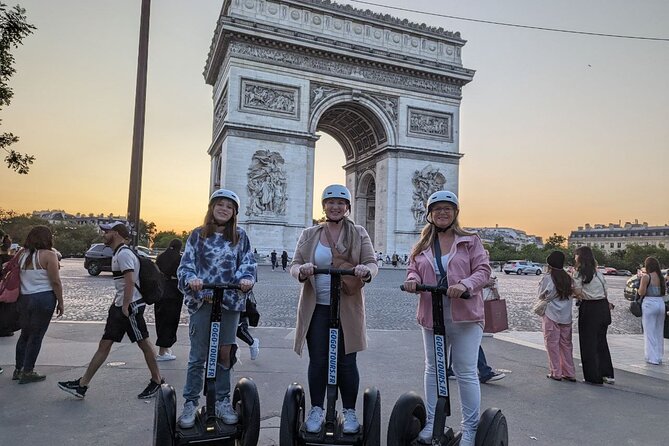
This tour runs about 1 hour 30 minutes and starts at 101 Av. de la Bourdonnais in the 7th arrondissement at 6:30 pm. You end back at the same meeting point, which is convenient after dark.
You will stop often, usually for short photo breaks and explanations. The pacing is designed so you keep moving, but you still get time to look up at the facades, bridges, and riverside angles that only really work from the street.
The sight list is classic Paris, but the trick is how it is strung together. You go from the grand story of Napoleon’s world to the ceremonial bridges over the Seine, then into the museum grand scale near the Louvre and Orsay, and finally to the Eiffel Tower when it is lit and dramatic.
Stop at Musée de l’Armee des Invalides: Napoleon’s setting in the 7th
Your first major stop is Les Invalides, the Musée de l’Armee des Invalides and the tomb area associated with Napoleon. The site is tied to royal-era Paris: it was commissioned in 1670 by Louis XIV to house and care for wounded soldiers.
On a Segway, this works well because you can take a few minutes to frame shots while you understand what you are looking at. The buildings here feel official and heavy, not romantic and airy. Getting that context early makes the rest of the ride more meaningful.
If you love military history, or you just want to know why this complex matters in the French capital, this stop gives you something solid right away. Expect a quick photo break rather than museum time, since admission is not included.
Seine glamour at Pont Alexandre III (and why it is more than a pretty bridge)
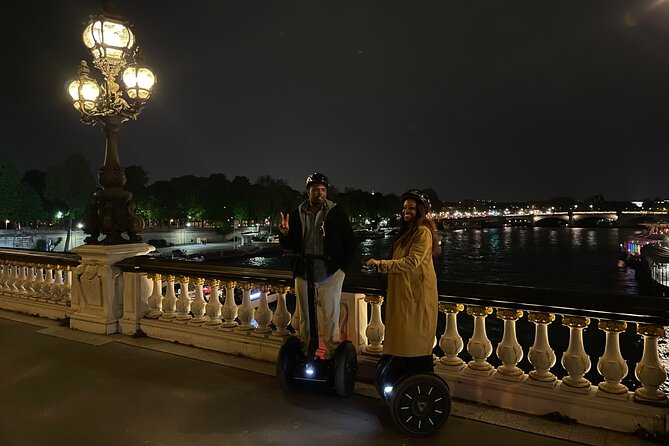
Next you roll to Pont Alexandre III, one of the beautiful Seine bridges that connects key areas of the city. This one stands out because it was built for the World Fair held in Paris, and it has that grand, exhibition-era styling that feels different from most crossings.
Your stop here is short, but it is the kind of location that rewards even a brief pause. You get the river perspective, plus the chance to photograph the bridge itself as a centerpiece. At dusk, the contrast between stonework and evening light really pops.
Practical tip: bridges can be windy after sunset. If you feel cold easily, plan for it even if the day was mild.
Petit Palais and Grand Palais: Paris built for the 1900 World Fair
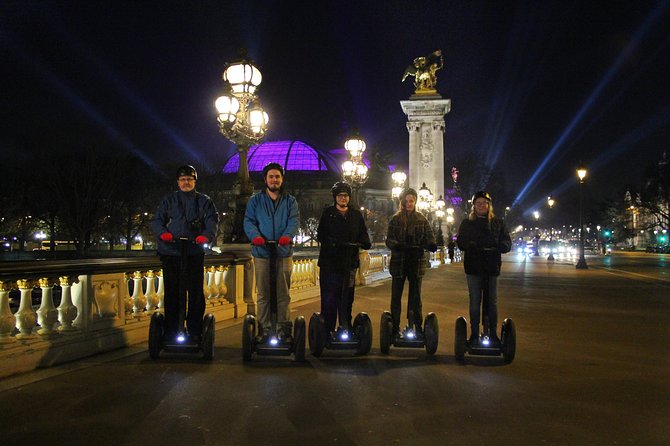
From the bridge, you head toward two neighboring landmarks that are tied to the same big historical moment. Petit Palais was built for the 1900 Universal Exhibition and later became a museum in 1902. Grand Palais also dates to the 1900 exhibition era and is dedicated by the French Republic to the glory of French art.
These stops are great for two reasons. First, they look stunning from the street when they are lit. Second, the guide can connect the exterior architecture to the 1900 fair idea: Paris showing off its culture, engineering, and style in one concentrated burst.
Because you are on a Segway, you are not stuck standing in one spot for a long time. You can reposition for angles that most pedestrians miss, then move on without losing the momentum of the night.
You can also read our reviews of more evening experiences in Paris





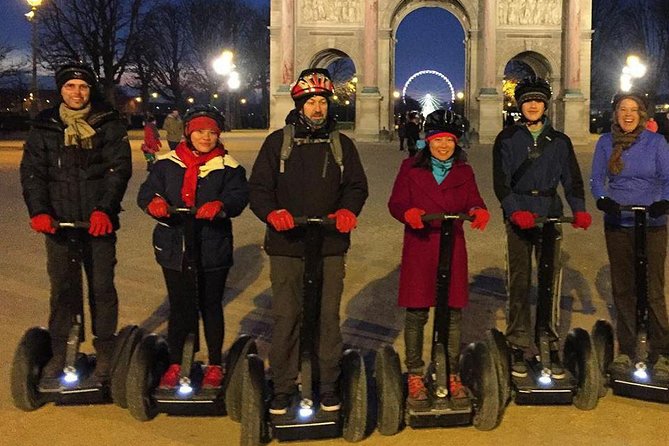
Place de la Concorde: a big square with a lot of layers
You then pass through Place de la Concorde, located between the Champs Elysées and the Tuileries Gardens. It is one of Paris’ most evocative public spaces, partly because of its layered history.
This stop is not about long walking. It is about catching the scale. Place de la Concorde is the largest square in Paris, and it is also the country’s second largest after a similar large space in Bordeaux. At night, that open feel can be strangely calming after you have been riding near busy streets.
Photo tip: in an open square, you will see more sky in your shots. If your camera settings are easy to adjust, take one or two photos straight up at the buildings and one or two from ground level for a more balanced result.
The Louvre area at dusk: fortress origins to royal palace changes
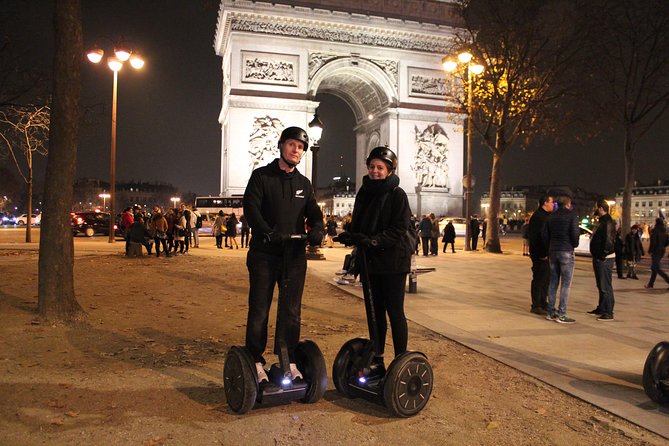
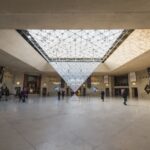
Next up is the Louvre Museum. Here the story is about transformation. The Louvre began as a fortress in 1190, then was reconstructed in the 16th century to serve as a royal palace. Like so much of Paris, it grew through rebuilding and changing roles over time.
On this tour, you are not doing an in-depth museum visit. You are doing a quick external look plus context, which is perfect if you want the symbolism and setting without eating hours inside.
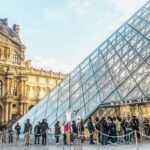
If you are traveling in summer, there is a specific highlight timing that makes the evening feel extra special: you may get a view around sunset with the sun setting behind the Louvre Pyramid. Even if you do not catch the exact moment, the dusk light still makes the area feel cinematic.
Musée d’Orsay: a former train station turned museum
After the Louvre zone, you move to Musée d’Orsay. The key detail here is that it started life as a train station, Gare d’Orsay, built to bring visitors for the 1900 World’s Fair. The station also had modern features for its time, designed by architect Victor Laloux.
This stop is a good reminder that Paris has always repurposed big infrastructure into culture. The building is dramatic even from the outside, and when you understand it used to be a station, the architecture clicks.
If you are short on time, this is one of the better ways to decide whether you want a full Orsay visit later. You get enough of the vibe to know if it matches what you like in a museum.
Eiffel Tower time: the symbol that was not supposed to last
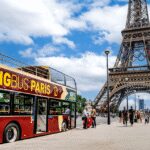
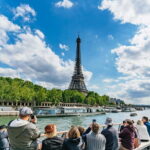
The final stop is the Eiffel Tower. The tower is described as part of French national heritage and a symbol of Paris for decades. But the backstory adds flavor: when Gustave Eiffel achieved its construction in 1889, it was meant to be temporary, and it was not immediately favored by Parisians.
This is exactly where the evening format pays off. The ride gets you close enough to feel how central the tower is to the skyline, but you are not stuck in lines or constrained by one viewing spot. The goal is to see it lit, feel the scale, and take photos while you still have energy for the night.
If it is later in the evening, keep in mind you will be spending time outdoors. Gloves can help if you run cold.
How the Segway training and safety coaching really works
Before you go, you get the equipment: helmet included, plus raincoats and hats if it is cold. That is not fluff. If you are riding at night and the weather turns, the tour still keeps you comfortable enough to focus.
You also get instruction for using the Segways. Guides are careful about the learning curve, and the experience is built for first-timers as long as you can follow directions and feel comfortable balancing. More than one guide has been praised for being patient during the initial training and for keeping the tour safe when moving near traffic zones.
You should be prepared for the reality of cycling infrastructure in Paris. One big practical note from the experience style: you may travel into bike lanes and cross at intersections, so you will ride more defensively than you would on a quiet path. The best approach is simple: keep your speed as instructed, watch for signals, and let the guide set the rhythm.
Guide names that have come up include Alex, Santiago, Kenzo, Kenza, Jack, Violet, Victor, Norris, Iggy, Valerie, and Kenza again. Not every name will be guaranteed on every date, but the pattern is consistent: the guides teach the controls first, then talk you through what you are seeing.
Price and value: what you pay for, and what you get
At $85.68 per person, this is not a bargain-basement activity, but it is also not just a transfer service dressed up as sightseeing.
You are paying for three things at once:
- Guided expertise: someone local helps you connect landmarks to the story behind them
- Time compression: you cover a lot of distance and viewpoints in a short window
- The equipment and coaching: helmet, rain gear, and hands-on training so you can ride safely
If you tried to recreate this yourself, you would still need time for figuring out a route, plus you would lose the built-in pacing that keeps you moving between key areas. And if you rented a Segway on your own, you would miss the guidance and stop-by-stop context.
Value also improves if you are traveling with teens or family members who would rather move than stand. A Segway turn can become the day’s highlight quickly because it feels like a real activity, not just another walking tour.
Who this tour fits best (and who should think twice)
This works especially well if you want a fun introduction to central Paris in one evening. It is also a good match if you like history but you do not want to spend your night inside. The stop timing makes it easy to get exterior impressions of major sites, then choose later what deserves a deeper visit.
It is also a strong fit for people in their 50s and up who want an active way to see the city without spending hours on foot. First-timers can do it if they follow the training instructions and stay focused.
The age rule matters: the tour is not allowed for children aged 11 and under. If you are traveling with younger kids, you will need a different option.
Think twice if you are extremely sensitive to cold, because the ride is outdoors. Also, if you hate the idea of riding near intersections, bike lanes, and moving through real city traffic patterns, choose an activity that stays on quiet pedestrian routes.
Quick practical tips to make the ride smoother
Dress smart casual so you can move easily. If it is cold, use the provided hats. If it looks like rain, you should feel good knowing raincoats are part of the package.
Bring a phone or small camera strap if you hate fumbling while riding. You will stop for photos, but the best time to shoot is often during those short stops, when you will want both hands under control.
If you want better photos, plan to take a few shots at each stop rather than going for one perfect angle. On a moving, timed tour, consistency beats perfection.
Should you book this night Segway tour?
If you want Paris highlights in a lively format, I think this is a smart booking. For the price, you get enough sights, plus training and safety coaching, plus context that makes the landmarks more than just postcard backdrops. It is the kind of activity that gives you energy for the rest of your trip.
I would skip it only if you know you dislike riding near traffic patterns, if cold weather ruins your evenings, or if you need museum entrance time. Otherwise, this is one of the easier ways to see a large swath of iconic Paris in just 90 minutes.
FAQ
How long is the Paris by Night Segway tour?
It runs for about 1 hour 30 minutes.
Where does the tour start and where does it end?
It starts at 101 Av. de la Bourdonnais, 75007 Paris, France, and it ends back at the same meeting point.
What time does the tour begin?
The start time listed is 6:30 pm.
Is the tour offered in English?
Yes, it is offered in English.
What is included in the tour price?
You get a local guide and professional guide, a helmet for safety, and raincoats and hats if it is cold.
Are museum admission tickets included for stops like the Louvre and Orsay?
No. The stops are listed with admission ticket not included, so you would need separate tickets if you want to enter museums.
Can I cancel if my plans change?
Free cancellation is available up to 24 hours before the experience start time for a full refund.