REVIEW · PARIS
Montmartre Walking Tour: A Journey Through Art and History
Book on GetYourGuide →Operated by Parisian Tales · Bookable on GetYourGuide
Montmartre can feel like a postcard, but this tour makes it click into real stories. I really liked the small interactive group size (ten people) and the fact that the guide, Arthur, uses tablet visuals to explain what you’re seeing as you walk. The only watch-out is that it’s not ideal if you’re traveling with kids under 10 or if stairs and uphill walking are a concern for older visitors.
You get a focused 2.5-hour route that combines iconic landmarks with quieter lanes, plus a guide who’s careful with English and answers questions without rushing. You’ll walk past the big names you expect and also learn why they ended up here, when art, religion, and politics were all rubbing shoulders on the hill.
In This Review
- Key highlights worth planning around
- Montmartre in 160 Minutes: Cabaret, Artists, and Hilltop Views
- The Guide Makes It: Arthur’s Art-and-History Method
- Meeting at Place Blanche: Where Your Walk Starts
- Moulin Rouge and the Hill’s Secrets: Your First Big Payoff
- Le Bateau-Lavoir: Following Picasso’s Footsteps Without the Guesswork
- Windmills, Viewpoints, and the Maison Rose: Seeing Montmartre Beyond Postcards
- Musee de Montmartre and Sacré-Cœur: Closing the Story on the Hill
- Walking Pace, Photo Stops, and Tablet Visuals: How to Get More From Every Minute
- Value for $34: What’s Included, What’s Not, and Why It Feels Fair
- Who This Montmartre Tour Suits Best
- Should You Book This Montmartre Walking Tour?
- FAQ
- How long is the Montmartre Walking Tour?
- What does the tour cost?
- Where do we meet, and where does the tour end?
- Is the tour in English?
- How big is the group?
- Are there any rules about recording during the tour?
- What should I wear or bring?
- Are there age limits?
- Is it accessible for wheelchair users?
Key highlights worth planning around
- Arthur’s story-first approach: art, politics, and religion tied to specific corners of Montmartre
- Tablet-based picture support so the art context stays clear while you’re outside
- Iconic stops plus quieter paths: Moulin Rouge, Sacré-Cœur, and lesser-seen streets
- Tight timing (160 minutes) with short photo breaks and guided segments that actually match the scenery
- Strong English delivery with time for questions and a friendly, caring vibe
Montmartre in 160 Minutes: Cabaret, Artists, and Hilltop Views
If you only think of Montmartre as scenery, you’re missing the point. This tour is built to show you the neighborhood as a living idea—one shaped by famous artists, religious power, and political tension, all on the same steep hill. The walk runs about 160 minutes (2.5 hours), so it’s long enough to feel like a real experience but short enough to keep your energy for the rest of your day in Paris.
Now the price matters. At $34 per person, you’re not paying for a long bus ride or a meal. You’re paying for guide time, a small group limited to 10, and an education method that stays practical while you’re outside: the content is illustrated through pictures on a tablet. If you’ve ever done a walking tour that turns into a blur of names, this one is designed to keep the stories connected to the actual streets.
You’ll also get a route that hits the obvious icons—Moulin Rouge and Sacré-Cœur—but it’s not only about posing for photos. The guide takes you along lesser-known paths away from the biggest tourist crowd, so you can see how Montmartre functions when it’s not shoulder-to-shoulder.
A helpful note: the tour isn’t a speed-walk, but it is Montmartre. You’ll be on a hill, and the schedule includes multiple photo stops and viewpoints, plus guided segments at key sites.
You can also read our reviews of more walking tours in Paris



The Guide Makes It: Arthur’s Art-and-History Method
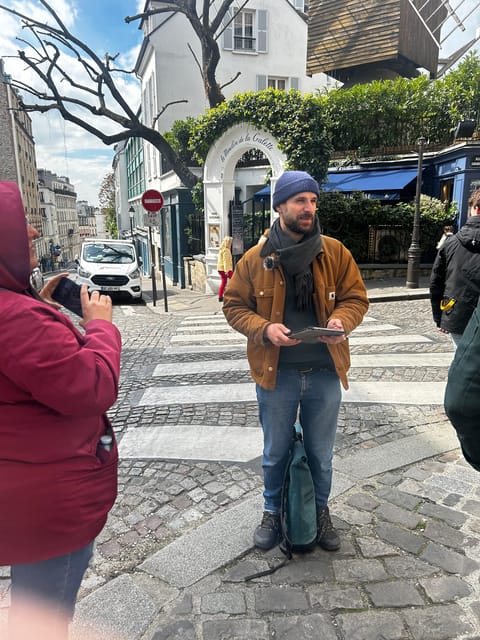
The biggest reason this tour gets top marks is simple: the guide knows how to teach outside. Arthur is presented as a Parisian who has lived in Montmartre for several years and has studied history and history of art. That matters because the stories don’t feel random—they’re tied to why specific places mattered in the late 19th and early 20th century, when artists like Picasso and Van Gogh were part of the local art world.
In plain terms, Arthur helps you “see” art history while you’re walking. The tablet visuals mean you’re not just hearing about paintings or movements—you’re also getting picture support that helps you connect the dots on the street. That’s especially valuable if art history isn’t your main hobby. Even if you’re more interested in atmosphere, the way he explains the setting makes the neighborhood feel understandable, not just pretty.
One other detail I appreciate from the way the tour is described: the storytelling includes a feminist lens, including attention to women artists and the way history often sidelined them. That doesn’t change the fact you’ll still cover major milestones and major names—it just makes the narrative fairer.
Arthur also seems to manage group energy well. The tour’s format is interactive, with a friendly, caring tone, and it’s capped at ten people so questions don’t get ignored.
The one consideration is the tour rules: no video recording and no audio recording. So if you’re the type who likes to capture everything hands-free, plan to take notes or just enjoy the walk.
Meeting at Place Blanche: Where Your Walk Starts
You meet at 3 Pl. Blanche, outside the Five Guys restaurant. It’s a clear, easy landmark meeting point, and it sets you up in the right area before the hill climbs and the viewpoints start.
Before you go, think about comfort and weather. Montmartre is specifically flagged as colder than the rest of Paris, so bring a layer even if the city center feels mild. If rain is in the forecast, you’ll want an umbrella or rain coat. And if it’s hot, bring water—there’s a supermarket by the meeting point (so you’re not stuck searching for supplies at the last minute).
What to bring is mostly straightforward: comfortable shoes and whatever you need to be comfortable walking and standing at photo stops. The tour itself basically says you don’t need much beyond that—your feet and ears are the main “equipment.”
Also remember the tour length and flow. You’re walking for roughly 2.5 hours with short stops (sometimes just 5 minutes for viewpoints), so bring the mindset of a stroll with purpose. This is not a sit-down museum visit that you can slow down and linger in for an hour.
Moulin Rouge and the Hill’s Secrets: Your First Big Payoff
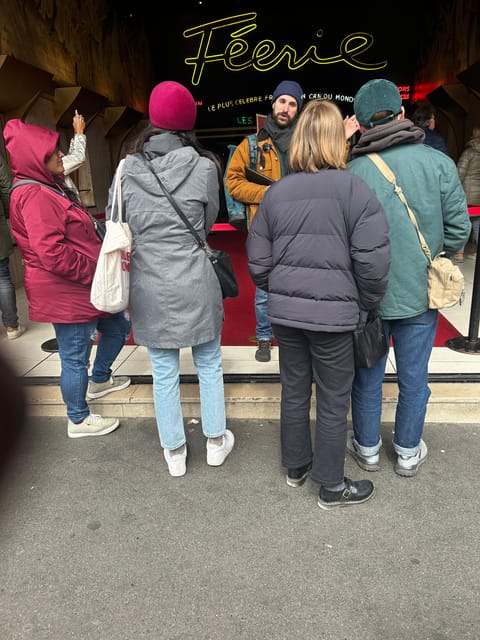
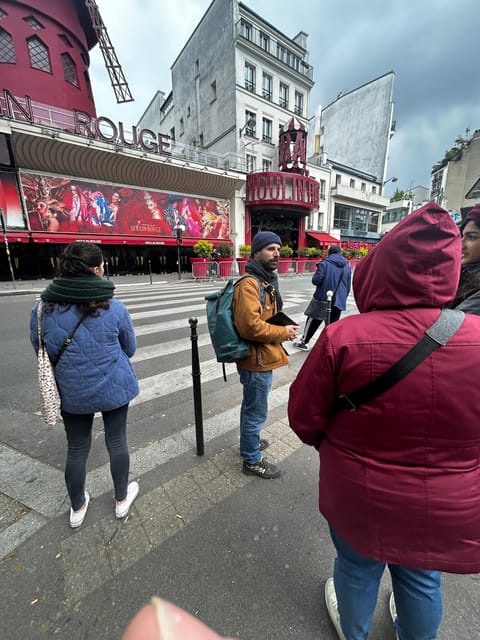
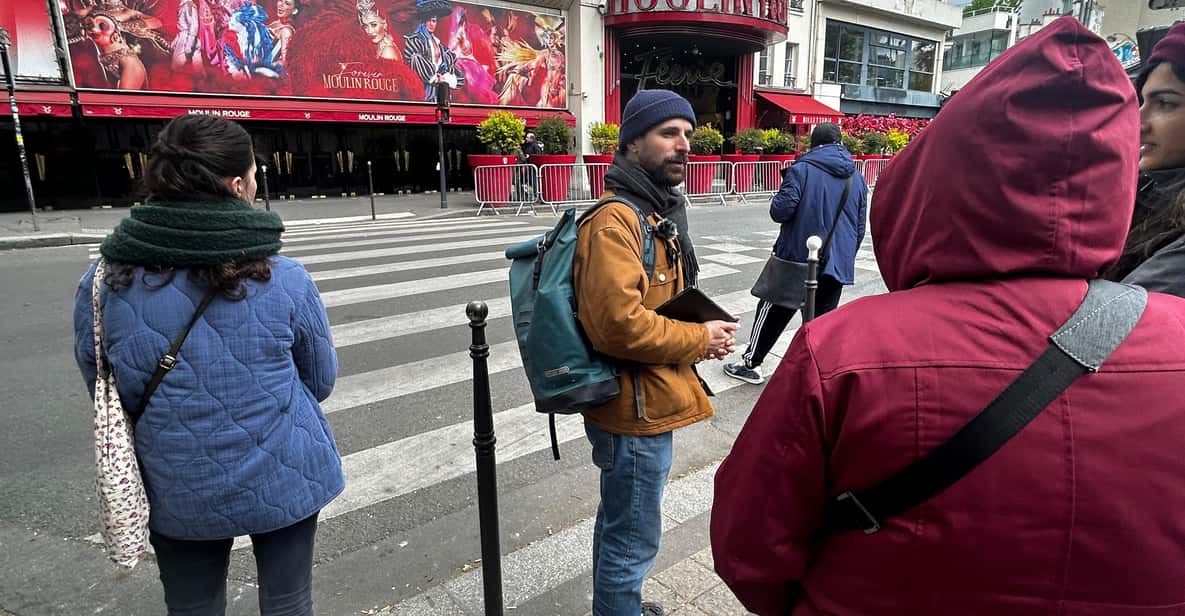
The tour kicks off with Moulin Rouge. You’ll have a photo stop and guided tour there for about 20 minutes. This is a smart opening. Moulin Rouge is loud and iconic, but Arthur uses that energy to set context—why Montmartre became tied to performance, spectacle, and modern art life as the hill evolved at the turn of the century.
Next comes a secret stop with another 20 minutes of guided storytelling. The point of this kind of stop is to shift you away from the “I’ve seen this before” feeling. You’ll get a different angle on Montmartre’s character—more street-level and less checklist sightseeing.
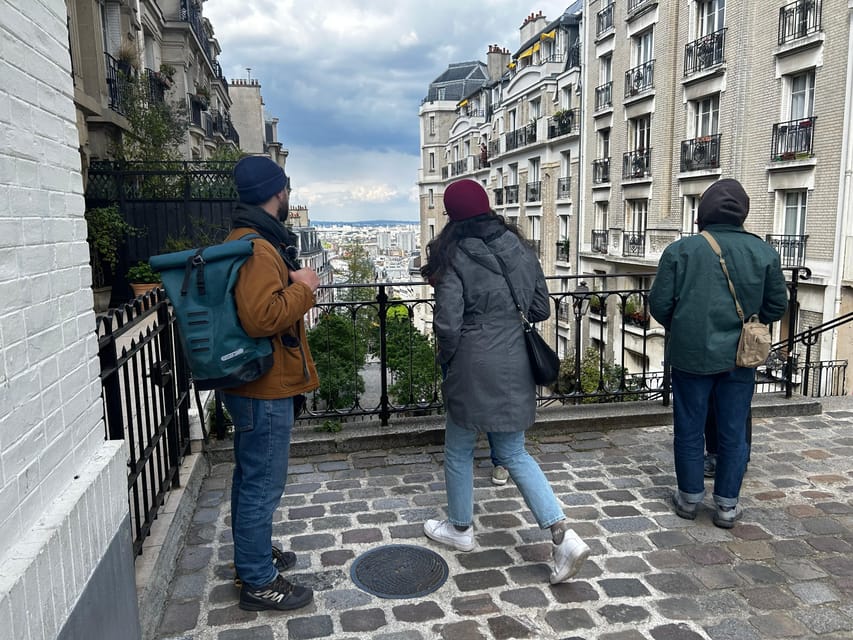
Then you hit a viewpoint with a short 5-minute sightseeing/photo window. This quick pause is where the tour starts training you to look. You’re not just standing for a photo; the guide’s story is meant to make the view feel meaningful—like you’re seeing why artists wanted this neighborhood, not just where to take pictures.
One small practical consideration: the viewpoints are short. If you want slow photo editing or a long snack break, this schedule won’t match that style. If you like quick moments with good context, you’ll enjoy the pace.
Le Bateau-Lavoir: Following Picasso’s Footsteps Without the Guesswork
After the first set of icons and viewpoints, you move to Le Bateau-Lavoir for 20 minutes of guided tour and sightseeing. This stop is where the “art” in the tour becomes very real.
The tour connects Montmartre to the artists who lived and worked there around the late 1800s and early 1900s. Names like Picasso and Van Gogh show up in the story, and Le Bateau-Lavoir is the kind of place that helps explain why Montmartre became a creative magnet. Even if you’re not sure how all those names connect, Arthur’s tablet visuals and guided explanations are designed to make the connections clearer as you walk.
You also start to feel the neighborhood shift. The early part has big recognizable landmarks. As you move on, the tour leans into place-based storytelling—what you can read in the street layout, how the area’s identity formed, and why it mattered culturally and politically.
This is also a good moment for questions. The tour format is small and interactive, which means you can ask about how art movements connected to real life here, not just facts from a textbook.
You can also read our reviews of more historical tours in Paris






Windmills, Viewpoints, and the Maison Rose: Seeing Montmartre Beyond Postcards
Then comes the windmills photo stop and guided segment (about 5 minutes). Short? Yes. But this is exactly how you should approach Montmartre. Those moments help you “register” what you’re seeing and then move on with the guide’s explanation in your head.
Right after that is another viewpoint (5 minutes), which again feels brief but works because you’ve already warmed up to the idea of quick, meaningful pauses. Arthur can point out details you might miss if you were just casually walking.
Next is La Maison Rose, with a photo stop and guided tour (20 minutes). This stop is useful for two reasons. First, it gives you a recognizable visual marker in the walk. Second, it helps anchor the story to the kind of everyday physical spaces where artists and creative life were happening—not just grand monuments.
After La Maison Rose, you move to the vineyard stop (5 minutes). Even in a city built up around you, Montmartre’s identity includes agriculture history and local quirks. The short guided storytelling here is meant to keep that sense of place alive without turning the tour into a detour you’d never choose on your own.
Then there’s another viewpoint later, but by the time you reach this part of the route, you already understand what the guide is doing: pairing famous sites with the street texture that makes the neighborhood feel like a character, not a set.
Musee de Montmartre and Sacré-Cœur: Closing the Story on the Hill
You’ll visit the Musee de Montmartre for about 15 minutes of guided tour and sightseeing. This is a compact museum stop, so the value is in what the guide chooses to emphasize. You’re not spending a full afternoon here, so you need stories that explain what to look for and how it ties back to what you’ve already seen outside.
This museum segment is a nice bridge between the “street myth” and the documented past. It helps you understand the neighborhood’s identity with less guesswork.
Then you return to the views with another photo stop (5 minutes). That’s a good rhythm check in the schedule. By now, you’ve been walking and learning for over an hour. The quick viewpoints reset your attention and keep the energy up.
Finally, you reach Sacré-Cœur Basilica for a photo stop and guided tour of about 20 minutes. Sacré-Cœur is the big ending image people think they want. What makes it better here is that the guide ties it to the mix of art, religion, and politics that shaped Montmartre in the era when artists were living and working nearby. Instead of treating the basilica like a one-off photo location, you get a reason for its place in the story.
The tour ends at 35 Rue du Chevalier de la Barre, 75018 Paris, France. That end point is close enough that you can keep exploring after the tour, but far enough that you’ll feel like you finished the hill walk rather than looping back immediately.
Walking Pace, Photo Stops, and Tablet Visuals: How to Get More From Every Minute
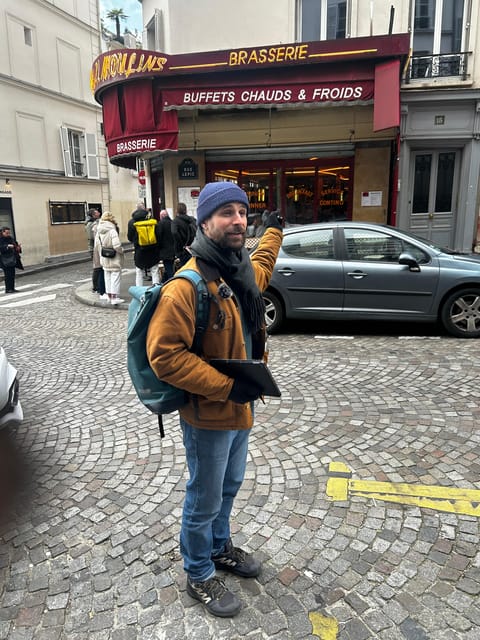
This tour works because it’s built around a rhythm. You’ll have short photo and viewpoint breaks—often 5 minutes—and guided storytelling blocks that last 15 to 20 minutes. That balance helps you both enjoy the sights and actually absorb what the guide is saying.
Here’s how I suggest you mentally prepare:
- Treat viewpoints as quick checkpoints, not long stops. You’ll get better photos when you stay focused.
- Use the guided time to ask one or two targeted questions. Arthur is set up for that kind of interaction.
- Pay attention to what the guide connects to tablet pictures. If you think of the tablet as a “floating guidebook,” it becomes easier to remember what you saw later.
The tablet format is more than a gimmick. On a street tour, your brain can feel overloaded. Pictures give your eyes something structured to match with the story.
And because the group is limited to ten people, the tour can stay conversational. It’s not a lecture where you barely hear the guide under a crowd.
One more practical thing: there’s no mention of snacks or drinks being included. So if you know you get hungry fast, plan to grab something on your own before or after the walk. That way you don’t feel rushed during the segments.
Value for $34: What’s Included, What’s Not, and Why It Feels Fair
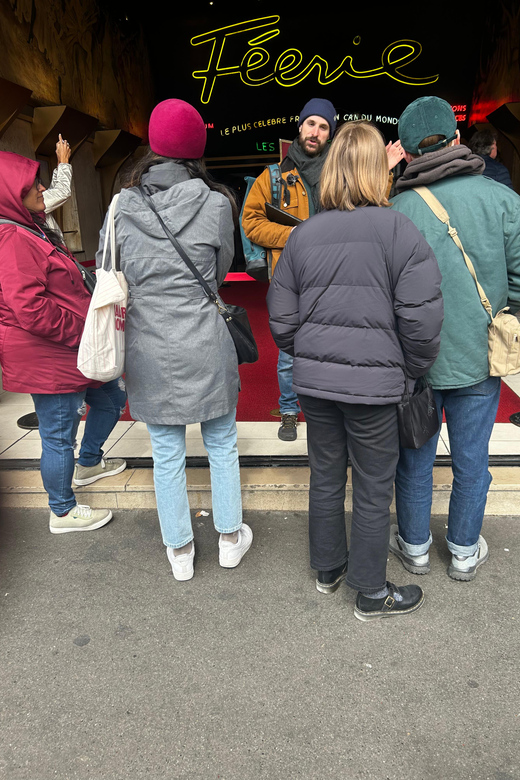
At $34 per person for 160 minutes, the math works out if you value quality guiding over self-guided wandering. You’re paying for:
- A live English-speaking guide (Arthur)
- A small-group experience capped at ten
- Tablet-based picture support during storytelling
- A route that includes both major icons and quieter streets
- Clear, friendly energy rather than a hard-sell approach
What’s not included is equally important. Snacks and drinks aren’t included, and that’s fine if you planned your day. The tour also notes there’s nothing to sell and the visited places have nothing to sell. That matters because it keeps the experience from turning into a shopping detour.
If you’re comparing this to free walking routes you could DIY, the key difference is structure. Montmartre is easy to get lost in. This tour gives you a path with meaning, so you’re not just taking pictures of whatever you reach first.
Who This Montmartre Tour Suits Best
This tour is a strong fit if you:
- Like art history explained through real places
- Want a small-group format with time for interaction
- Prefer a guided experience that feels friendly, not robotic
- Enjoy seeing the familiar sites with fresh context
It’s also described as ideal for families and lonely travelers. The family part comes with clear boundaries, though: it’s not suitable for children under 10. And it’s also flagged as not suitable for people over 80. So you’ll want to judge the walking and standing time with your group in mind.
The tour is marked wheelchair accessible, which is great to see. Still, because this is Montmartre, you should expect an uphill setting. Wheelchair accessibility doesn’t automatically mean zero slopes.
If you dislike guided tours in general, this one might work anyway. The reason: the structure is short, the guide stays story-driven, and the tablet pictures keep the learning tied to what you can literally see around you.
Should You Book This Montmartre Walking Tour?
I’d book it if you want Montmartre to feel like a story you understand, not a set of photos you snap and forget. The combination of small group size, Arthur’s strong English, and the picture-supported explanation is a practical way to learn while you walk. Add in stops that cover both the obvious icons and quieter routes, and the experience feels balanced for 2.5 hours.
I’d skip it if:
- You need a very slow pace with long breaks
- Your group includes kids under 10
- You or your party has limited comfort with uphill walking and standing (especially if you’re over 80)
- You rely on recording audio or video during tours
If you’re open to learning through streets, you’ll get good value out of the $34 price and come away with a Montmartre you can actually describe.
FAQ
How long is the Montmartre Walking Tour?
It lasts about 160 minutes, or roughly 2.5 hours.
What does the tour cost?
The price is $34 per person.
Where do we meet, and where does the tour end?
You meet just outside Five Guys at 3 Place Blanche (3 Pl. Blanche), 75009 Paris. The tour finishes at 35 Rue du Chevalier de la Barre, 75018 Paris.
Is the tour in English?
Yes, the tour guide provides the tour in English.
How big is the group?
The group is small, limited to ten participants.
Are there any rules about recording during the tour?
Yes. Video recording and audio recording are not allowed.
What should I wear or bring?
Bring comfortable shoes. Also check the weather: bring a rain layer if it’s wet, warm clothes if it’s cold (Montmartre can be colder), and water if it’s hot.
Are there age limits?
Yes. It’s not suitable for children under 10 and not suitable for people over 80.
Is it accessible for wheelchair users?
It’s listed as wheelchair accessible.