REVIEW · PARIS
Historic Paris Walking Tour
Book on Viator →Operated by Walkative! TOUR · Bookable on Viator
Skip the map; grab the highlights. This Historic Paris Walking Tour strings together major sights with a simple flow and a local guide doing the heavy lifting, so you can focus on photos and street-level details. I like the mobile ticket convenience and the way the route keeps you moving without constant navigation. The tour also feels like a smart sampler of central Paris, with frequent stops to reframe what you’re looking at.
One thing to watch: timing matters. If a parade or closure affects the streets, the meeting point can get tricky, and being late may cost you time—so show up a bit early and stay in touch with the group if anything unexpected happens.
In This Review
- Key things to know before you walk
- Why This 2.5-Hour Historic Paris Walk Works
- Hôtel de Ville: Start at Paris’s Renaissance heart
- Notre-Dame: Quick Gothic takeaways without getting lost
- Sainte-Chapelle: The stained-glass moment in 20 minutes
- Louvre Museum stop: What you’ll actually get in the time
- Pont des Arts and Pont Neuf: Two Seine photo stops, two different vibes
- Tuileries finish: A gentle landing near Place de la Concorde
- Value for $26.49: What the price gets you in real life
- How the guide experience feels on the street
- Timing and practical pacing: make it work for your day
- Should You Book This Historic Paris Walking Tour?
- FAQ
- How long is the Historic Paris Walking Tour?
- Is the tour offered in English?
- Are admission tickets included for the stops?
- Where does the tour start and end?
- Does the tour run in bad weather?
- Can I get a refund if I cancel?
Key things to know before you walk
- A tight 2.5-hour loop: roughly 150 minutes from Hôtel de Ville to the Tuileries area.
- Ticket-free stops listed: each stop is marked as admission ticket free, so you spend time looking rather than ticketing.
- English-only experience: you’ll get the narrative in English.
- Max group size of 40: big enough to meet others, small enough that you can usually keep up.
- Built for photos on foot: regular stops make it easier to get your angles right.
- All-weather operation: dress for rain or cold, because the plan stays the plan.
Why This 2.5-Hour Historic Paris Walk Works
Paris can eat your whole day. This tour is built to fight that. In about 2 hours 30 minutes, you’ll hit the big names in a way that feels doable even when you’ve already got museums on your calendar or you’re managing jet lag.
The biggest value isn’t just the sights. It’s the structure: a constructed narrative that connects what you see—city hall, medieval churches, Gothic stained glass, the Louvre zone, and two classic Seine bridges—so the landmarks start making sense as part of one story. When I’m in a new city, I love anything that helps me order my impressions, and this route does that by design.
You’ll also appreciate the “walk and stop” rhythm. You can pause for photos without constantly breaking the pace yourself. Plus, the guide leads the way, so you’re not spending your trip time arguing with street signs.
You can also read our reviews of more walking tours in Paris



Hôtel de Ville: Start at Paris’s Renaissance heart
You begin at Hôtel de Ville (City Hall) in the 4th arrondissement. Even if you don’t plan to go inside anywhere, this is a strong kickoff. The building’s Renaissance architecture and grand façade make a clear statement: you’re in the civic center of Paris, not just a sightseeing bubble.
You’ll spend about 20 minutes here, which is just enough time to get oriented. Think of this stop as your “baseline.” From this part of Paris, it’s easier to understand why the route flows the way it does—toward the historic cathedral core, then into the river-crossing viewpoints, and finally toward the museum gardens.
Practical tip: take a moment before the explanation starts to look at the façade as a whole, not just your favorite detail. If you do that, the guide’s comments will click faster—and you’ll notice more during the rest of the walk.
Notre-Dame: Quick Gothic takeaways without getting lost
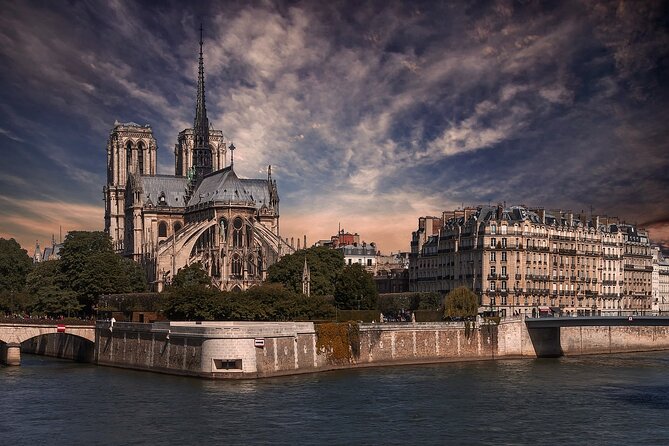
Next up is Notre-Dame Cathedral. You’ll have around 20 minutes at this stop, and that’s the perfect amount of time for a first look. Notre-Dame’s French Gothic design is the kind of architecture you can’t fully grasp in a rush—but you can still learn how to read it.
What’s worth your attention here is not only the big silhouette. Look for the way the façade and vertical lines pull your eyes upward. Even from typical viewpoints on a city street, you’ll start spotting recurring Gothic cues—pointed forms, strong structure, and layers of ornament—before you move on.
A short warning, based on how street conditions can shift in central Paris: this area can be affected by crowds and occasional disruptions. If you arrive on time, you’ll get the most out of the stop. If not, you’ll feel it—this tour keeps momentum.
Sainte-Chapelle: The stained-glass moment in 20 minutes
Then comes Sainte-Chapelle, with about 20 minutes on the schedule. This is the kind of stop that makes a short tour feel worthwhile, because you get a high-impact contrast: compared with the larger cathedral zone, Sainte-Chapelle’s identity is concentrated in its stained-glass work and vertical drama.
Even when your visit is brief, you can still experience the main point: the way the light hits those windows and turns the chapel into an atmosphere, not just a building. You’ll likely find yourself slowing down naturally here, because it’s visually “loud” in the best way—color, scale, and detail all competing for your attention.
If you like photo ops, this is a good one to prep your angle. Try not to only shoot the grand view—also look for how the architecture frames the glass. Those frame lines often look good in photos and make the place feel more “complete” when you look back later.
Louvre Museum stop: What you’ll actually get in the time
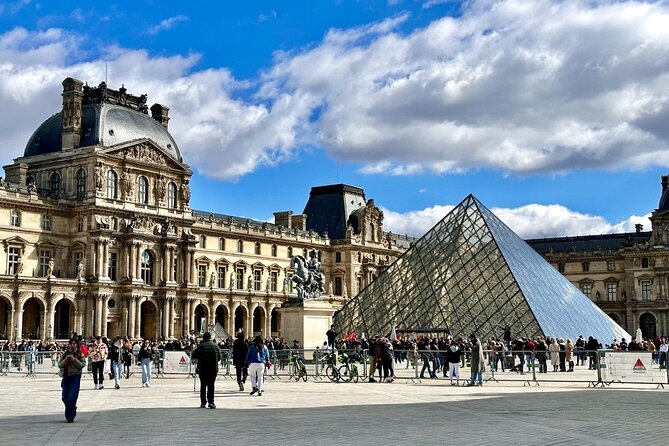
You’ll reach the Louvre Museum area for about 20 minutes. In most people’s minds, the Louvre equals massive museum hours. On this tour, the goal is different. You’re here to connect the Louvre to the surrounding geography—why it sits where it does, and how it connects the city’s major zones.
So if your plan is Louvre interior sightseeing, use this stop as a warm-up and a way to choose where you’ll focus later. It’s a chance to get your bearings around the museum complex and the famous entrance area, then decide if you want to spend another day inside with a specific strategy.
One practical note: security lines and crowd flow can vary. Since the stops are listed as admission ticket free, don’t assume this is a full museum entry experience. Treat it like a guided landmark stop, and you’ll be happier with what you get.
You can also read our reviews of more historical tours in Paris






Pont des Arts and Pont Neuf: Two Seine photo stops, two different vibes
After the Louvre zone, you cross into “river views” mode with Pont des Arts and Pont Neuf—each with about 20 minutes.
- Pont des Arts: This bridge is famous for its romantic ambiance and panoramic Seine River views. It’s one of those places where your photo instinct kicks in immediately, because the river acts like a natural lens for the city behind it.
- Pont Neuf: Then you get the older, historic-feeling bridge—the oldest bridge spanning the Seine in Paris. It connects the Left and Right Banks and has a timeless look that feels different from the more modern “photo spot” energy.
This pairing is smart. You’re not just stacking landmarks. You’re also changing viewpoint types. One bridge gives you a scenic postcard mood, and the other gives you a more time-worn, classic streetscape feel. Both are useful when you’re trying to understand how Paris “turns” around the river.
Tip for photos: walk a few steps along each bridge instead of shooting from one spot. Even small movement can change the framing of buildings and horizon lines.
Tuileries finish: A gentle landing near Place de la Concorde
The tour ends at the Tuileries Gardens area, with about 30 minutes to close things out. The Tuileries sit between the Louvre area and Place de la Concorde, so finishing here is a practical move. You get a calmer zone after a series of major, high-intensity monuments.
This final stop also helps you transition. If you want to continue sightseeing on your own, you’re stepping into an easy walking corridor with options. If you want to slow down, this is your breathing space—trees, paths, and a more leisurely pace after the clock-driven monument stops.
Don’t underestimate what that extra 30 minutes buys you. A lot of tours end abruptly right at the last photo stop. Here, you’re given time to decompress and still feel like you accomplished something.
Value for $26.49: What the price gets you in real life
At $26.49 per person, the tour sits in the “surprisingly affordable” category for central Paris, especially when you consider how much ground it covers and how much guide time you’re getting. The value isn’t the price alone—it’s the fact that the structure reduces your mental work.
Here’s what you’re effectively paying for:
- a guided route that skips map-reading
- a narrative tying the sights together
- time-efficient stops (about 20 minutes each, plus 30 at the end)
- a guide who keeps things moving without requiring you to plan your own itinerary
Also worth noting: all stops are listed as admission ticket free. That matters because it lowers the friction of planning. You can keep your day flexible instead of banking on entry times.
Group size can also affect value. This one caps at 40 people, which is usually large enough for a lively atmosphere but still manageable for a walking tour.
How the guide experience feels on the street
A good walking guide can make or break a short tour. The standout theme in the feedback is that guides often bring the sights to life with humor and flexibility—exactly what you want when you’re moving fast and juggling lots of impressions.
That said, not every guide approach lands the same way for everyone. One report pointed out that some narration can wander into lighter or silly topics. That doesn’t mean the core information is missing, but it’s a signal that the tone may be casual and story-driven rather than strictly lecture style.
My advice: if you’re the type who likes a friendly guide and don’t need every fact to be museum-grade, you’re likely to enjoy this format. If you want only tightly curated historical detail with zero joking, you might find some moments less targeted.
Timing and practical pacing: make it work for your day
This tour runs in all weather conditions, so treat it like a realistic walking plan, not a fair-weather stroll. If it’s raining, your experience will depend on how you dress and how comfortable you are walking on city sidewalks.
The route also assumes moderate physical fitness. You’re on your feet for the full time, and you’ll be following a group pace. You don’t need to be an athlete, but you should be ready to walk consistently for the entire 2.5 hours.
One more thing: if the streets are affected by a parade or closure, you may hit delays around the center of Paris. When that happens, you’ll want to be early at the meeting point and stay calm. In one documented issue, late arrival plus a disruption led to missed timing and confusing directions to reconnect—so I’d recommend building a little buffer into your schedule.
If you’re traveling with kids, the rule is clear: children must be accompanied by an adult.
Should You Book This Historic Paris Walking Tour?
Book it if you want a smart “high points” day in central Paris. It’s a strong choice when you:
- want to see Hôtel de Ville, Notre-Dame, Sainte-Chapelle, the Louvre area, Pont des Arts, Pont Neuf, and the Tuileries without building an itinerary from scratch
- prefer a guide-led route that helps you understand what you’re looking at
- like photo stops with breathing room (about 20 minutes at most monuments)
Skip it if you’re expecting a deep, slow, museum-style experience inside big venues. This walk is about connections and orientation, not an all-day deep dive. Also, if you hate any chance of timing stress, remember that street closures can happen in Paris and the tour moves as a group.
If you’re flexible, arriving a bit early, and you dress for weather, this is a good way to make your Paris day feel purposeful—and still leave you time to wander on your own afterward.
FAQ
How long is the Historic Paris Walking Tour?
It’s listed at about 2 hours 30 minutes.
Is the tour offered in English?
Yes, the tour is offered in English.
Are admission tickets included for the stops?
Each stop on the route is marked as admission ticket free.
Where does the tour start and end?
It starts at Hôtel de Ville in Paris (75004) and ends next to the Tuileries Gardens (75001).
Does the tour run in bad weather?
Yes, it operates in all weather conditions. Dress appropriately.
Can I get a refund if I cancel?
Yes. You can cancel for a full refund up to 24 hours before the experience’s start time.