REVIEW · PARIS
Guided tour of the Louvre Museum with tickets included
Book on Viator →Operated by Matteo Allavena · Bookable on Viator
The Louvre can chew up your day. This skip-the-line guided tour gets you into the museum fast, then links big-name works to the buildings and eras around them, led by Matteo Allavena. You’ll spend about 2 hours seeing the museum’s top arc, from ancient and Greek sculpture to Giotto’s Middle Ages painting and the drama of Romanticism. The only real downside: with a museum this massive, a focused tour means you’ll have to resist wandering off plan too much.
I also like the pacing here: it’s a small group (up to 6), so you’re not stuck behind a sea of elbows while the guide tries to talk over the crowd. You meet at Le Café Marly on Rue de Rivoli and the tour loops back to the same spot, which makes your day feel controlled instead of chaotic. For first-timers, that structure matters.
At $114.93 per person, you’re paying for more than entry. You’re buying time saved at peak crowds and a guided route that hits major sights like Venus de Milo, the Victory of Samothrace, and the Mona Lisa without turning your visit into a sprint. Food and drinks are not included, so plan a snack or plan to grab something afterward.
In This Review
- Key Highlights at a Glance
- Why This Louvre Tour Works in 2 Hours
- Meeting Matteo at Le Café Marly (And Actually Starting on Time)
- Medieval Louvre Walls: See the Fortress Under the Museum
- Tanis Sphinx: A 4,000-Year-Old Reminder of How Old Paris Really Is
- The Greek Sculpture Stops: Athena, Venus, and Victory
- Galerie Apollon and the Big-Scale Louvre Moment
- Giotto and the Middle Ages: St. Francis Isn’t Just a Story
- Classicism Room: Napoleon and Jacques-Louis David’s Battle of Ideas
- Romanticism Rooms: The Medusa Shock and Delacroix’s Liberty
- Skip-the-Line: What You Actually Save (Beyond Comfort)
- Price and Value: What $114.93 Buys You at the Louvre
- Who This Tour Is Best For
- What to Expect Inside: Pacing, Groups, and Realistic Footwork
- Should You Book This Louvre Highlights Tour?
- FAQ
- How long is the Louvre guided tour?
- Is the tour in English?
- What’s the price per person?
- What time should I plan to meet?
- Does it include skip-the-line entry and museum tickets?
- What’s included in the tour besides the guide and tickets?
- What is not included?
- How large is the group?
- Is there free admission for some visitors?
- Can I cancel for a full refund?
Key Highlights at a Glance

- Skip-the-line entry so you can head toward the most important stops sooner
- A guided storyline that ties art to its wider context, not just dates and names
- Medieval Louvre walls and the Tanis Sphinx to widen the museum beyond famous paintings
- Greek sculpture anchors like Venus de Milo and the Victory of Samothrace
- Royal-scale galleries including the Galerie Apollon / Grande Galerie areas
- A tight 2-hour route that still leaves room to look closely
Why This Louvre Tour Works in 2 Hours
The Louvre is one of those places where your first instinct is to “go everywhere.” Your second instinct should be “pick a smart route or I’ll lose the day.” This tour is built for the second instinct. You get a guided loop that moves across eras so the museum doesn’t feel like one giant room of unrelated stuff.
What you’re really buying is direction. The guide isn’t just pointing at objects. You’ll get the why behind the famous works, plus context for sculptures and paintings that most people pass without understanding what to notice. And because entry is skip-the-line, you start the experience before the worst of the crowd crush eats your energy.
Two hours is still a sprint, so you’ll want to treat the tour as the “best hits” preview. After that, you’ll likely want to return later for deeper looking. That’s not a failure of the tour. It’s a smart way to approach a museum designed to overwhelm even seasoned art lovers.
You can also read our reviews of more tours and experiences in Paris



Meeting Matteo at Le Café Marly (And Actually Starting on Time)

Your tour start is at Le Café Marly, 93 Rue de Rivoli, 75001 Paris. That’s a good choice: Rue de Rivoli is easy to reach, and the meeting point is central enough that you can plan your day without complicated transit transfers. The tour ends back at the same meeting point, so you don’t have to guess where you’ll pop out of the Louvre.
One practical tip: show up a few minutes early. The Louvre area can be crowded, and meeting outside a busy landmark is never as tidy as online directions. If you run into trouble, it helps to have your confirmation details ready on your phone.
Medieval Louvre Walls: See the Fortress Under the Museum
Most people think of the Louvre as a pure art museum. But it started as a fortress, and this tour makes sure you don’t miss that foundation. You’ll visit the 13th-century walls—the sort of detail that changes how you understand the entire complex.
Why it matters: when you see the museum’s older structure, the scale of the later galleries feels more logical. Instead of treating the Louvre like a random building that happens to house masterpieces, you start seeing it as a long-running architectural project. It also breaks the pattern of standing in front of paintings and gives you a different kind of “reading” experience—space, stonework, and defensive design.
If you’re the type who likes a museum to feel like a place with a past, this start hits the right note early.
Tanis Sphinx: A 4,000-Year-Old Reminder of How Old Paris Really Is

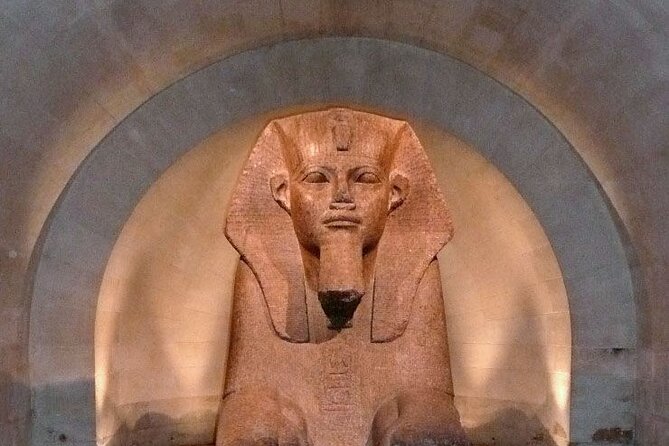
Next up is the Tanis Sphinx, a sculpture that dates back roughly 4,000 years. Yes, that number can sound abstract. Standing near it makes the age feel real in a way no photo can.
What I like about including this early: it stops you from only chasing the modern-famous names. The Louvre’s strength is that it’s not one culture or one period—it’s a pileup of civilizations. The Tanis Sphinx is a quick way to reset your brain and get you into the museum’s bigger timeline.
Also, a sphinx works well in a guided format. A good guide will point out what to look for—how it’s carved, how it’s presented, and how it fits into the Louvre’s collection story.
The Greek Sculpture Stops: Athena, Venus, and Victory

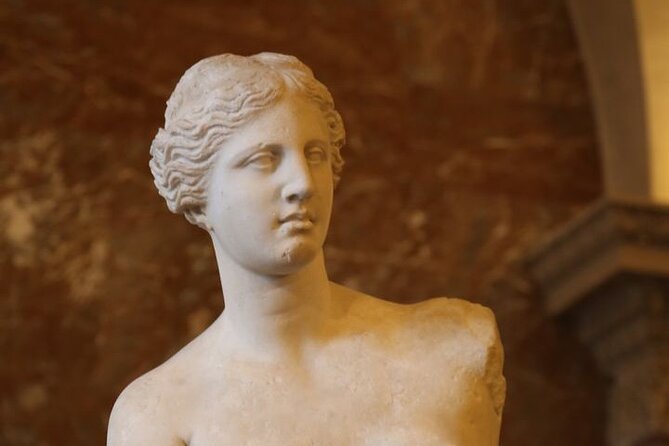
This is where the tour becomes a kind of guided “how to look.” You’ll hit major Greek works including Athena of Velletrie, Venus de Milo, and the Victory of Samothrace.
Each of these is famous for a reason, but fame can trick you into half-looking. With a guide, you get cues for noticing form and intention:
- With Venus de Milo, you can focus on stance and posture rather than just the caption.
- With Athena of Velletrie, you’re encouraged to think about the artwork’s role and symbolism.
- With the Victory of Samothrace, you’re led to see the motion and drama in a sculpture that feels almost theatrical.
The Victory is the one that usually gets people to stop talking to each other. You’ll probably feel that too once you’re in front of it, because the pose makes your eyes do work. The guide helps you avoid the “I saw it” trap and turn it into “I understood what I was seeing.”
You can also read our reviews of more guided tours in Paris






Galerie Apollon and the Big-Scale Louvre Moment
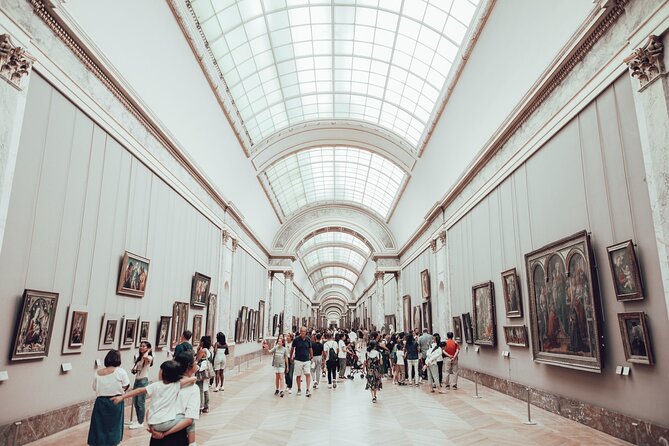
After the Greek rooms, you shift into spaces that feel built for power and performance. You’ll spend time around the Galerie Apollon and the broader Grande Galerie areas.
This part of the tour is about scale and symbolism. Galerie Apollon is tied to the idea of royal display—so it helps explain why so much of Versailles feels like it’s doing the Louvre’s aesthetic job at another address. Even if you never plan a Versailles visit, the link gives you a way to interpret what you’re seeing: this isn’t just art on walls, it’s a design language.
And the Grande Galerie stretch is where the museum’s sheer volume becomes part of the experience. You’ll see major decorative and art highlights in this grand setting, including works like Veronese’s Les noces de Cana and, of course, Leonardo da Vinci’s Mona Lisa as part of the tour’s major-hit route.
Practical note: even with skip-the-line entry, this is still the Louvre. You’ll want to accept that people gather. Use the guide’s pacing to move with the group and avoid getting stuck doing “crowd math” in front of the most famous artworks.
Giotto and the Middle Ages: St. Francis Isn’t Just a Story
Next is the Italian painting stop, centered on Giotto’s Saint Francis receiving the stigmata. This is a smart inclusion because it changes the mood from sculpture’s form to painting’s narrative.
For you, the value here is learning how to read a Middle Ages image without needing a special art degree. The guide’s job is to translate symbolism into something you can actually see—how the composition, the figures, and the drama of the scene create meaning.
A quick warning, though: Middle Ages painting can feel “less obvious” than Renaissance art at first glance. That’s why the guide context matters. With the explanation in place, you’re less likely to feel like you’re staring at a painting and guessing what you’re missing.
Classicism Room: Napoleon and Jacques-Louis David’s Battle of Ideas
You’ll then move into classicism with major works, including Jacques-Louis David’s The Coronation of Napoleon and Leonidas at Thermopylae. This is a section where the museum shifts gears from myth and religion toward politics, leadership, and civic ideals.
Why this matters in a tour like this: classicism is about rules and clarity, and David’s paintings are built like arguments. A guide can point out the structure and the intent behind the image—what the composition tries to claim about power and destiny.
This stop is also a good reminder that the Louvre isn’t only about beauty. It’s also about how societies imagine themselves—who belongs, who leads, and what sacrifice looks like on a grand stage.
Romanticism Rooms: The Medusa Shock and Delacroix’s Liberty
Finally, you reach the Romanticism room highlights, including Géricault’s Raft of the Medusa and Delacroix’s Liberty Guiding the People. If classicism is about order, Romanticism is about emotion and impact.
Raft of the Medusa tends to feel heavy, even when you don’t know the background. Having context helps you understand why the painting made waves: it’s not merely a scene, it’s an accusation and a warning.
Liberty Guiding the People is the opposite kind of energy. The guide helps you connect the symbolism with the political moment it responds to. You’ll likely see why this work became a visual shorthand for rebellion.
This is also a great closing stretch because you’ll finish with images that are unforgettable. When your last stop hits that hard, the Louvre stops feeling like a checklist and starts feeling like a story with an ending.
Skip-the-Line: What You Actually Save (Beyond Comfort)
Skip-the-line is usually sold as convenience. Here, it matters more than you’d think because the Louvre is easy to waste time in even when you’re motivated. The difference between entering quickly and waiting is the difference between seeing key works with fresh attention and seeing them half-zombied from standing and stress.
During a 2-hour highlights tour, every minute counts. The guide route is designed so you spend less time figuring out where to go and more time looking at the art once you get there.
And if you’re visiting in the heat or during busier seasons, skipping the entrance crush helps you arrive to the first gallery without that cranky, dehydrated feeling. That’s not glamorous, but it’s real.
Price and Value: What $114.93 Buys You at the Louvre
At $114.93 per person, this tour sits in the “worth considering” category rather than the “budget” category. The reason is simple: you’re not just paying for entry. You’re paying for a guide, a guided plan, and entrance tickets included (28 euros entrance fee included).
So the real question isn’t whether it’s expensive. It’s whether it saves you from the two biggest Louvre problems:
1) getting overwhelmed and not knowing what to prioritize
2) spending time in lines and moving slowly through crowds instead of enjoying the art
If you’re a first-timer, I think the value is strong because the Louvre’s best parts aren’t evenly distributed. A guide helps you hit the high-impact works in a logical order and understand what you’re seeing while you’re there.
If you already love museum touring and you know the Louvre floor plan well, you might feel this is optional. But for most people, the time and context are the payoff.
Who This Tour Is Best For
This tour works especially well if:
- you’re short on time and want the Louvre highlights without chaos
- you enjoy art when you understand the story behind it
- you want a tour that moves across eras, not just paintings or only sculptures
It also seems to fit families well. In the feedback I saw, kids stayed engaged because the guide can adapt explanations and answer questions along the way. If you’re traveling with teens or older kids, this kind of guided rhythm can turn “standing around” into something closer to a guided expedition.
It may be less ideal if you want total freedom to wander slowly for hours. This is a focused route. You’ll get a lot, but it won’t let you linger wherever your curiosity pulls you.
What to Expect Inside: Pacing, Groups, and Realistic Footwork
With a maximum of 6 travelers, the pace is easier to manage than big group tours. You can usually hear the guide without fighting the crowd volume. It also helps that the tour has a coherent sequence: you’re not randomly teleporting from stop to stop.
Still, the Louvre is large and marble floors are not forgiving. You’ll want comfortable shoes and a plan for hydration. The tour includes the art time, not coffee breaks. Build a snack or drink stop around it, not during it.
Also, if you like to ask questions, this format is a good fit. People who enjoy discussion tend to get more out of short tours, because every explanation has to land quickly.
Should You Book This Louvre Highlights Tour?
I’d book it if you want a Louvre visit that feels guided, efficient, and meaning-based. You get skip-the-line access, entrance included, and a route that runs from medieval walls and ancient sculpture through Greek and Renaissance-to-Romantic masterpieces. In about 2 hours, you’ll see major works like Venus de Milo, the Victory of Samothrace, Giotto’s Saint Francis receiving the stigmata, and the Mona Lisa, plus the political drama of David and Delacroix.
Skip the booking if your dream day is slow wandering, long gallery naps, and building your own route from the moment you step inside. In that case, you can do it on your own. But if you want to leave feeling like you understood the Louvre’s highlights, this is one of the more practical ways to do it.
FAQ
How long is the Louvre guided tour?
It runs about 2 hours (approx.).
Is the tour in English?
Yes, it’s offered in English.
What’s the price per person?
The price is $114.93 per person.
What time should I plan to meet?
The tour meets at Le Café Marly at 93 Rue de Rivoli, 75001 Paris, and it ends back at the meeting point. (Exact start time isn’t listed in the provided details.)
Does it include skip-the-line entry and museum tickets?
Yes. It includes a skip-the-line benefit and the entrance fee (28 euros entrance tickets).
What’s included in the tour besides the guide and tickets?
The included items are a speaker guide, entrance fee, and skip the line.
What is not included?
Coffee and/or tea, food & drinks, and transfer are not included.
How large is the group?
The maximum group size is 6 travelers.
Is there free admission for some visitors?
Yes. Free admission applies to visitors under 18 and EEA residents under 26 with valid ID and proof of residency.
Can I cancel for a full refund?
Yes, free cancellation is available. You can cancel up to 24 hours in advance for a full refund.