REVIEW · PARIS
Paris Medieval Heart: Walking Tour in Ancient Marais
Book on Viator →Operated by My Super Tour · Bookable on Viator
Le Marais has a medieval side you can actually walk to. This Paris Medieval Heart tour strings together major historic sites and the quieter corners between them, with a local guide keeping the story clear and human. You also get practical suggestions for where to eat and shop after the walking part ends.
I love how much you cover for the time: you move from big-name landmarks like Place des Vosges to lesser-seen courtyards, gardens, and institutions. I also like the value angle, since many stops are listed with free admission.
One thing to consider: the meeting point near Place de la Bastille can be tricky to spot, so I’d arrive early and double-check the exact address.
In This Review
- Key takeaways before you go
- Why this Le Marais medieval walk makes sense in 2.5 hours
- Starting at Place de la Bastille: quick logistics, big impact
- From the oldest synagogue to Place des Vosges: the neighborhood’s foundation
- Victor Hugo to Sully’s courtyard garden: Paris behind the walls
- Rue des Rosiers and the medieval wall traces: food streets meet defenses
- Templar fortress and old institutions: the Marais behind the postcard
- Fashion, LGBT community area, and Pompidou’s modern contrast
- Price and value: why 51.66 feels fair
- Who should book this walking tour of the Marais
- Should you book this tour or skip it?
- FAQ
- How long is the Paris Medieval Heart walking tour?
- What is the price per person?
- Where does the tour start and when?
- Where does the tour end?
- Is the tour in English?
- Is a mobile ticket used?
- Are admissions included?
- Is bottled water included?
- Is there a maximum group size?
- Can I bring a service animal?
Key takeaways before you go
- Small group (max 15) means more time for questions and a less chaotic pace.
- Many free-entry stops let you focus on seeing, not ticket math.
- Old Paris through multiple centuries: medieval defenses, Jesuit Baroque, and then 1970s Pompidou.
- Courtyards and gardens show you a Paris you can’t easily stumble into on your own.
- A guide who brings the streets alive, with some guides using illustration notes to explain what you’re looking at.
- End point at Pompidou is a handy finish line for planning the rest of your day.
Why this Le Marais medieval walk makes sense in 2.5 hours

Le Marais is the kind of neighborhood that looks pretty on photos. But without context, it can also feel like a collection of streets and pretty facades. This tour gives you a guided thread through the area’s past, from religious history and royal squares to medieval structures and later cultural landmarks.
The pacing is one of the best parts. You’re out for about 2 hours 30 minutes, and the stops are short enough to keep you moving, but long enough to understand what you’re seeing. That matters in Paris, where a “quick look” can turn into wandering with no payoff. Here, the walking feels purposeful.
I also like the tour’s balance between must-see and lesser-noticed. You’ll start with the oldest synagogue in Paris, then hit Place des Vosges, and after that you’ll shift into places that are more about structure and atmosphere than celebrity sightseeing. One of the reasons people rate this so highly is that the guide time feels well spent, not rushed.
You can also read our reviews of more walking tours in Paris



Starting at Place de la Bastille: quick logistics, big impact

The tour starts at 3bis Pl. de la Bastille (75004 Paris) at 10:00 am and ends near Centre Pompidou at Place Georges-Pompidou. That setup is practical: you begin where the area opens up, and you finish right in the cultural core so you can keep exploring after.
One detail I’d take seriously: the meeting point location can be hard to find. A negative experience in the feedback centered on people not spotting the exact start spot, even after asking other groups. So don’t treat this like a casual drop-in. I’d aim to be there well before the start time, and I’d use the address on the map, not just the neighborhood name.
You’ll also be given a mobile ticket, which is convenient for check-in. The tour is offered in English, and the group is capped at 15 travelers, so you’re not squeezed into a big herd.
Finally, remember that this is a walking tour. The weather in Paris can shift fast, so bring a rain layer and comfortable shoes. Bottled water is not included, so I’d plan to grab a small bottle or reusable bottle before you start.
From the oldest synagogue to Place des Vosges: the neighborhood’s foundation
The first stop is 21bis Rue des Tournelles, where you’ll discover the oldest synagogue in Paris. Even if you know Paris has layers, this kind of opening stop changes how you read the neighborhood. The Marais isn’t just a pretty district; it’s been home to communities with long memories, and the streets still reflect that.
Next comes Place des Vosges, described as the oldest square in Paris. This square can feel like a postcard, but the guide framing is what makes it worth a stop. You’ll get the stories and the hidden corners tied to the square itself, and that helps you see it as a hub—royal, civic, and later social—rather than just a static landmark.
Stop 3 is Maison de Victor Hugo, where you visit the apartment of the iconic French writer. That’s a nice bridge from the religious and civic history of the earlier stops into the world of ideas. Victor Hugo’s name is famous, but the value here is in seeing how a writer’s home sits within the lived-in rhythm of the Marais.
Drawback-wise, if you’re the kind of traveler who wants long museum time, this tour won’t be that. Most stops are around 10 to 15 minutes. The payoff is the orientation and the highlights-first focus, not deep immersion at each site.
Victor Hugo to Sully’s courtyard garden: Paris behind the walls
After the square and the writer’s apartment, you shift into a quieter Paris. Stop 4 is Cour et jardin de l’Hotel de Sully, described as a real treasure: a hidden garden tied to the mansion built by Sully, the finance minister during King Henry IV’s era (1589–1610).
This is exactly the kind of stop that changes your whole travel style. Paris is famous for grand facades, but the daily life often happens in places you don’t notice from the street. Courtyards and garden plots like this teach you where to look next time you walk around Le Marais. It’s also a good pause point—short, calm, and photo-friendly if the light is decent.
Stop 5 takes you to Paroisse Saint-Paul Saint-Louis. This church is highlighted for breaking away completely from Gothic style and using the newer Baroque style associated with the Jesuits. In other words, this isn’t just about a building. It’s a lesson in how architectural taste can shift like political winds.
The structure of the stop is also helpful: you’ll get a guided explanation of what you’re looking at, and then you move on. If you’ve ever stared at church details and felt lost, this kind of quick orientation can be surprisingly satisfying.
Rue des Rosiers and the medieval wall traces: food streets meet defenses
Then comes the Marais you can taste. Stop 6 is La Rue des Rosiers, in the heart of the ancient Jewish Quarter, with a focus on the food scene and gastronomical delicatessens. It’s a great moment to switch from architecture and history into everyday Paris. Even if you don’t stop for a full meal, you’re walking through the kind of street where locals and visitors mingle differently than on the grand boulevards.
Stop 7 is Jardin des Rosiers – Joseph-Migneret, described as a hidden garden with traces of the medieval defensive wall of Paris. This is one of those stops that gives you a story you can picture. You’re not just seeing greenery; you’re seeing how protection and urban life used to be part of the same system.
If your goal is a “medieval Paris” experience, these two stops pair well. One is medieval memory through community and food. The other is medieval memory through the actual remnants of defense. Together they make the neighborhood feel real, not themed.
Tip for your own pacing: if you’re hungry, snack before the tour or plan a quick bite right after. During the tour, the time is tight, and you’ll want your energy for the later streets and museum facades.






Templar fortress and old institutions: the Marais behind the postcard

Stop 8 is Halles des Blancs Manteaux, introduced as a fortress used by the Templar Knights in the Middle Ages. Whether you know Templars already or you’re starting fresh, this is one of the most intriguing “wait, really?” moments of the walk. It helps you see Le Marais as a place with military and institutional layers, not only culture and cafés.
Stop 9 goes to Rue des Francs Bourgeois, where the guide shows you a very specific space: the factory of ashes, described as a unique institution that worked until the middle of the 19th century. I love stops like this because they widen what you think history can include. People expect castles and kings. But institutions tied to everyday infrastructure can be just as fascinating—and more surprising.
Then there’s a quick stop in front of Musee Picasso-Paris (Stop 10). You’re not going deep into the museum here; you’re getting a break in pace and a point of orientation. Still, it works as a reminder that the Marais isn’t locked in the past. It’s where new creative identity sits next to old stones.
Stop 11 is Musee des Archives Nationales, where the emphasis is on what you can see behind the facade: hidden gardens and luxury mansions that noble people had around the time of the kings. This is a helpful stop if you enjoy the “where did power live” angle. Paris can be vague about that unless you’re shown the spaces.
Fashion, LGBT community area, and Pompidou’s modern contrast

Stop 12 is Hotel de la Bretonnerie, a route through an area known for trendy fashion stores, food shops, and cafés around the LGBT community. The tour uses this as a modern counterpoint: not every story in Le Marais is medieval or royal. Some of it is living culture—shopping streets, local hangouts, and identity that continues to shape the neighborhood.
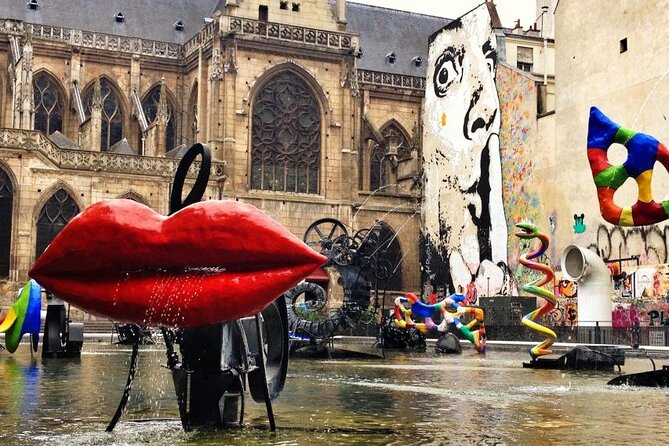
The final chapter is Stop 13: Centre Pompidou. You’ll get acquainted with the building created in the 1970s as a postmodern museum for contemporary art, along with a library and cinema. It’s a strong way to end the tour because it turns your attention to today’s Paris without ignoring the earlier centuries.
One extra note from the experience: at least some groups have gotten a view from inside Pompidou, including high-floor sights back over the city. That’s not guaranteed by the basic stop description, but it’s a good reason to consider going a bit further once you finish.
Ending at Place Georges-Pompidou is also practical. It puts you near transit and gives you options for dinner, museum time, or just a final wander.
Price and value: why 51.66 feels fair
The price is $51.66 per person for about 2 hours 30 minutes, with an experienced local guide. For Paris, that’s a reasonable cost for a guided route that hits multiple historic points instead of one big-ticket attraction.
The best value lever here is the admissions setup. Many stops are marked with Admission Ticket Free, which means you’re paying primarily for guidance and access to interpretation, not for piling up entry fees. The tour does include at least one note where admission isn’t included (Place des Vosges is listed as not included), but since it’s a square rather than a paid attraction, this isn’t usually a deal-breaker.
The small-group cap (max 15) also makes the price easier to justify. When you aren’t packed in, you can ask the follow-up questions that make history click. In feedback, guides like Sacha, Maria, and Lucie/Lucy came up often, and a couple of people highlighted that the guides were prepared with materials like illustration notes to help explain what you’re looking at.
One practical cost to remember: water isn’t included, so budget a small bottle or plan a refill if you’re carrying one.
Who should book this walking tour of the Marais
This is a great match if you want your first or second day in Paris to feel organized without being stiff. You’ll get a strong Marais orientation, and you’ll leave with names you can revisit later—Victor Hugo’s home, the synagogue area, the Sully garden courtyard, and the streets tied to Templar lore and older institutions.
It also works well for families. In one case, a guide was described as perfect for a 10-year-old granddaughter, and another mention said the tour kept teenagers interested. That’s a good sign that the guide style is adaptable, not only for adults.
If you’re a museum-only traveler, you might find the tour’s museum time brief. This is more about streets, gardens, churches, and building exteriors—paired with enough explanation to make those stops meaningful.
And if you hate logistical stress, do yourself a favor: arrive early at the start address. A single missed detail at 3bis Pl. de la Bastille can turn a smooth start into an exhausting search.
Should you book this tour or skip it?
I think you should book it if your goal is a high-signal Le Marais walking tour that connects medieval-era spaces to the modern Paris around Pompidou. The combination of free-entry stops, a small group, and guides who explain what you’re actually seeing makes it feel worth your time.
Skip it only if you want long stays at museums or you prefer self-guided wandering with minimal structure. Also, if you’re the type who hates arriving early to find meeting points, plan to double-check the address and give yourself extra time at the start.
If you do book, I’d pair it with a plan for lunch or a café stop afterward near Pompidou or along the Marais streets your guide points out.
FAQ
How long is the Paris Medieval Heart walking tour?
It runs for about 2 hours 30 minutes.
What is the price per person?
The price is $51.66 per person.
Where does the tour start and when?
It starts at 3bis Pl. de la Bastille, 75004 Paris, France, with a start time of 10:00 am.
Where does the tour end?
The tour ends at the square in front of the Centre Pompidou, Place Georges-Pompidou, 75004 Paris, France.
Is the tour in English?
Yes, it’s offered in English.
Is a mobile ticket used?
Yes, the tour uses a mobile ticket.
Are admissions included?
Several stops list admission ticket free. One stop notes admission ticket not included, while others are described as free to visit within the tour stops.
Is bottled water included?
No, bottled water is not included.
Is there a maximum group size?
Yes. The tour has a maximum of 15 travelers.
Can I bring a service animal?
Yes, service animals are allowed.