REVIEW · PARIS
Paris Latin Quarter & Left Bank – History Walk (Small Group Tour)
Book on Viator →Operated by Visit the Hidden Paris · Bookable on Viator
The Left Bank tells its story in layers. I like how this tour mixes flexibility with expert site-by-site context, so you can linger where you care most. You’ll also get a clear, guided thread through major eras, from church foundations and Revolution-era streets to Roman remains. One thing to consider: two stops involve places with admission fees you’ll need to handle separately.
What I like most is the pacing and the guide’s help. The route is built around short, focused stops you can actually absorb, and the guide uses a tablet for photo and video detail when the stone is hard to read at street level. The main drawback is practical, not historical: on a hot day, the walking and sun can feel like a lot, so bring water and plan for heat.
In This Review
- Key highlights worth your attention
- A smart 2-hour walk across the Left Bank’s biggest eras
- Quick practical expectations
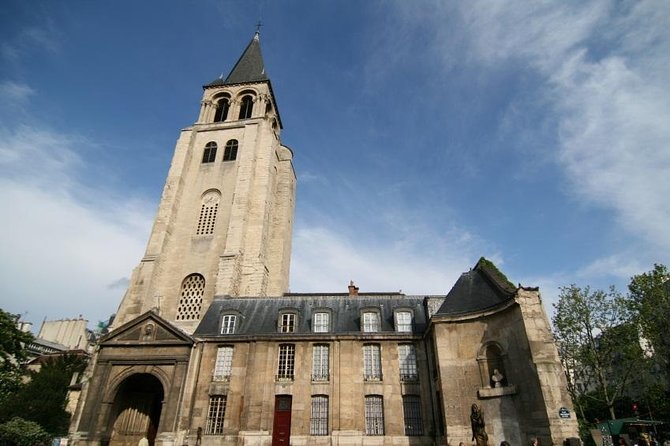
- Saint-Germain-des-Prés: a church that dates back to 990 AD
- A small note on timing and your mindset
- Cour du Commerce Saint-André: Revolution-era names with street-level context
- Why this stop works
- One drawback to plan for
- Cluny Roman baths (Thermes de Lutece): make sense of ruins with 3D help
- Admission fees note
- Luxembourg Gardens: statues, the Senate, and the Medici Fountain (with real dates)
- A practical tip for your comfort
- The Pantheon: tombs of thinkers and the Foucault pendulum story
- Admission fees note
- St-Étienne du Mont: baroque drama and a 30-foot rood screen
- If you hate crowds, good news
- Arenes de Lutece: Roman remains to close the loop
- Price and value: what $85.98 really buys you
- Who this tour suits best
- Should you book this Left Bank history walk?
- FAQ
- How long is the Paris Latin Quarter and Left Bank history walk?
- Is this tour private?
- What’s included in the price?
- Are entrance fees included?
- What should I bring for the tour?
- Can I cancel for a refund?
Key highlights worth your attention
- Private feel with a small cap (max 10): you get personal attention without a huge crowd
- Tablet-led storytelling: photos and video help you understand what you’re looking at
- Revolution names in the right locations: Danton, Marat, Robespierre tied to real streets
- Roman Paris with visuals: 3D models and video make the baths easier to grasp
- Iconic landmarks in one sweep: Saint-Germain-des-Prés, Luxembourg Gardens, Pantheon area, and Roman arenas
- Most stops are free to view: you’re paying mostly for the guide and time, not entry fees everywhere
A smart 2-hour walk across the Left Bank’s biggest eras
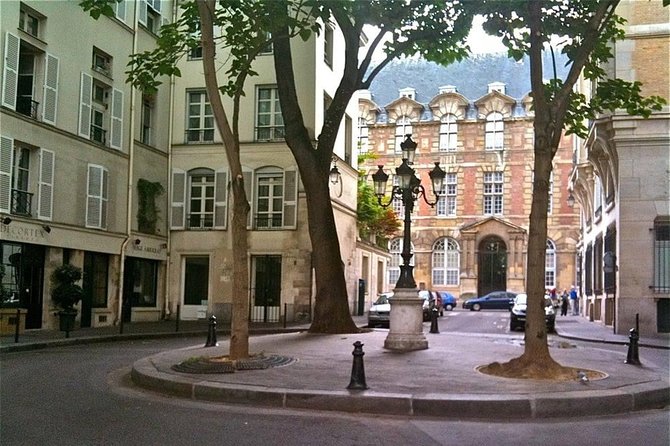
This tour is built for people who want more than a photo stop. In about 2 to 2.5 hours, you cover a pocket of the Left Bank where medieval Paris, Revolution-era legends, and Roman remains all show up in the same walkable radius. The value here is not just the list of sights. It’s how a guide turns those sights into a timeline you can hold in your head.
Because it’s private for your party (while still run as a small group with a maximum of 10), you don’t feel like you’re lost in a marching line. If you want more time on a square, or you’re the type who asks questions at the curb, this format is made for that. And since the guide is bilingual, you should find it easy to follow even if your French is basic.
You can also read our reviews of more historical tours in Paris



Quick practical expectations
You’re mostly walking through neighborhood streets and stopping for short visits, often outdoors. That means:
- Wear solid walking shoes.
- Bring bottled water, especially in summer.
- Expect the weather to matter. The tour runs in all weather conditions, so come ready with an umbrella if rain shows up.
Saint-Germain-des-Prés: a church that dates back to 990 AD

You start at Église de St Germain des Prés inside the Saint-Germain-des-Prés area. This church is special because you’re not looking at a single “one-and-done” building story. Parts date back to 990 AD, and the tour is timed so you can first get a proper look around the church itself. After that, you shift into the neighborhood mood—charming squares and time around a local food market.
What I like about this opening is that it anchors everything else you’ll see later. When you understand the older layers—when the city was already forming its identity—you start to notice how later politics and architecture grew out of the same ground-level geography.
A small note on timing and your mindset
This is a start-stop experience, not a long museum session. If you’re the type who wants to read every plaque and take 40 minutes inside, you might feel slightly rushed. If you like guided focus and then free time afterward, you’ll probably enjoy how the tour sets you up for independent wandering.
Cour du Commerce Saint-André: Revolution-era names with street-level context
Next comes Cour du Commerce Saint Andre, one of the older passages in Paris. Passages in the city can look like simple alley shortcuts, but this one has serious personality. It’s tied to early Revolutionaries—Danton, Marat, Robespierre—so the guide can connect the names you’ve heard in textbooks to a physical place you can point to.
Then the tour brings in the café connection—another reason this stop feels more alive than a typical “look at the building” moment. This is where Franklin and Jefferson are described as having rubbed shoulders with the Revolution crowd, along with philosophers such as Voltaire. There’s also the anecdote about Napoleon leaving his hat when he couldn’t pay his bar tab. Even if you take that story with a little grain of salt, it’s exactly the kind of detail that turns history into something human.






Why this stop works
The best parts are the overlaps: political figures plus everyday life, all in a tight area. You’re not just hearing about the Revolution—you’re seeing how close it sat to ordinary streets and social spaces.
One drawback to plan for
Passages and narrow lanes can feel dim or echo-y, which sometimes makes photos tricky. If you care about pictures, move slowly when the guide pauses, and consider saving your best shots for after the commentary—when you can look without juggling questions.
Cluny Roman baths (Thermes de Lutece): make sense of ruins with 3D help
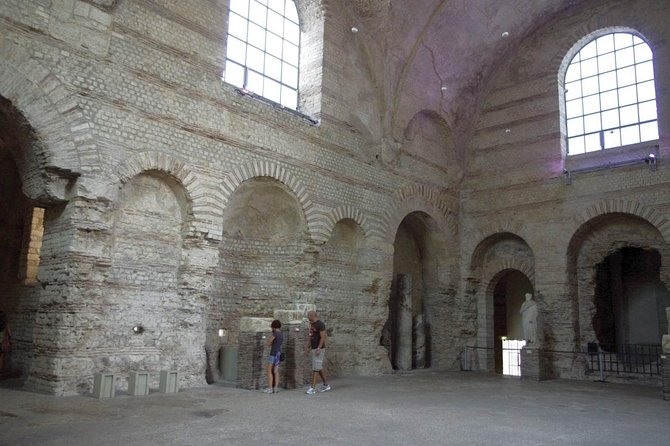
At Les Thermes de Lutece at Cluny, you’re looking at remains, not a fully restored structure. That’s where a guide’s visuals matter. Here, the tour uses video, visual material, and 3D models to explain how the baths were constructed and what you’re seeing in front of you.
This is one of the most useful parts of the route because Roman ruins can be frustrating on your own. Stone fragments are interesting, but without the “what this used to be” layer, they can blur together. With the 3D explanation, you can start mapping the site in your head.
Admission fees note
This stop lists an admission ticket as not included. That doesn’t mean you can’t see what’s around you, but it does mean you should be ready that you may need to pay if you want to enter specific areas tied to the monument.
Luxembourg Gardens: statues, the Senate, and the Medici Fountain (with real dates)
Then you float into Luxembourg Gardens, one of the Left Bank’s nicest breaks from street life. It’s a strong stop for anyone who wants a calmer rhythm while still getting cultural context. The garden holds 110 statues, including a working model of the Statue of Liberty. You’ll also be pointed toward the nearby Luxembourg Palace, built in 1612, which is now home to the French Senate.
And you’ll hear about the Medici Fountain, built in 1630. These details matter because the garden isn’t just pretty—it’s a time machine. When you know the dates and the political role of the palace, the place feels more purposeful.
A practical tip for your comfort
Gardens are where you can breathe, but they’re also where sun and heat can sneak up. Bring water and use shade when you can. Even a short stop can feel longer when it’s hot out.
The Pantheon: tombs of thinkers and the Foucault pendulum story
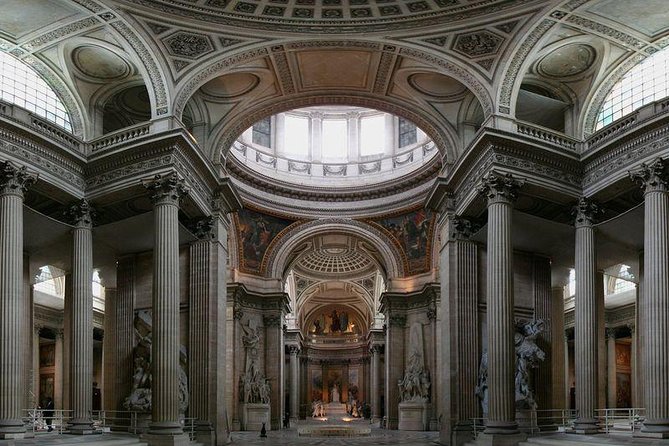
Next you’ll see the Pantheon, a mausoleum tied to France’s big thinkers and influential writers. It includes tombs of philosophers like Voltaire, Diderot, and Rousseau, plus authors such as Victor Hugo, Alexandre Dumas, and Antoine de Saint-Exupéry. Scientists Pierre and Marie Curie are also connected to the site.
What I especially like is that the guide includes the story of Foucault’s pendulum. That’s the kind of detail that makes a monument feel like more than architecture. You’re not just passing by a big dome—you’re picking up a specific idea about science and how it changed how people thought.
Admission fees note
This stop lists an admission ticket as not included, so check your plans. If you want inside time, you’ll want to budget for entry or decide how much you can enjoy from the outside.
St-Étienne du Mont: baroque drama and a 30-foot rood screen
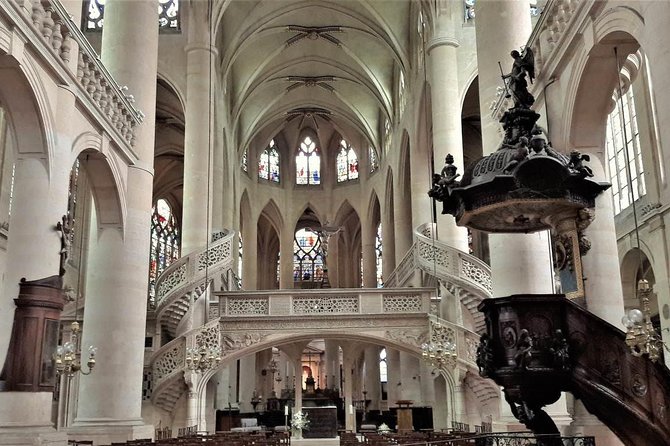
Your next church stop is St. Etienne du Mont, described as one of the most beautiful baroque churches in the area. The headline detail is the nation’s largest rood screen, carved and measuring about 30 feet wide. That’s the kind of “you have to see it” object where a quick guide pointing out key parts makes a huge difference.
You’ll also get other baroque treasures addressed in detail. This stop works well if you like churches as more than religious spaces—if you’re interested in how art, scale, and symbolism show up in stone.
If you hate crowds, good news
Since you’re in a small group and stops are short, you can usually take in the most important details without feeling like you’re trapped behind a nonstop flow of visitors.
Arenes de Lutece: Roman remains to close the loop
You end at Arenes de Lutece, another Roman vestige. By the time you get here, you’ve already seen the church foundations and the Roman bath visuals earlier, so this last stop clicks. It’s a satisfying closing note because it reinforces the Roman layer of the Left Bank without turning the day into only ruins.
It’s also a good way to leave feeling oriented. When you see the “Roman Paris” thread ending at a street-level place like this, it becomes easier to spot other Roman echoes after your tour.
Price and value: what $85.98 really buys you
At $85.98 per person, this isn’t a bargain bus tour. But you’re also not paying for a string of museum tickets. Most stops are free to view, and the cost is mostly paying for:
- a historian guide with in-depth information
- a private tour feel for your party
- the use of a tablet with photo and video documentation
- a route that keeps the walking efficient and the story coherent
If you’re the kind of traveler who would otherwise stop at a landmark, snap a photo, and move on, the guide’s interpretation is where the money goes. In the reviews, the use of a tablet stood out—especially when the guide named Ellen used her iPad to add extraordinary detail. That matters because it helps you understand what you’re seeing right now, not just what it used to be.
Who this tour suits best
This tour fits you if:
- you want context more than crowds
- you like short stops with lots of talking points
- you’re curious about the overlap of politics, religion, and daily life
- you want a manageable walk with a guide adjusting to your interests
It might be less ideal if:
- you need long, unhurried museum time
- you hate weather-related discomfort and refuse to walk outdoors (even briefly)
- you prefer audio-only self-guided tours
Should you book this Left Bank history walk?
If you’re focused on value and real understanding, I’d say yes. The strongest reason to book is the guide-led format: you get a guided thread from Saint-Germain-des-Prés through Revolution-era sites and Roman ruins, with helpful visuals where the stones can’t speak for themselves.
One last check before you commit: plan for walking and weather. Dress for comfort, bring water, and be ready for short stops with some outdoor time. If you do that, you’ll leave with the Left Bank feeling less like a blur of sights and more like a readable story.
FAQ
How long is the Paris Latin Quarter and Left Bank history walk?
The tour runs about 2 hours to 2 hours 30 minutes.
Is this tour private?
It’s described as a private tour for just you and your party, and it operates with a maximum of 10 travelers.
What’s included in the price?
You get a local guide, a private tour, and the guide uses a tablet for photo and video documentation.
Are entrance fees included?
No. Entrance fees are not included for museums and monuments, and the tour notes admission as not included for Thermes de Lutece (Cluny) and the Pantheon.
What should I bring for the tour?
Wear solid walking shoes, bring bottled water, and dress for the weather. The tour operates in all weather conditions, so bring an umbrella for rain and warm clothing in winter.
Can I cancel for a refund?
Yes. You can cancel for a full refund if you do it at least 24 hours before the experience start time.