REVIEW · PARIS
Small Group Marais/Place des Vosges Walking Tour -10 people max
Book on Viator →Operated by SLL Paris Tours · Bookable on Viator
Paris hides stories in plain sight. This small-group Le Marais and Place des Vosges walk is built for getting your bearings fast, with stops at famous façades and lesser-noticed details. I like two things most: the chance to see major sights in a short time and the way Sébastien turns buildings into real-world stories. One possible drawback: it’s a walking, look-and-learn style route, so if you’re craving lots of time inside museums, you may want extra add-ons.
Le Marais is one of those neighborhoods where you can spend hours drifting, but a guided loop keeps it efficient. The tour is also timed for the morning, so you’re done while the day still has options. You’ll finish near Rue des Rosiers, which is a handy setup if you want food or a relaxed wander after.
In This Review
- Key points at a glance
- Le Marais in 2 hours: how this walk actually helps
- Meeting at Saint-Paul-Saint-Louis and finishing by La Boutique Jaune
- Who’s running the show: the value of Sébastien
- The route through Le Marais: what you’ll see and why it clicks
- Stop 1: Le Marais orientation
- Stop 2: Hôtel de Beauvais
- Stop 3: Medieval houses at Maisons à l’Enseigne du Mouton et du Faucheur
- Stop 4: Maison Européenne de la Photographie (in Hôtel Hénault de Cantobre)
- Stop 5: Square Albert Schweitzer and the Hotel d’Aumont roofs
- Stop 6: Hôtel de Sens
- Stop 7: The Wall of Philip II Augustus
- Stop 8: Cour et jardin at Hôtel de Sully
- Stop 9: Place des Vosges
- Stop 10: Maison de Victor Hugo
- Stop 11: Rue des Francs Bourgeois
- Stop 12: La Rue des Rosiers and La Boutique Jaune
- Price and group size: is it good value for $60.24?
- Walking comfort: the one “watch out” factor
- Who should book this Le Marais and Place des Vosges walk?
- Should you book?
- FAQ
- How long is the Small Group Marais/Place des Vosges Walking Tour?
- What is the maximum group size?
- Is the tour offered in English?
- Where does the tour start and where does it end?
- Are there admission tickets included for the stops?
- Do I need a printed ticket?
Key points at a glance
- Max 10 people means you actually hear the guide and notice details.
- English-language hosting keeps the history clear and practical, not academic filler.
- Sébastien’s style blends facts with playful conversation and smart recommendations.
- Ticket-free stops let you focus on sightlines and stories without extra entry hassle.
- A morning schedule leaves the rest of your day open for your own plans.
Le Marais in 2 hours: how this walk actually helps
Le Marais can feel like a maze at first. That’s not a bad thing, but it’s easy to miss what matters while you’re busy snapping photos and finding your way. This tour works because it’s short, structured, and paced so the neighborhood makes sense by the end.
You start with the broad idea of what Le Marais is and why these streets look the way they do. Then you move spot by spot through the area’s big-name corners—Hôtel particulier mansions, Place des Vosges, and historic street sections—without turning it into a full-day marathon. For most people, it’s the fastest route to “I get this neighborhood now.”
The other practical advantage is the group size. With a maximum of 10 travelers, you’re less likely to get lost in the back row. On at least one day described in feedback, the group was just a couple, which is the kind of setup where questions actually get answered and the guide can steer the pace.
You can also read our reviews of more walking tours in Paris



Meeting at Saint-Paul-Saint-Louis and finishing by La Boutique Jaune
Your day begins near Paroisse Saint-Paul Saint-Louis, at 99 Rue Saint-Antoine. You’re set right where Le Marais starts to feel like Le Marais—close to the energy of the neighborhood without needing a long commute.
The tour ends on Rue des Rosiers, at 27 Rue des Rosiers, by La Boutique Jaune (Sacha Finkelsztajn – La Boutique Jaune). That finish matters more than you might think. Rue des Rosiers is a logical next step if you want a snack or a longer walk after the tour. It also means you’re not closing the loop in the most touristy dead-end area; you’re stepping into a street where you can keep exploring at your own speed.
One small planning note: because this is a point-to-point route, you’ll want to think about how you’ll get back to where you’re staying. It’s not a circular walk that returns to the exact starting spot.
Who’s running the show: the value of Sébastien
The guide is the heart of this experience, and the feedback is very consistent on that point. Sébastien is repeatedly described as friendly, on time, and organized. He speaks perfect English, which matters in Paris—because when you don’t have to work to understand the guide, you pay attention to the details.
What I like about his approach, based on the way this tour is described, is that he doesn’t just list dates and names. He points out small visual cues on the buildings and streets, so you can look at the same façade later and actually recognize what you’re seeing. There’s also a personal angle: if you have specific needs or interests, the guide is described as going above and beyond to help.
A bonus that can genuinely improve your trip: Sébastien is said to share recommendations beyond the walking route—food, restaurants, arts, and museum ideas in Paris. That’s the kind of advice that can save you time later when you’re deciding what to do next.
The route through Le Marais: what you’ll see and why it clicks
The walk is built like a guided tour of the neighborhood’s “why.” Each stop adds a piece of the puzzle: architecture, power, culture, and the way Parisians adapted older spaces for later uses.
Stop 1: Le Marais orientation
You begin with an introduction to the neighborhood and what you’ll notice as the tour moves forward. This is the part that helps the rest land. Instead of random sightseeing, you get a framework for the sights ahead—so when you reach Place des Vosges or the historic street sections, you understand what they’re connected to.





Stop 2: Hôtel de Beauvais
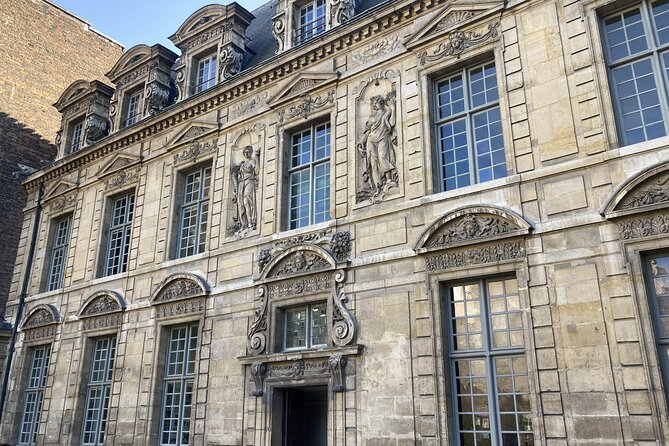
Next comes Hôtel de Beauvais, introduced as a private mansion and explored through its story. Even without a long stop, this is the kind of place where the architecture gives clues about status and era. Your time here is short, but it’s enough to make you look more carefully.
Stop 3: Medieval houses at Maisons à l’Enseigne du Mouton et du Faucheur
Then you shift to medieval-style houses—Maisons à l’Enseigne du Mouton et du Faucheur—where the façades reflect older street traditions. These are the moments when a guide can help you spot what you’d otherwise walk right past.
Stop 4: Maison Européenne de la Photographie (in Hôtel Hénault de Cantobre)
You’ll move to the Maison Européenne de la Photographie, which lives in the mansion Hénault de Cantobre. You’re not just hearing a generic pitch; you’re admiring the outside and learning the backstory, then using that context to understand why this area keeps changing uses while retaining its character.
Stop 5: Square Albert Schweitzer and the Hotel d’Aumont roofs
At Square Albert Schweitzer, the focus turns to rooflines and the famous Mansard roofs associated with the Hotel d’Aumont. Roof shapes can feel like trivia until someone points out why they exist and what they signal visually. This stop gives you a new “lens” for the rooftops you’ll see across Paris.
Stop 6: Hôtel de Sens
At Hotel de Sens, you get another story-based stop at a private mansion. The idea is similar to Hôtel de Beauvais: you walk away with a better sense of who these places belonged to and why the building itself is worth looking at.
Stop 7: The Wall of Philip II Augustus
Then comes a tangible reminder that Paris once had walls. The Wall of Philip II Augustus is described as the oldest city wall in Paris. This is a quick stop—five minutes—but it’s one of those historical anchors that makes the neighborhood feel older than it looks.
Stop 8: Cour et jardin at Hôtel de Sully
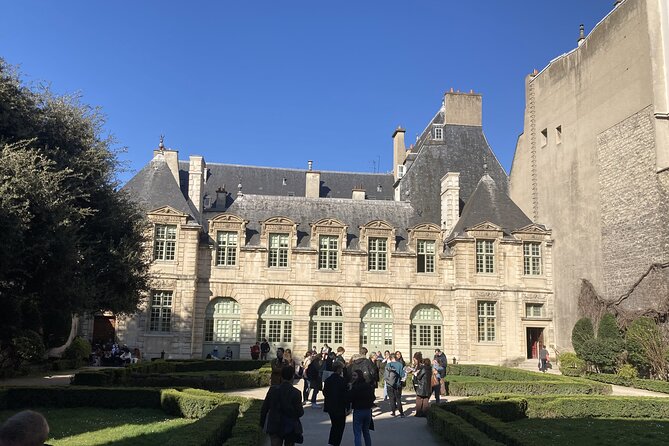
At Hôtel de Sully, you’ll see the idea of an inner courtyard and garden space (cour and jardin). Even if you don’t spend long inside, it helps you understand the difference between street life and private life in old Paris.
Stop 9: Place des Vosges
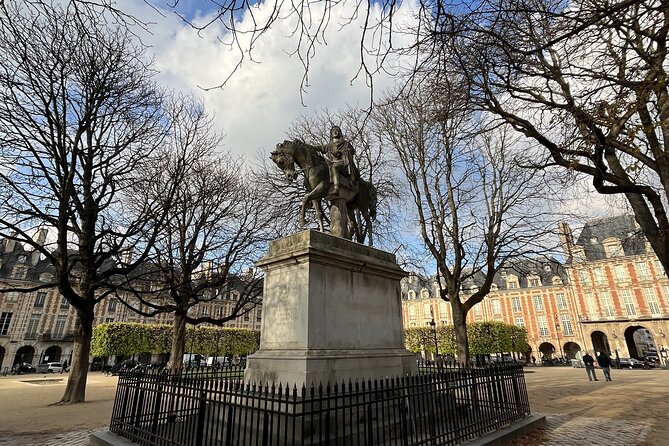
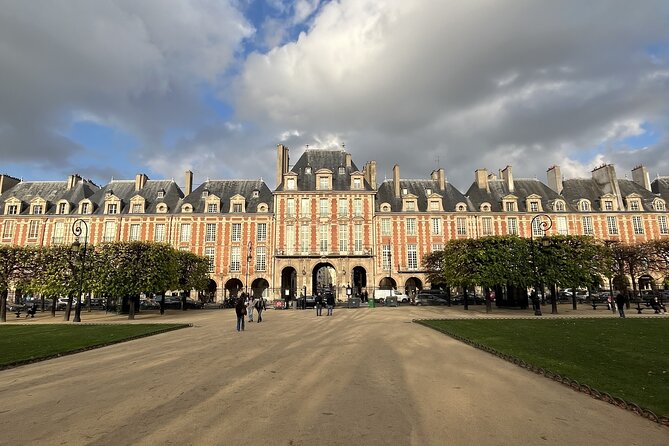
Now you reach the big payoff: Place des Vosges. The tour gives it about twenty minutes, which is long enough to actually take in the square instead of treating it like a quick photo checkpoint. This is where you pause and let the surroundings do the work.
Stop 10: Maison de Victor Hugo
Next is the Maison de Victor Hugo, where he lived from 1832 to 1848. This is the moment where the tour becomes more than architecture. Victor Hugo ties the setting to literature and to a specific time, giving you an easy mental hook for what you’re seeing.
Stop 11: Rue des Francs Bourgeois
You then walk down Rue des Francs Bourgeois, a historic street section that helps bridge the formal landmarks back to the day-to-day feel of the neighborhood.
Stop 12: La Rue des Rosiers and La Boutique Jaune
Finally, you land in La Rue des Rosiers and finish by La Boutique Jaune, a traditional kosher deli/bakery. The tour describes it as a last vestige of the old Jewish quarter. That context gives the street a deeper meaning than the storefront photos alone.
Price and group size: is it good value for $60.24?
At $60.24 per person for about 2 hours, the value comes from the combination, not any one item. You’re paying for:
- A guided route that keeps the walk efficient
- A very small maximum group (10 people)
- English interpretation throughout
- A guide who’s strong on details and recommendations
- Stops described as ticket-free (so you’re not buying entry fees at each point)
If you’re the kind of traveler who likes to wander but hates wasting time trying to figure out what you’re looking at, this is a smart middle ground. You get structure and context, but you still have plenty of time after for your own choices.
If you prefer fully independent travel, you could technically replicate parts of this with a map. But paying for a guide is often what turns “pretty streets” into “I understand what that is and why it matters.”
Walking comfort: the one “watch out” factor
This is a walking tour in a historic district. The total duration is listed as about two hours, with short stops at each location. For most people, that’s manageable, especially with breaks built into the route.
Still, here’s the honest consideration: some stops are exterior and story-focused, which means you’ll want to enjoy looking closely rather than expecting long indoor exhibits at every turn. If you want lots of museum time, budget your energy for one major stop later in the day.
Who should book this Le Marais and Place des Vosges walk?
Book it if you want:
- A fast overview of Le Marais that makes the area feel navigable
- A guide-led experience that helps you notice details you’d miss
- A morning plan that leaves the rest of your day free
- An English tour with a guide who shares practical ideas for the rest of your trip
Skip it if:
- You dislike walking for two hours
- You’re only interested in long indoor visits and don’t want an outside, story-driven format
- You want a loop that returns to the exact start point
Should you book?
Yes, I’d lean toward booking this one if your goal is to get oriented in Le Marais and understand why the sights feel the way they do. The small-group limit and Sébastien’s track record for English clarity, friendliness, and detail-spotting are strong reasons to choose it over a bigger, less personal tour.
It’s also a good choice when you want to end near Rue des Rosiers, because you can tack on food and extra wandering right after.
If you’re in Paris for a short visit, this tour is one of the better ways to make the neighborhood work for you, not the other way around.
FAQ
How long is the Small Group Marais/Place des Vosges Walking Tour?
The tour lasts about 2 hours.
What is the maximum group size?
The experience has a maximum of 10 travelers.
Is the tour offered in English?
Yes, it’s offered in English.
Where does the tour start and where does it end?
It starts at Paroisse Saint-Paul Saint-Louis, 99 Rue Saint-Antoine, 75004 Paris, and ends at Sacha Finkelsztajn – La Boutique Jaune, 27 Rue des Rosiers, 75004 Paris.
Are there admission tickets included for the stops?
The stops listed are marked with Admission Ticket Free.
Do I need a printed ticket?
No. You receive a mobile ticket.