REVIEW · PARIS
Paris Street Art, smartphone audioguided tour
Book on Viator →Operated by REWIND · Bookable on Viator
Paris graffiti has a smart GPS guide. This Rewind smartphone walk in the 13th turns famous murals into a timed story, with automatic GPS-triggered audio that starts exactly where you stand. I love the way the commentary mixes art facts with the street-art business model, so you understand not just what you see, but how it works.
One watch-out: the route focuses on a handful of big sites, so if you want wall-to-wall art on every corner, plan to wander afterward. The walk still feels full, but it is not a complete neighborhood sweep.
I also like the control: you can pause for a terrace or shop, then resume right where you left off, with a map and geo-localization to keep you on track. It’s run as a private experience for your group.
In This Review
- Key things you’ll like about this Paris street art tour
- Paris 13th is the right setting for street art you can actually understand
- Where you start at the Town Hall of the 13th (and how the walk finishes)
- Rewind smartphone audio: the guide is in your pocket, not on your heels
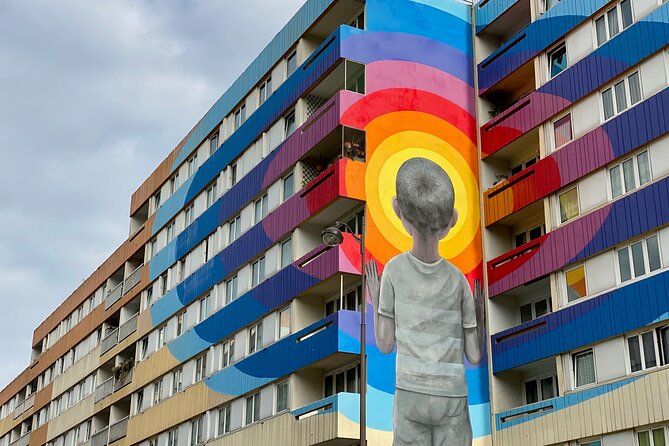
- Stop 1: Zabou’s Paper planes fresco
- Rue Pinel: history and the street-art business model
- Place Pinel: a concentration of famous works
- OBEY: a serious message on the wall
- Boulevard Vincent Auriol: the open-air museum stretch with DFace, C215, Invader, and more
- How long it really takes (and how to pace it without getting tired)
- Price and value: $11.85 for guided murals that actually teach
- Who should book this (and who might want something else)
- A simple takeaway before you go
- Should you book this Paris street art smartphone tour?
- FAQ
- How long is the Paris Street Art smartphone audioguided tour?
- Where does the tour start and end?
- Do I need to follow a guide on the street?
- Can I pause the tour and continue later?
- Is this tour private?
- Can I get a full refund if I cancel?
Key things you’ll like about this Paris street art tour
- GPS audio that plays automatically as you reach each mural
- A clear start and finish in the 13th, from Place d’Italie area to Rue Dunois
- Context beyond the visuals, including why street art took root and how the business works
- Big-name frescoes in an open-air museum, with artists like Zabou, OBEY, DFace, C215, and Invader
- Easy pacing with pause/resume plus geo-localization if you drift off
Paris 13th is the right setting for street art you can actually understand
If you think street art is just random tagging, this is a great way to recalibrate. The 13th arrondissement has a dense cluster of large frescoes and murals, so you’re not hunting for art—you’re walking through it.
The tour’s real strength is that it treats the walls like a living cultural system. You don’t just get artist names; you get why the work appeared here and how the whole scene can be recognized internationally without losing its original edge.
You can also read our reviews of more tours and experiences in Paris


Where you start at the Town Hall of the 13th (and how the walk finishes)
You begin at the Town Hall of the 13th arrondissement, at 1 Pl. d’Italie, 75013 Paris. From there, the route heads through key street-art zones and ends around 78 Rue Dunois, 75013 Paris.
That start location matters. It’s a straightforward landmark to aim for, and it helps you get moving fast instead of spending your first 20 minutes stuck at the map stage. If you like to keep your day efficient, this kind of end-point is a win.
Also, it’s set up as a private activity for your group. That tends to make the whole experience feel calmer, since you’re not constantly navigating around strangers.
Rewind smartphone audio: the guide is in your pocket, not on your heels
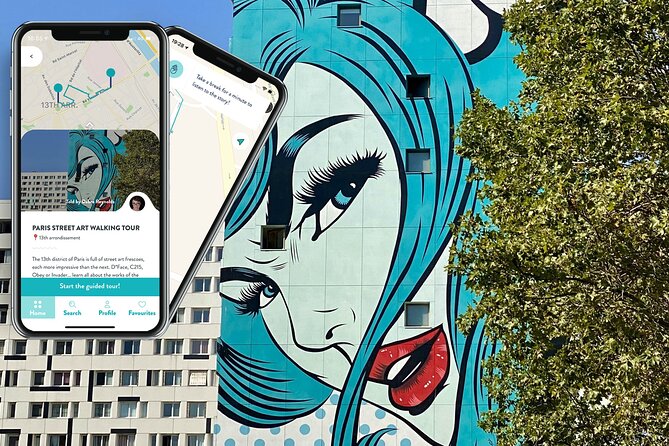
This is a smartphone audioguided experience built around the Rewind app. What makes it practical is how little work you have to do once you’re walking.
Audio commentaries trigger automatically right where each artwork is located. You also get a map that provides clear directions in real time, and there’s geo-localization if you take a wrong turn. In plain terms: you can focus on the art instead of constantly checking your phone like it’s a full-time job.
You also get flexibility. The format lets you pause for a drink, snack, or quick browse in a nearby shop, then resume right where you stopped. If your walking pace is slower—or you stop to take photos more often than you planned—this matters more than you’d think.
And yes, there’s human energy behind it. The tour is guided by a professional and passionate voice, and the guide also runs a café in Montmartre. That detail fits the tone: the commentary feels like it’s coming from someone who’s embedded in the Paris art scene, not just reading a script from afar.
Stop 1: Zabou’s Paper planes fresco
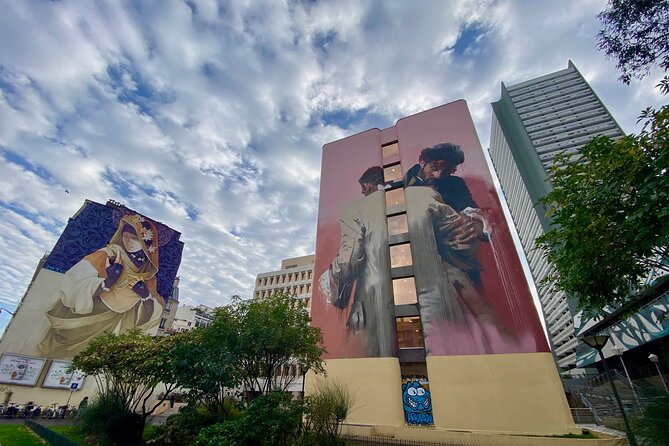
Your first major stop is the fresco Paper planes by Zabou. Plan for about 10–15 minutes of audio here, because this one is treated like an opening statement.
This is a smart place to start. You’re introduced to the scale of the work and the way a mural can shape a street. Even if you’re new to street art, seeing an artist’s style on a wall that size makes the genre click quickly.
It’s also a good warm-up for the rest of the route. After your first mural, the next stops hit harder because you’re already paying attention to technique, placement, and message—not just recognizing names.
Rue Pinel: history and the street-art business model
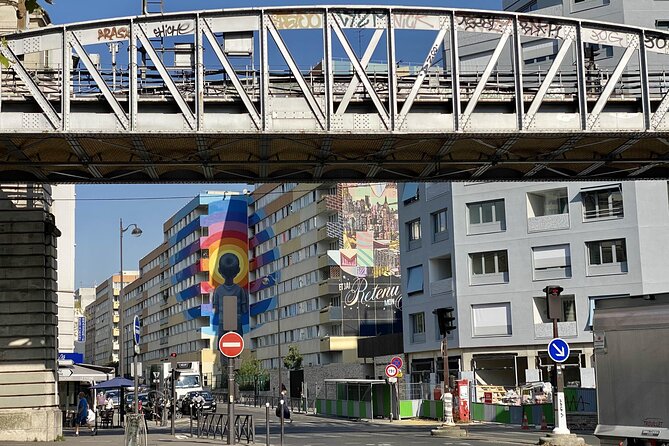
Next up is Rue Pinel. This section is where the tour does something valuable for first-timers: it explains the history of street art and the economic model behind it.
That may sound dry, but it’s exactly what helps you decode what you’re seeing. Street art often gets talked about as if it’s only rebellion. The reality is more complex—artists, neighborhoods, walls, visibility, and how the work becomes internationally recognized all intersect.
If you’ve ever wondered how street artists go from walls to wider fame (without turning the whole thing into a museum copy), this is the part that answers your questions.
You can also read our reviews of more tours and experiences in Paris



Place Pinel: a concentration of famous works
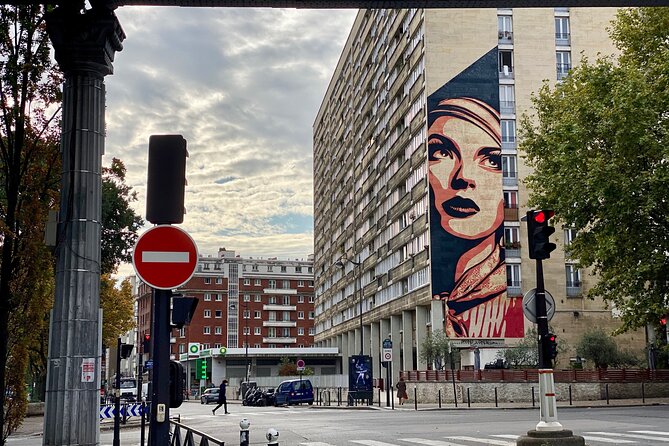
From Rue Pinel, you move to Place Pinel. Here, the focus is admiration: you’ll see majestic works by some of the world’s greatest street artists.
This stop works best if you slow down. Place Pinel gives you a chance to look at the scale and layout, not just the big signature elements. When you see multiple styles close together, you start noticing how artists talk to each other across different walls—sometimes in contrast, sometimes in conversation.
It’s also a good moment to take notes in your brain, if not on paper. After this, you’ll be walking with sharper eyes because you understand what to look for.
OBEY: a serious message on the wall
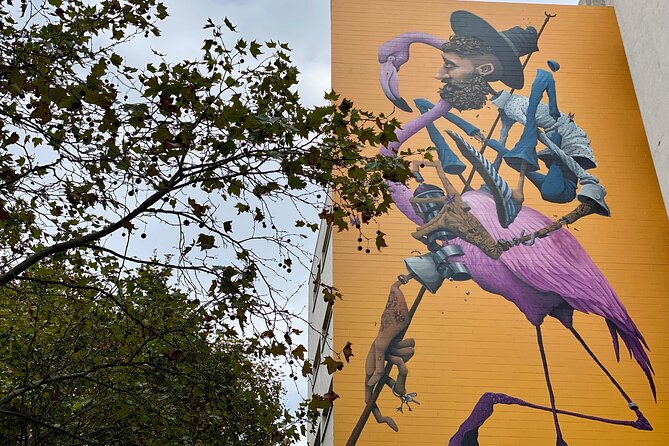
Then comes OBEY, featuring an homage to the victims of the 2015 terrorist attacks in Paris.
This is one of the tour’s more emotionally grounded segments. Street art isn’t only color and shock; it can also be memorial, reflection, and public meaning. Putting a remembrance mural inside a walk that also covers major contemporary names makes the genre feel bigger and more human.
I like that the tour doesn’t treat serious work as a detour. It’s integrated into the route like it belongs—because it does.
Boulevard Vincent Auriol: the open-air museum stretch with DFace, C215, Invader, and more
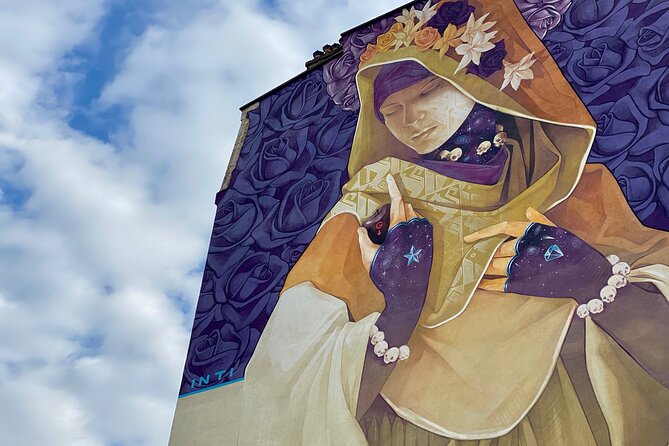
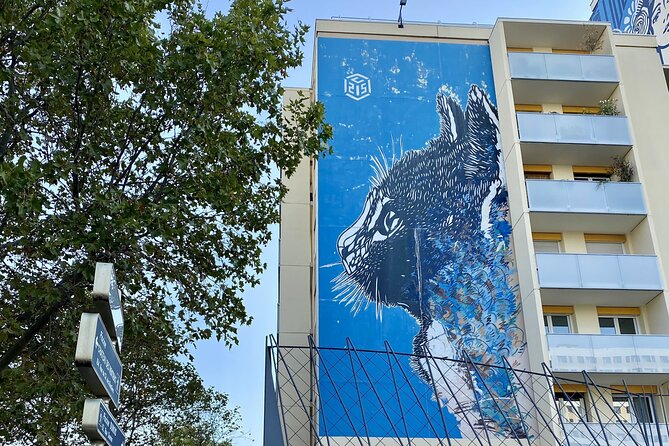
The heart of the walk is Boulevard Vincent Auriol, where you enter a true open-air museum feel. This stretch is longer—around 30 minutes—and it’s where you’ll meet multiple big names.
Expect to see artists such as D*Face, C215, OBEY, David de la Mano, Pantonio, and Invader, plus additional works along the way. The point isn’t just to name-drop. It’s to show how street art can carry different visual languages at once: portrait-style intensity, stencil-driven graphics, character-based iconography, and large-format mural storytelling.
If you’re the type who likes to “read” walls like they’re posters on a street. this is your section. Let the auto audio guide pace you, but don’t rush your looking. This area rewards patience because the works are often best understood from slightly different angles.
How long it really takes (and how to pace it without getting tired)
The whole experience is listed at about 1 hour to 1 hour 30 minutes. In practice, your time mostly depends on how often you pause for photos and how closely you listen.
The tour’s design helps you pace naturally. Since audio triggers automatically, you don’t need to constantly restart or hunt for content. If you pause at a café or shop, you can resume without losing the thread.
My practical advice: give yourself enough energy to look closely at least twice—once early at Zabou’s fresco and again during the Boulevard Vincent Auriol stretch. If you treat every stop equally rushed, the tour will feel like a quick hit. If you slow down at the big sections, it becomes a strong street art education.
Price and value: $11.85 for guided murals that actually teach
At $11.85 per person, this is one of the more cost-friendly ways to get street art context in Paris. You’re paying for guided audio tied to location, plus a structured route through some of the area’s standout frescoes.
Here’s the value logic: street art is everywhere, but context is not. A cheap “self-walk” can turn into wandering with no clue what you’re looking at. This tour reduces that problem by giving you explanations where you stand, with GPS so you don’t lose time.
Also, the private-group setup can be a good deal if you’re traveling with one or two people, because it keeps the experience tidy and focused.
For the price, it delivers two things that matter: you get to see big murals and you get meaning—artist background, local reasons the art took hold, and the business mechanics behind international recognition.
Who should book this (and who might want something else)
This works especially well if:
- you’re curious about street art but want guidance that doesn’t assume deep prior knowledge
- you like walking on your schedule and dislike being held to a rigid pace
- you want to explore the 13th arrondissement beyond the usual postcard stops
It might be less ideal if:
- you’re expecting an exhaustive mural inventory of the entire neighborhood in a single short walk
- you prefer a live guide who can adapt to your questions in real time
The tour is a curated-feeling route, but it also pairs well with extra wandering after you finish. If you want more walls, you’ll find them nearby—you just won’t get every single one covered in one session.
A simple takeaway before you go
Think of this as a guided introduction to the 13th’s wall art system. You’ll start with a clear entry point, learn how street art became internationally recognized, hit a remembrance work by OBEY, and then spend the most time in the open-air gallery zone on Boulevard Vincent Auriol.
If you want street art that feels like a real neighborhood experience—not just photos—this is a strong bet.
Should you book this Paris street art smartphone tour?
Yes, if you want street art with location-based audio, low hassle navigation, and a route that explains what you’re seeing instead of just pointing at it. The $11.85 price is hard to beat for a 1 to 1.5 hour walk with GPS-triggered commentary and multiple major artists’ works.
If you’re a serious street art hunter who already knows the scene and expects to cover every mural in depth, you might want to treat this as your warm-up walk and then branch out on your own afterward.
FAQ
How long is the Paris Street Art smartphone audioguided tour?
The duration is about 1 hour to 1 hour 30 minutes.
Where does the tour start and end?
It starts at the Town Hall of the 13th arrondissement at 1 Pl. d’Italie, 75013 Paris, and it ends at 78 Rue Dunois, 75013 Paris.
Do I need to follow a guide on the street?
No. The experience uses the Rewind app with audio that triggers automatically where you are, plus a map and geo-localization for directions.
Can I pause the tour and continue later?
Yes. You can stop for a terrace or shop and then resume the visit right where you paused.
Is this tour private?
Yes. Only your group participates.
Can I get a full refund if I cancel?
Free cancellation is available up to 24 hours in advance for a full refund. If you cancel less than 24 hours before the start time, the amount paid is not refunded.