REVIEW · PARIS
Louvre Guided Tour with Mona Lisa & Masterpieces
Book on GetYourGuide →Operated by City Wonders Ltd. · Bookable on GetYourGuide
The Louvre feels manageable, for once. This tour uses reserved afternoon access and a live English-speaking guide (with headsets) to help you see major masterpieces without getting lost in the chaos.
I especially like the way the guide turns famous paintings and statues into something you can actually follow, not just walk past. And I like that you’re guided through multiple highlights, so your 3 hours feel like real museum time.
You’ll focus on big-name works like Mona Lisa by Da Vinci, plus Renaissance and Baroque touchstones, including pieces by Caravaggio and Michelangelo, and sculptures from the classical collection. You also get less-obvious context for Greek and Roman antiquities and how the Louvre’s rooms evolved over time.
One possible drawback: you need to meet at the Arc de Triomphe du Carrousel (not the Louvre entrance), then you still pass Louvre security and you’ll do a fair amount of walking.
In This Review
- Key things I’d watch for on this tour
- The Louvre’s afternoon advantage: why reserved entry matters
- Meeting at Arc de Triomphe du Carrousel: how to avoid a first-day headache
- Inside the museum with an expert guide and headsets
- Mona Lisa and Renaissance power: getting more from famous names
- Classical sculpture you can actually compare in one visit
- Apollo Gallery and Napoleon Apartments: why palace rooms change your view
- The route and timing: what 3 hours feels like in real life
- Price and value: what you’re really paying for
- Who this Louvre tour fits best
- Who should skip it or adjust expectations
- Should you book the Louvre guided tour with Mona Lisa & Masterpieces?
- FAQ
- FAQ
- How long is the tour?
- Where do I meet the group?
- Where does the tour end?
- What is included in the $80 per person price?
- Can I skip the ticket line?
- Are there limits on bags or luggage?
- Is the tour wheelchair accessible?
- Is there free cancellation?
Key things I’d watch for on this tour
- Reserved afternoon access can make the Louvre feel far calmer than the usual peak crush
- Headsets help you hear your guide even in busier galleries
- A tight highlight list takes in Mona Lisa, Renaissance masters, and major antiquities
- Classical collection must-sees include Venus de Milo and Winged Victory of Samothrace
- Power rooms like the Apollo Gallery and Napoleon Apartments help explain the Louvre’s past
- Group size can split if you’re traveling in a party of 7 or more
The Louvre’s afternoon advantage: why reserved entry matters
The Louvre is famous for being overwhelming. Even if you love art, hours can disappear fast when you’re constantly waiting, rerouting, and trying to remember what matters most. This tour’s main trick is reserved afternoon access, which helps you start your museum time when it’s typically less crowded.
That timing shift changes the whole feel. With fewer bottlenecks around key areas, you have a better chance to slow down for details instead of rushing to beat the lines. And because you’re not stuck searching for what to see next, you can focus on learning and observation.
Security is still part of the reality here—you’ll pass security before entering the museum. But once you’re in, the reserved flow gives you a clearer start and helps you use your limited 3 hours more effectively.
You can also read our reviews of more guided tours in Paris



Meeting at Arc de Triomphe du Carrousel: how to avoid a first-day headache
Your tour starts beside the Arc de Triomphe du Carrousel. The team wears blue, and they stand to the left of the Arc along the wall railing. This matters because the meeting point is not at the Louvre entrance.
To locate the Arc quickly, stand with your back to the Louvre Pyramid entrance. Look across the road, just before the entrance to the Tuileries Garden—you should spot the horse-drawn chariot on top of the Arc. It’s an easy landmark once you know the angle, but it’s still worth doing a quick check so you don’t arrive flustered.
Plan for getting there a little early. Even with reserved entry, you’ll want a buffer for finding the group and settling in before you start walking.
Inside the museum with an expert guide and headsets
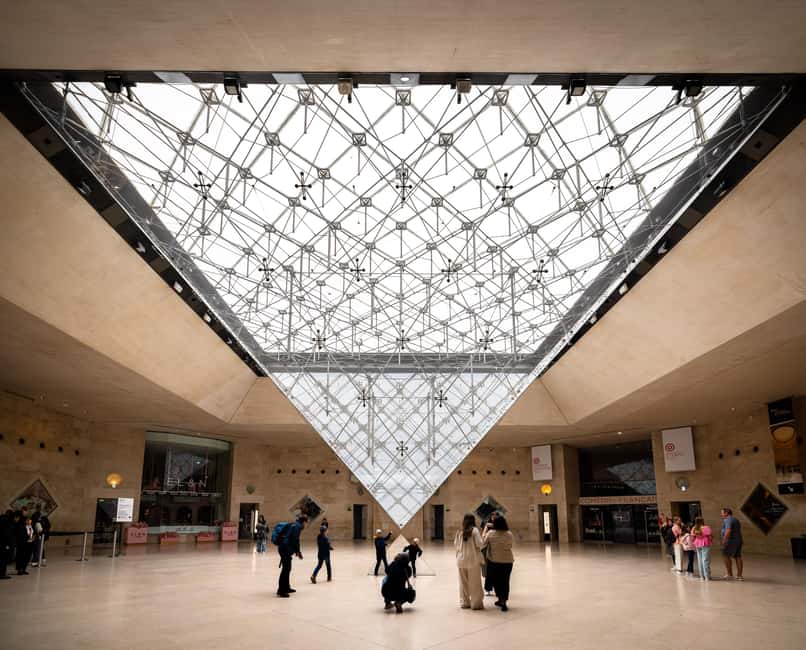
The guide is the heart of this experience. You get a live English-speaking expert plus headsets, so you can keep up without straining your ears or drifting behind when groups move through tight spaces.
This is especially important at the Louvre, where masterpieces are spread across huge areas. Without help, it’s easy to see plenty of art and still feel like you didn’t truly understand anything you saw. With a guide, you’re given a roadmap—what to notice, why it matters, and how to connect what you’re looking at to broader art and history themes.
You’ll also walk through major Louvre areas with a plan, rather than piecing together your own route. That’s a real time-saver. And if you’ve ever worried you’d miss important works in a first visit, this is where that worry gets replaced by structure.
Mona Lisa and Renaissance power: getting more from famous names
Let’s be honest: the Louvre’s biggest names can feel like a stop-and-snap situation. This tour aims to do better. You’ll spend time seeing iconic works and also get help reading what makes them significant.
You’ll focus on Da Vinci’s Mona Lisa, but the tour doesn’t stop at one painting. You also see Renaissance masterpieces connected to the same era’s bigger story—works including pieces attributed to artists such as Da Vinci and Raphael, plus other major masters like Caravaggio and Michelangelo. That combination matters, because it shows how styles, subjects, and artistic ambitions shifted over time.
What I like about this setup is the way it makes the Louvre feel like more than a list of famous works. You’re given context that helps you understand what you’re looking at and how the art fits into the era. Even if you’re not a hardcore art buff, you’ll likely walk away knowing more than you expected, without needing a museum degree.
Classical sculpture you can actually compare in one visit
The classical collection is a highlight for a reason. When you see Greek and Roman sculpture in person, the scale, pose, and carving details hit differently than photos. On this tour, you’ll see major works that act like anchors for the whole collection.
Expect to view Venus de Milo and the Winged Victory of Samothrace. These are the kinds of statues people recognize instantly, but the guide’s role is turning recognition into understanding: how artists conveyed movement, idealized bodies, and dramatic expression.
And because you’re not just dropping by for a quick look, you have time to take in how the style changes across pieces. That makes comparison possible. You start noticing things like how posture and drapery create emotion, not just decoration.
You’ll also get stories about Greek and Roman antiquities, including details you might otherwise miss if you’re just wandering on your own. That’s where guided time becomes valuable: someone helps you see what your eyes might not naturally pick up at first glance.






Apollo Gallery and Napoleon Apartments: why palace rooms change your view
The Louvre isn’t only an art museum. Parts of it were royal spaces, and it shows. This tour includes stops in areas like the Apollo Gallery and the Napoleon Apartments, which helps you understand the building as something more than walls full of paintings.
When you’re in the Apollo Gallery, the setting adds a layer to the art. You’re not just viewing artworks; you’re experiencing how the Louvre was designed to impress and communicate power. That context can change how you interpret the pieces you’re seeing and why they were valued.
In the Napoleon Apartments, the atmosphere is different again. You’re reminded that the Louvre has served changing rulers and changing tastes. For me, this is one of the best ways to make a first visit feel coherent: art plus the rooms that housed it.
The route and timing: what 3 hours feels like in real life
This tour runs about 3 hours, and it involves a fair amount of walking. That’s not a complaint—it’s just the truth of seeing multiple major sections of a huge museum in one go.
Here’s the practical way to think about it: you’re not “doing everything.” You’re doing the important works and the most memorable rooms with a guide. For first-timers, that’s often the best trade. You see a lot, you learn a lot, and you don’t spend your whole day trying to solve the Louvre like a puzzle.
You’ll start at the Arc de Triomphe du Carrousel and finish at the Louvre Pyramid. That matters because it usually keeps you from spiraling into museum fatigue. You get a defined end point, which helps you manage your energy and plan what comes next.
If you’re visiting other sights afterward, this format is useful. You’ll likely be able to head out with your bearings, because you’re coming away with a clearer mental map of what the Louvre contains.
Price and value: what you’re really paying for
The price is listed at $80 per person for a 3-hour guided experience. That includes entrance/reservation plus the expert guide and headsets.
There are two value drivers here. First, you’re paying for reserved access that helps with timing and crowd levels. Second, you’re paying for guided interpretation. In a museum like the Louvre, those two elements can be more valuable than adding one more stop you already would have found on your own.
A useful reference point: the entrance ticket is listed at 22€ and there’s also a reservation fee (70€ per group). The math depends on group size, but the overall structure signals that a chunk of your fee is going into making your entry and route work better.
If you’re an EU visitor aged 18 to 26, museum entry is free. In that case, your value calculation shifts slightly. You may still be paying for the guide time and reserved access, but you might want to confirm how the free-entry rule interacts with the tour reservation.
Also note: the tour includes the entrance ticket and reservation fee, so you’re not juggling separate purchases on the day. That reduces friction and helps you keep the day moving.
Who this Louvre tour fits best
I think this tour is a great match if you want a first Louvre visit that actually teaches you something. It’s also good if you like the idea of seeing both iconic art and major sculpture without planning a complicated route.
You’ll probably like it if:
- You’re short on time and want a focused lineup of key masterpieces
- You don’t want to fight crowds around the most famous works
- You appreciate explanations that connect paintings and sculptures to their era
- You want to see signature areas like the Apollo Gallery and Napoleon Apartments, not only galleries with paintings
It’s also a smart choice for couples, friends, and solo travelers who still want the benefits of a group plan.
Who should skip it or adjust expectations
This tour isn’t a fit for everyone. It’s not suitable for wheelchair users. Baby strollers aren’t allowed, and large luggage isn’t allowed.
Also, be ready for walking. If you’re coming in with limited mobility or you’re expecting a mostly sit-and-watch experience, you might find the pace more active than you want.
Finally, remember that Louvre security is required for all visitors. The reserved access helps, but it doesn’t eliminate security—so you still need to factor that step into your mental timeline.
Should you book the Louvre guided tour with Mona Lisa & Masterpieces?
Yes, I’d book it if your goal is a high-impact Louvre visit with real guidance, not just a long walk between artworks. The biggest win is the combination of reserved afternoon access, a structured route, and headsets that keep you with the guide.
If you’re comfortable walking in a big museum and you want a first-timer-friendly overview of masterpieces—paintings, sculptures, and major palace rooms—this tour does the job well. And if you care about hearing the stories behind the works, the expert guide turns familiar names into something you can describe later.
If you’re extremely price-sensitive or already plan to arrive with a very strict self-guided list, you might feel torn. But for most people, the value here is not only what you see—it’s how much easier the Louvre becomes when someone else handles the route and interpretation.
FAQ
FAQ
How long is the tour?
The tour lasts about 3 hours.
Where do I meet the group?
Meet beside the Arc de Triomphe du Carrousel, with the team dressed in blue. The meeting point is not at the entrance to the Louvre Pyramid.
Where does the tour end?
The tour finishes at the Louvre Pyramid.
What is included in the $80 per person price?
Included are reserved access to the Louvre, an expert English-speaking guide, headsets, plus the entrance ticket and reservation fee.
Can I skip the ticket line?
Yes. The tour includes reserved access and lets you skip the ticket line.
Are there limits on bags or luggage?
Yes. Baby strollers are not allowed, and luggage or large bags are not allowed. Items exceeding 55 x 35 x 20 cm are not permitted in the museum.
Is the tour wheelchair accessible?
No. It is not suitable for wheelchair users.
Is there free cancellation?
Yes. You can cancel up to 24 hours in advance for a full refund.
If you tell me your travel month and whether you’re visiting with others (and roughly how many), I can help you decide if the afternoon timing is the right move for your schedule.