REVIEW · PARIS
Area ,Opera, Jewellery,Fashion,Palais Royal walking tour
Book on Viator →Operated by Ned · Bookable on Viator
Paris fashion and opera, stitched into one walk. This small-group stroll is designed to help you grasp the Opéra area fast, with stops that connect power, theater, luxury streets, and the perfume that turns style into a memory.
I really like two things about it: the max 5 travelers setup (so questions don’t get lost), and the laidback pace that gives you time to look up at façades and not just speed past them.
One thing to think about: the exterior walk past Palais Garnier is included, but if you want to go inside the opera house, that’s a separate 14 euro add-on.
In This Review
- Key points to know before you go
- Getting Oriented: an Opéra-area loop built for fashion and jewelry lovers
- Jardin du Palais Royal: Richelieu’s 1633 plan and the courtyard you can feel
- La Comédie-Française: Molière and why this theatre still sets tone
- Rue Saint-Honoré and Eglise Saint-Roch: façades, fashion, and the Paris you feel in your feet
- Place-Vendôme: Louis XIV, Napoleon, and the square built for jewellery
- Palais Garnier: the exterior story is included, the interior is your decision
- Musée du Parfum – Fragonard: why perfume fits a fashion walk
- Price and practical value for $74.49
- Who should book this walk
- Should you book this Opéra, Jewellery, Fashion walking tour?
- FAQ
- How long is the tour, and what times does it run?
- Where does the tour start and end?
- What is included in the $74.49 price?
- Is entry to the Palais Garnier interior included?
- Are the other museum stops free to enter?
- How big is the group, and what language is the tour in?
- Is there free cancellation?
Key points to know before you go
- Max 5 people means the guide can actually answer your questions as you walk
- Palais Royal and Théâtre/Comédie-Française area gives you culture and government-in-one-block context
- Rue Saint-Honoré is treated as a fashion runway, not just a shopping street
- Place-Vendôme links Louis XIV, Napoleon, and modern luxury jewellery into one compact stop
- Fragonard Musée du Parfum turns perfume history into something you can picture, bottle-by-bottle
- Palais Garnier interior costs extra (14 euro), so decide early if it matters to you
Getting Oriented: an Opéra-area loop built for fashion and jewelry lovers
This tour is short on paper—about 2 hours 10 minutes—but it’s efficient in the way Paris usually rewards: you move at human speed and still hit the big “why this neighborhood matters” points. You start at Le Nemours (Galerie de Nemours), 2 Place Colette, 75001 Paris, and you end at Palais Garnier (Pl. de l’Opéra, 75009). That means you’re walking through a story, not just collecting postcards.
The vibe is laidback and conversational. With a group capped at 5, you’re not stuck waiting your turn at every stop. And because it’s offered in English, you won’t lose the thread when the guide connects architecture to culture to the luxury trade around you.
The route also matches your stated interests: opera, jewellery, fashion, and the surrounding Paris power centers. Even if you’re not a “try-on” shopper, this neighborhood makes sense when you understand how taste gets marketed here—street by street.
Practical tip: bring comfortable shoes and a layer. Two-plus hours in the open means you’ll feel every change in light and temperature, especially as you near the more exposed squares.
You can also read our reviews of more walking tours in Paris



Jardin du Palais Royal: Richelieu’s 1633 plan and the courtyard you can feel
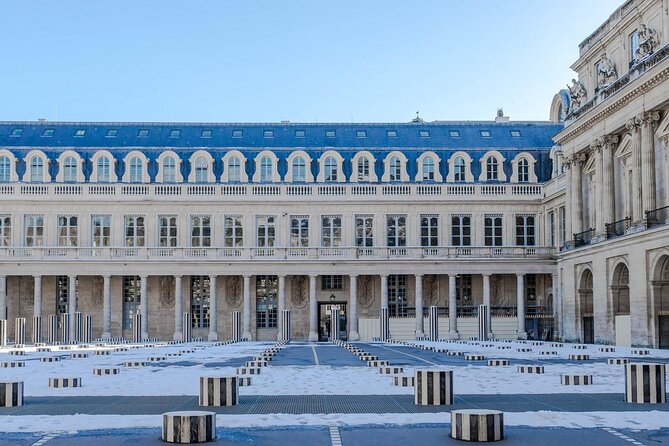
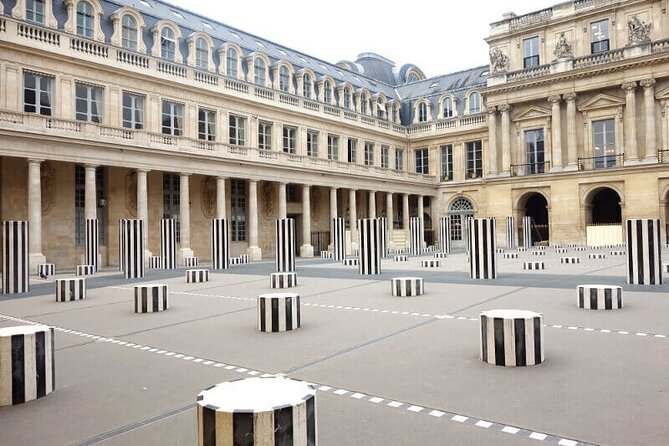
Your first stop is Jardin du Palais Royal, tucked near the Louvre, and it’s famous for being both central and slightly secretive. It was ordered by Cardinal de Richelieu in 1633, and the palace was built close to the Louvre so Richelieu could stay near the king. In other words: this wasn’t a decorative gesture—it was political convenience.
What makes this stop work on a fashion-and-style tour is the setting. The Jardin du Palais Royal sits amid a cluster of institutions: things like the Constitutional Council, Ministry of Culture and Communication, Comédie-Française, and Théâtre du Palais Royal. That mix matters, because luxury neighborhoods in Paris are rarely just about boutiques; they’re about culture and influence sharing the same air.
If you’re looking for your bearings fast, this is a great place to do it. You get a sense of scale and placement, and the garden gives you a calmer moment before the tour turns into street-level style.
This stop is also simple in the logistics: admission ticket is free, and the time here is about 20 minutes. You don’t need to rush or plan an extra entry.
La Comédie-Française: Molière and why this theatre still sets tone
Next you shift from garden calm to theatre prestige at La Comédie-Française. The big story you’re meant to take away here is Molière—his plays have been translated into major languages and are still performed at the Comédie-Française more often than those of any other playwright.
The reason that detail is more than trivia: the Comédie-Française is described as the oldest active theatre company in the world. When something has that long a runway, it shapes more than stagecraft. It shapes taste—what audiences consider classic, what performers consider standard, and what Paris considers worth preserving.
This stop is short—about 5 minutes—and that’s fine. The value is in the connection: how Paris builds continuity around style and art. Even if you never buy a ticket to a performance during your trip, this quick framing helps you read the city differently.
And like the garden, this one is free to approach on the tour.
Rue Saint-Honoré and Eglise Saint-Roch: façades, fashion, and the Paris you feel in your feet
After theatre, you move to Rue Saint-Honoré, and here the tour leans hard into fashion. This is a 1,840-meter (6,036 feet) stretch linking the heart of Paris to the 8th arrondissement, known for its trendy side. The guide’s angle is that you’ll find more than shops: cultural and historical sites and “artistic jewels” along the way.
It’s also visually important. The tour description calls out Haussmann-style façades, which is the key to understanding why this street looks and feels like Paris even when you’re surrounded by luxury names. If you pay attention while walking, you’ll start seeing how these façades set the stage for boutique storefronts—stone framing the commerce.
You’ll spend about 25 minutes here, which is long enough to slow down. Use the time to do something practical: look up at the building lines, then look down at the rhythm of entrances. That’s how Paris fashion streets work. They’re not just product—they’re choreography.
Then you pause at Eglise Saint-Roch, one of the larger churches in Paris. It’s 126 meters long, and its plan is inspired by Notre-Dame-de-Paris. Because construction took decades, you can see a mix of architectural styles, including classical and baroque elements.
Why include a church on a fashion-and-jewellery walk? Because Paris luxury doesn’t live in a vacuum. It’s connected to patronage, religion, civic wealth, and the “serious” side of the city’s design. A church like Saint-Roch gives you a baseline for what grandeur looks like when it isn’t trying to sell you a bag.
This stop is about 15 minutes and free.
Small consideration: churches can be quiet and sometimes crowded, so if your timing is sensitive, keep your pace steady and be ready to listen while stepping aside for visibility.
Place-Vendôme: Louis XIV, Napoleon, and the square built for jewellery
Then comes Place-Vendôme, one of those Paris squares where you can feel layers. It was laid out in 1702 as a monument to Louis XIV and his armies. Later, it was replaced by the Vendôme Column, modeled after Trajan’s Column in Rome, celebrating Napoleon Bonaparte’s victory at Austerlitz in 1805.
So yes, you’re in a square today known for luxury boutiques, especially jewellery, but the tour makes sure you understand the “why” behind the branding. Luxury locations often sit on top of prestige—either literal monuments or symbolic ones. This square is prestige made vertical.
You’ll spend about 20 minutes here. That time is enough for two useful things:
1) to understand the column story as a cultural marker
2) to look at how jewellery boutiques benefit from the open-square visibility and the classic, symmetrical design around you
It’s a stop that can satisfy two types of travelers: the history person and the shopper-at-heart. Even if you don’t plan to buy anything, it helps you see luxury retail in its architectural setting.
Admission on the tour is free.




Palais Garnier: the exterior story is included, the interior is your decision
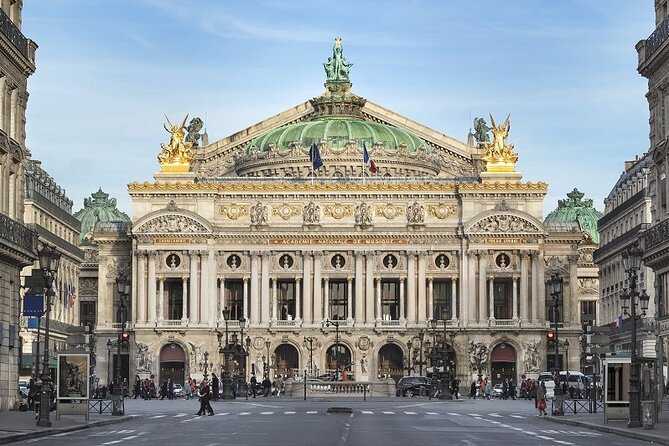
Your next anchor point is Palais Garnier, the glamorous Paris Opera House. This part matters for your theme because it’s designed like a public monument to taste.
Commissioned by Emperor Napoleon III as part of his plan to rebuild Paris, it involved a competition for the best design in 1860. The venue has long served as a centre of cultural excellence, hosting high-profile operas and ballet.
Here’s the practical thing: your tour covers the walk past and surrounding context, but visit inside of the Opera house is not included (priced separately at 14 euro). That means you should think in advance about what you want from this stop:
- If you want the architecture and the neighborhood story, the tour does the job without extra planning.
- If you want the interior experience, budget the add-on so you don’t feel rushed when the moment arrives.
The time you get near Palais Garnier is about 25 minutes, which helps you take in the building’s scale and details from the outside. And since your tour ends here, it’s also a clean way to set yourself up for whatever you want next—dinner, photos, or heading deeper into the Opéra district.
Musée du Parfum – Fragonard: why perfume fits a fashion walk
The last stop is Musée du Parfum – Fragonard, very close to Opéra Garnier. This museum is described as a one-of-a-kind concept: it brings to life the making of perfume as a luxury object that’s now part of everyday life.
This is a smart match for a tour about fashion and jewellery because scent is another form of personal style. Fashion can be seen; perfume lingers. Together, they tell a fuller story of luxury culture: not just what people wear, but what they choose to signal about identity.
The museum’s collection traces perfume history from Ancient Egypt to the 20th century, using ancient bottles and themed items. Examples mentioned include kohl pots, pomanders, vinaigrettes, perfume burners, pots-pourris, travel sets, smelling salt bottles, and precious flasks.
You’ll have about 15 minutes. That’s not long enough for slow wandering, but it’s plenty for building a mental map. If you tend to remember details visually, this stop works well because the objects are specific and varied.
Admission on the tour is noted as free.
Price and practical value for $74.49
At $74.49 per person for roughly 2 hours 10 minutes, you’re not paying for one single attraction. You’re paying for a guided thread that connects several categories:
- power and institutions (Palais Royal and surrounding cultural/government buildings)
- art form legitimacy (Comédie-Française and Molière)
- fashion retail streets (Rue Saint-Honoré)
- architectural grandeur (Saint-Roch)
- luxury location storytelling (Place-Vendôme and its monument roots)
- opera grandeur (Palais Garnier, mainly outside on this tour)
- luxury objects made understandable (Fragonard perfume museum)
Only one “big ticket” element is missing: the Palais Garnier interior. Since that’s 14 euro extra, you can treat the tour as a flexible menu. If you’re on the fence about interior access, you haven’t been forced into paying for it.
Also, the group size helps your value. With a maximum of 5 travelers, you get the benefit of a guide who can steer you toward what matters in each spot. For a theme like fashion/jewellery/opera, that’s the difference between collecting sites and actually understanding the neighborhood.
Who should book this walk
This tour fits best if you want:
- a tight overview of the Opéra area without juggling multiple tickets
- a guide who connects architecture to culture to luxury retail
- a slower, question-friendly format (thanks to the small-group limit)
It’s also a strong choice if you like the idea of opera but don’t want a full, inside-the-theatre plan. You get the story of Palais Garnier’s creation and cultural role, and you can add the interior if that’s your priority.
If you prefer tours that stop constantly for long sit-down explanations, you might want to be aware that the schedule is built for momentum: short stops at key points, with the guide using them to set context quickly.
Should you book this Opéra, Jewellery, Fashion walking tour?
Yes, I’d book it if your goal is to understand Paris luxury as a system: where it lives, why it looks the way it does, and how opera and theatre feed the city’s sense of taste.
You should think twice if you mainly want deep time inside one landmark. Since the Palais Garnier interior is extra, this tour works better as a neighborhood walkthrough than as a single building “tour.”
If you’re curious about perfume objects too, this is one of the nicer ways to end a fashion-and-jewellery route: you don’t just see luxury; you learn how it became a collectible culture.
FAQ
How long is the tour, and what times does it run?
It lasts about 2 hours 10 minutes and starts at 10:00 am.
Where does the tour start and end?
It starts at Le Nemours (Galerie de Nemours), 2 Place Colette, 75001 Paris, and ends at Palais Garnier, Pl. de l’Opéra, 75009 Paris.
What is included in the $74.49 price?
The price includes a walking tour with history and culture explained by the guide.
Is entry to the Palais Garnier interior included?
No. Visiting inside Palais Garnier costs 14 euro and is not included in the tour price.
Are the other museum stops free to enter?
The tour indicates admission tickets are free for the stops listed, including Musée du Parfum – Fragonard, and the other main stops on the route.
How big is the group, and what language is the tour in?
The tour is in English and has a maximum group size of 5 travelers.
Is there free cancellation?
Yes. You can cancel for a full refund up to 24 hours in advance of the experience start time.