REVIEW · PARIS
Somme Battlefields Small-Group Day Trip with John Monash Centre from Paris
Book on Viator →Operated by Paris TRIP · Bookable on Viator
WWI feels uncomfortably close on the Somme.
This full-day trip from Paris takes you to some of the most haunting sites of the Western Front, with a guide who connects the dots between why the battle happened and what it changed. You’ll visit major remembrance places like Delville Wood cemetery and the Australian-focused stops around Villers-Bretonneux, with time to look up, read names, and understand the scale.
I love two things most. First, the Sir John Monash Centre is a smart way to start the day: interactive, multimedia, and built around an Australian perspective. Second, I like the pace at the memorials and cemeteries, where you can absorb what you’re seeing instead of just rushing from photo point to photo point.
One consideration: this is long and emotionally heavy. The tour starts early, runs in all weather, and keeps moving through multiple sacred sites—so if you want lots of silence, you’ll need to be ready to manage your expectations in a small group.
In This Review
- Key things that make this Somme tour worth your time
- Why the Somme works as a day trip from Paris
- Morning departure: what the early start really means
- Sir John Monash Centre and Villers-Bretonneux: the Australian lens
- Pozières and Mouquet Farm: villages you can almost feel under your feet
- Delville Wood cemetery at Longueval: where the day gets heavy
- Lochnagar Crater: the preserved blast you can stand beside
- Thiepval Memorial, Ulster Tower, and Beaumont-Hamel: missing men and preserved trenches
- Historial in Péronne: museum time that ties the stops together
- Price and value: what $294.36 gets you in the real world
- Who this tour suits best (and who might want a different pace)
- Should you book the Somme Battlefields with John Monash Centre?
- FAQ
- How long is the Somme Battlefields day trip from Paris?
- What time do we meet and where is the meeting point?
- Where does the tour end?
- Is food included?
- What group size should I expect?
- Is transport included?
- Are site tickets included?
- Does the tour run in bad weather?
- What if I’m late to the meeting point?
- Can I cancel for free?
Key things that make this Somme tour worth your time
- Small-group feel capped at eight for personalization, with a maximum of sixteen people
- Australian Remembrance Trail focus built around the John Monash Centre in Villers-Bretonneux
- Delville Wood cemetery for more than 5,500 fallen soldiers laid to rest
- Lochnagar Crater preserved as a memorial, about 330 feet (100 meters) across
- British and Irish memorial stops at Thiepval Memorial and Ulster Tower
- Historial in Péronne with over 50,000 WWII-era objects spanning military and civilian wartime life
Why the Somme works as a day trip from Paris
A Somme day trip is one of those rare travel choices where the distance actually helps. You’re leaving Paris early, driving north, then spending the rest of the day in the same region where the battle unfolded—so the story stays grounded in real terrain, not just textbook images.
This tour is also built around remembrance, not sightseeing. You’re walking near cemeteries and memorials where people still come to pay respect. That matters because the Somme isn’t just “WWI history.” It’s a place where names, dates, and loss remain intensely present.
And you’re not only seeing one national viewpoint. The itinerary balances French and British sites with a strong Australian thread, especially in the Villers-Bretonneux area.
You can also read our reviews of more tours and experiences in Paris



Morning departure: what the early start really means
You meet at Le Duplex2 bis Av. Foch in central Paris at 6:50 am, then head north by air-conditioned minivan. Expect an 11-hour day (approx.), with the return drive bringing you back in the early evening.
That early start is the trade-off that makes the day possible. If you’re the type who hates van rides and just wants a quick look, you might feel it. But if you want the kind of day where you can walk, read, and reflect at each stop, the schedule works.
This is also a tour that keeps an eye on practicality:
- It operates in all weather, so bring layers.
- It’s designed for moderate physical fitness. You’ll be on your feet and walking short-to-medium distances at multiple sites.
- The group will not wait if you arrive late, and missing the tour means no refund.
Sir John Monash Centre and Villers-Bretonneux: the Australian lens
Most WWI tours can feel like a long list of dates. The Sir John Monash Centre is different. It’s set on the grounds of the Villers-Bretonneux Military Cemetery, right next to the Australian National Memorial. That location alone ties the exhibitions to the names you’ll see outside.
You get about one hour here. Admission is free, and the center uses interactive multimedia installations to explain the Australian Western Front experience. It’s a helpful “set-up” because it gives your brain a framework before you walk into the cemeteries and the craters.
A short time later, you’ll be in the cemetery area for the Australian National Memorial. This memorial formally commemorates 10,729 Australian servicemen who fought in France and Belgium during the First World War. There’s also a tradition tied to Anzac Day on April 25: a Dawn Service is held there each year.
I like this pairing because it does two jobs at once:
1) It explains the context before the sites hit you emotionally.
2) It gives you a place to understand why so many Australians still treat this part of France as personal ground.
Pozières and Mouquet Farm: villages you can almost feel under your feet
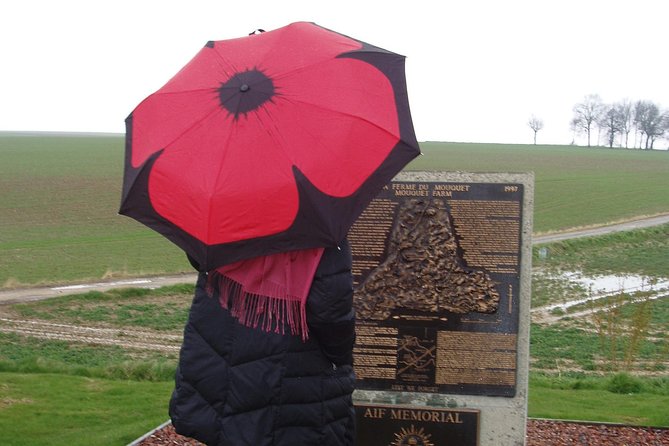
The Somme wasn’t fought only on big “battlefield” maps. It was fought in places that had buildings, blockhouses, and trenches—then those places became the prize.
On this tour, you’ll focus on Australian actions around Pozières and Mouquet Farm, including the land and positions tied to holding ground during mid-1916 fighting. Even if you don’t know the details yet, the guide can help you visualize why these locations mattered and why the struggle was so punishing.
There’s a specific stop for the 1st Australian Division memorial, close to the ruin of the Gibraltar blockhouse. This memorial ties to the Australian attack that took, held, and fought for Pozières village from 23 to 26 July 1916. It commemorates officers, non-commissioned officers, and men of the First Australian Division who fought in France and Belgium in 1916.
One practical tip here: take a minute to look at the terrain, then look again at the explanations. The names on memorials can feel abstract until you match them to the shape of the land.
Delville Wood cemetery at Longueval: where the day gets heavy
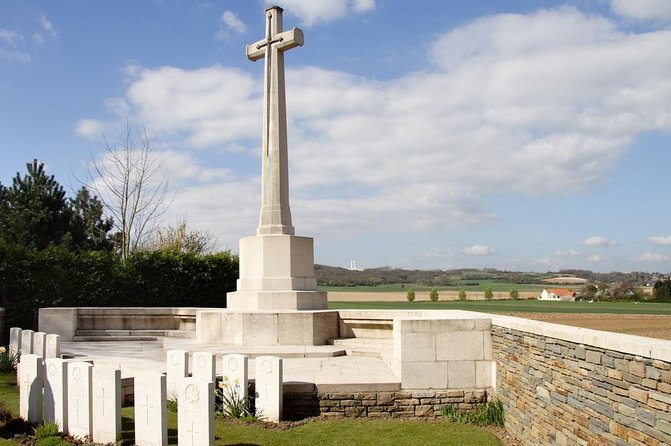
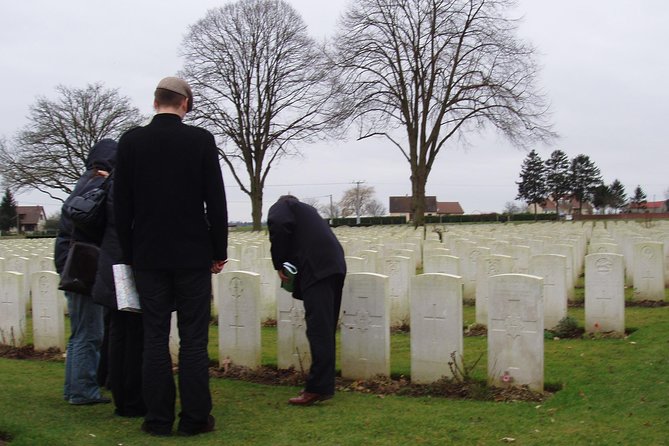
Delville Wood cemetery is one of the stops that most directly turns the history into something you can feel. The cemetery is the final resting place for more than 5,500 soldiers from World War I.
This is a “slow down” stop. You’ll be walking among graves and memorial stones, and the guide’s job is to connect what you’re seeing to why it matters—without turning it into a lecture that drowns out the moment.
I recommend you set an internal rule for yourself here: read fewer names, but read them carefully. If you try to read everything, you’ll get overwhelmed and move too fast. Better to pick a small section and sit with it for a couple of minutes.






Lochnagar Crater: the preserved blast you can stand beside
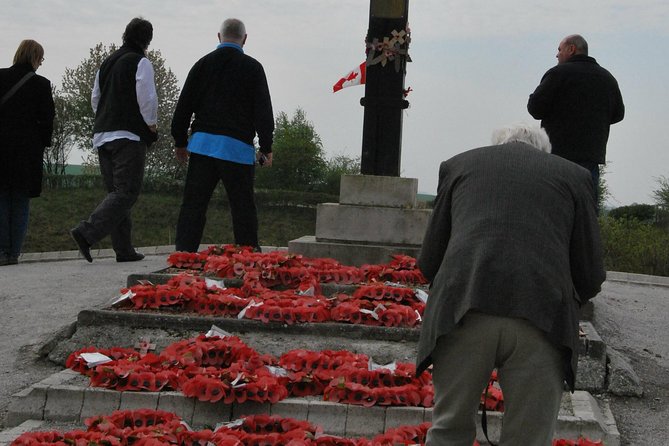
Next up is the Lochnagar Crater—an enormous mine crater preserved as a memorial. The scale is hard to grasp until you’re there: about 330 feet (100 meters) across.
You’ll see a crater that still looks like impact rather than history. And that’s part of the point. This is what industrial-scale war did to the ground and why battlefield memories linger even after the fighting stops.
There’s also a clearer reason to include Lochnagar in an itinerary like this. You can visit memorials and cemeteries all day, but without one “physical event” landmark, the story can stay too symbolic. The crater gives you an anchor.
Admission here is included, so you’re not juggling ticket hassles mid-day.
Thiepval Memorial, Ulster Tower, and Beaumont-Hamel: missing men and preserved trenches
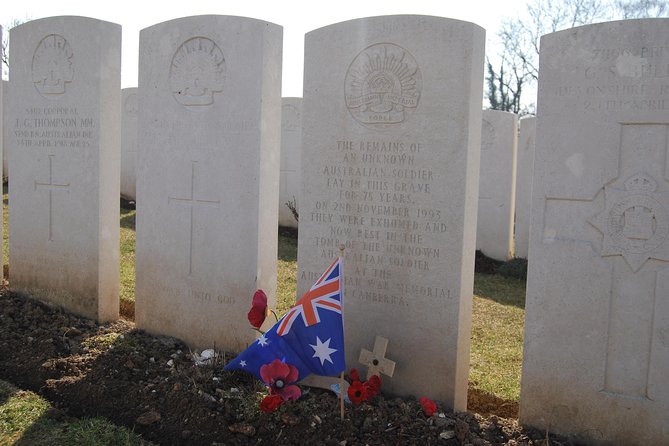
The Somme is full of names—but it’s also full of people who were never found. That’s where the British memorials matter.
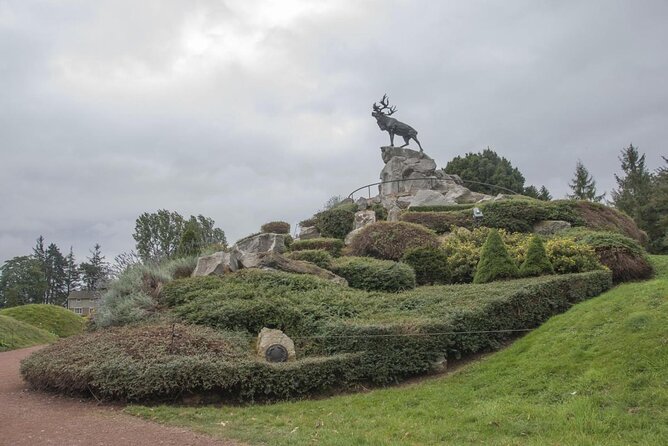
At the Thiepval Memorial, you’ll see the memorial dedicated to missing British soldiers. It’s one of those places that reminds you what “no known grave” really means in human terms. Near it, you’ll also encounter the Ulster Tower—a key part of the British and Irish remembrance landscape on the Somme.
The tour also includes the Beaumont-Hamel area and the Newfoundland memorial sites. You’ll be able to visit well-preserved battlefield grounds and trenches associated with the memorial area. This is where the day shifts again—from remembering loss in cemeteries to standing at terrain shaped by the battle’s mechanics.
If you’re someone who likes structure, here’s a good way to pace yourself at these stops:
- Walk forward to see the trenches/land first.
- Then read the memorial details second.
- Finally, step back and look at the whole scene again.
That order helps the facts land in the right place.
Historial in Péronne: museum time that ties the stops together
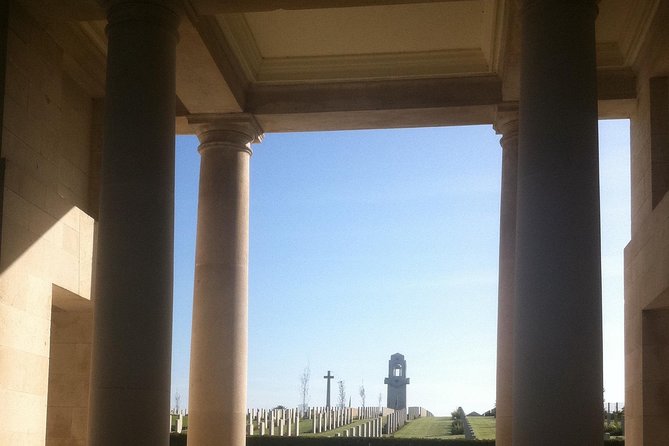
By late afternoon, you’ll likely feel the emotional weight of the morning. This is where the Historial in Péronne helps.
This museum focuses on the Great War and is set up to show the origins and aftermath of the conflict. It also shows wartime life for both military and civilian communities. You’ll see more than 50,000 historic objects, which range beyond uniforms and weapons into the broader texture of daily life.
I like museum time on battlefield tours because it gives your brain a place to organize what you’ve absorbed outside. You’re not just “seeing sites.” You’re building a mental timeline.
Plan for this stop to feel like a reset. Even if you don’t read every display label, you can still watch for patterns: how the battle escalated, what technology changed, and how communities lived with the war long after headlines moved on.
Price and value: what $294.36 gets you in the real world
At $294.36 per person, this isn’t a cheap day trip. But it’s also not just a minivan ride with a vague overview.
Here’s where the value comes from:
- Small-group format keeps the day more personal and easier to follow.
- Transport by air-conditioned minibus handles the long road north without you driving or figuring out parking.
- An English-speaking driver/guide runs the day, which matters for a battlefield itinerary where context is everything.
- Key site admissions are included—specifically the Thiepval Memorial and Lochnagar Crater.
- Other major stops are free, including the Sir John Monash Centre and the Australian National Memorial.
Food and drinks aren’t included, which is worth planning for since the day is long. Bring snacks if you’re the type who gets hungry early, then plan on buying lunch if there’s a break time during the route.
Also, this tour uses a mobile ticket, which is one less thing to manage once you’re on the ground.
In plain terms: the price feels fair if you care about understanding the battle, not just checking off locations.
Who this tour suits best (and who might want a different pace)
This is a strong match if you:
- Want a focused day in the Somme region without coordinating trains and transfers.
- Appreciate memorials and cemeteries and want a guide who can explain the causes and consequences.
- Prefer a smaller group size so you can hear details and ask questions.
It’s also a particularly good fit if you connect personally to Australian history of WWI, because the Villers-Bretonneux stops and the Monash Centre framing are a core part of the day.
Where it may not fit as well:
- If you want lots of free time to wander alone for hours, you might find the schedule tight.
- If you need very quiet moments at cemeteries, be prepared for the realities of a guided group experience.
Should you book the Somme Battlefields with John Monash Centre?
If your goal is to understand the Somme in one full day, while paying respect in a way that feels grounded, I think this is a solid choice. The combination of Monash Centre multimedia context, cemetery time at Delville Wood, and major memorials like Thiepval and Lochnagar Crater gives you both meaning and physical place.
I’d book it if you can handle an early start, lots of walking on uneven ground, and a heavy emotional theme. If you’d rather keep it lighter or you dislike structured itineraries, you might prefer a slower, more flexible battlefield route.
FAQ
How long is the Somme Battlefields day trip from Paris?
It’s about 11 hours long.
What time do we meet and where is the meeting point?
You meet at 6:50 am at Le Duplex2 bis Av. Foch, 75116 Paris.
Where does the tour end?
The tour ends at Arc de Triomphe, Pl. Charles de Gaulle, 75008 Paris.
Is food included?
No. Food and drinks are not included.
What group size should I expect?
The tour is described as a small-group experience up to eight people, and it also lists a maximum of 16 participants.
Is transport included?
Yes. You travel by air-conditioned minivan.
Are site tickets included?
Admission is included for Memorial de Thiepval and Lochnagar Crater. Sir John Monash Centre and the Australian National Memorial are listed as free.
Does the tour run in bad weather?
Yes. It operates in all weather conditions, so dress appropriately.
What if I’m late to the meeting point?
The group will not wait if you are late, and if you miss the tour due to a delay you won’t be entitled to a refund.
Can I cancel for free?
Yes. You can cancel for a full refund up to 24 hours before the experience starts.