REVIEW · PARIS
3 day Private Omaha Utah Full D Day Mont Saint Michel by Mercedes
Book on Viator →Operated by Clewel Travel · Bookable on Viator
Paris to Normandy in style: a Mercedes run. This 3-day private experience packs the big D-Day sites into a smooth, car-based route, with a real sense of place and story—plus a stop at Mont Saint-Michel and a Calvados tasting. I particularly like the live-guided approach that connects what you see to what happened, and I like the way the schedule balances major memorials with time to breathe. One thing to consider: the days are busy and you’ll be in transit a lot, even though it’s comfortable.
In the kind of service Clewel Travel provides on this trip, the guide details matter. One guide named Cyrus made extra stops for what interested us and explained events so the beaches felt understandable, not just dramatic. Another guide named David stayed close through practical moments, helping when language was a barrier at meals, while still keeping the whole day moving.
In This Review
- Key highlights you’ll feel right away
- Private Mercedes Transfer from Paris: fast, comfortable, and actually easy
- Caen Memorial and British Sword Beach: the human story before the shoreline
- Omaha Beach and Pointe du Hoc: where the day turns intense
- Utah Beach, Sainte-Mère-Église, and the Airborne Museum: the story with wings
- Mont Saint-Michel Abbey plus Calvados: medieval awe, then apple brandy education
- Price and value: what your money is really paying for
- Who this tour fits best (and who should think twice)
- Should you book it?
- FAQ
- Is hotel pickup in Paris included?
- Is this a private tour?
- What vehicle do you use for transportation?
- Which museums or major sites are included?
- Are meals included?
- Do you get to experience the Airborne Museum night jumps?
- Is Calvados tasting included?
Key highlights you’ll feel right away
- Private Mercedes transport: Mercedes E220 for 2 people or a Mercedes minivan for 3 to 7, with hotel door pickup in Paris
- Caen Memorial + Arromanches viewpoint: British Sword Beach context paired with the Mulberry Harbour story
- Omaha Beach, Overlord Museum, and Pointe du Hoc: classic stops grouped efficiently, with time to look, not just pose for photos
- Airborne Museum night-jump experience: a C-47 hyperreal simulation that turns history into a sensory moment
- Mont Saint-Michel Abbey plus Calvados tasting: end with one of France’s most famous medieval sights and an apple-brandy education
Private Mercedes Transfer from Paris: fast, comfortable, and actually easy
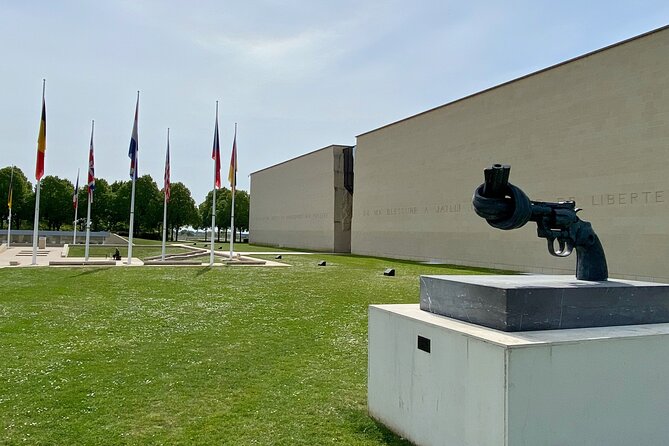
This tour is set up for comfort from the first minute. You’re picked up from the entrance door of your Paris hotel, early (plan on around 7:00 to 7:30am), and whisked by air-conditioned Mercedes E220 if you’re traveling as a couple, or a Mercedes minivan if your group is bigger. It’s a private tour, so you’re not negotiating with other schedules, bathroom stops, or photo-speed chaos.
That vehicle choice matters. Normandy is where you spend time looking down at coastlines and up at memorials, and being able to settle in for the drive makes the long day easier. One rest stop is built into the long route to Caen, which helps you stay fresh for museum time later.
Also note the pacing: you’re not stuck waiting around at every stop. The format is live-guided for the road portion, and you’ll typically be met with clear timing for the major sites. It’s structured enough that you don’t have to plan, but flexible enough that you can ask questions.
You can also read our reviews of more private tours in Paris


Caen Memorial and British Sword Beach: the human story before the shoreline
The first real “anchor” stop is the Memorial de Caen and museum, located in the British Sword Beach sector. This is where you get the big picture, before you start zooming into specific beaches. The museum is described as one of the best World War II museums in France, and it’s designed around both the battle overview and the personal lives of the people involved. There’s also a focused 19-minute film with original historic footage—short enough to keep your attention, but enough to give you context fast.
I like this kind of start for one reason: D-Day can feel like a list of places. Caen helps you turn it into a sequence of decisions, stakes, and losses.
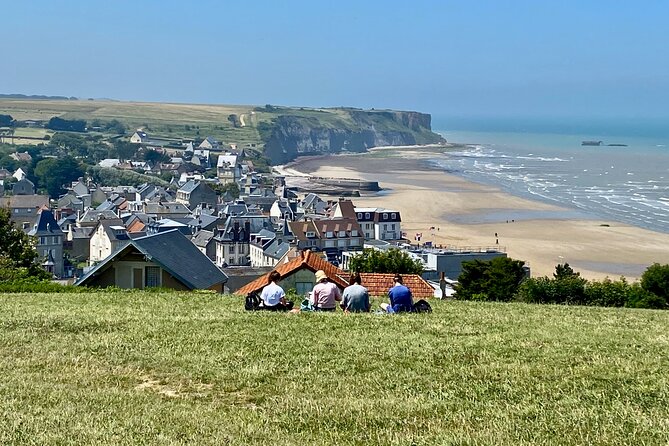
Next comes Arromanches-les-Bains, a small seaside town tied to the Mulberry Harbour artificial port. You’ll take a lunch break here and also see the town’s role in the landings. The Mulberry Harbour detail is exactly the kind of fact that makes later beach sites click—because it explains how the Allies kept supplies flowing even after the first landings.
From there, you head to the Arromanches 360 Circular Cinema. The location on a hill gives you a natural viewpoint, and the “100 days” documentary approach helps connect Operation Overlord’s timeline to what you’re about to see along the coast.
Potential drawback: the early day is museum-heavy. If you prefer lots of outdoor strolling early on, you may feel “museum mode” for a few hours before you reach the beaches.
Omaha Beach and Pointe du Hoc: where the day turns intense
After Arromanches and the cinema, the route shifts toward the most recognizable Omaha-area memorials.
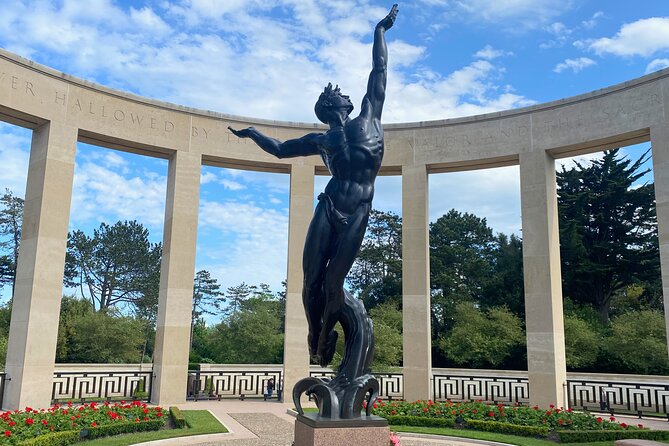
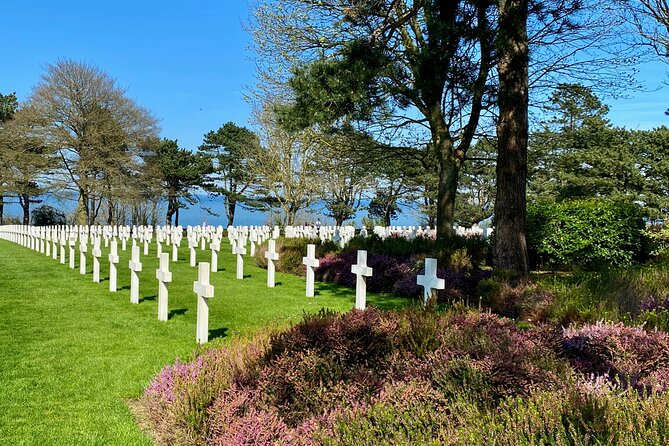
First up is the Normandy American Cemetery and Visitor Center in Colleville-sur-Mer, overlooking Omaha Beach. This cemetery matters for two reasons. One is scale: it contains 9,387 U.S. soldiers, most killed during the Normandy landings, and the Wall of the Missing with names of 1,557 soldiers missing in action. The second is how it’s positioned—built into the cliffs and sightlines that make the beach feel close even from above.
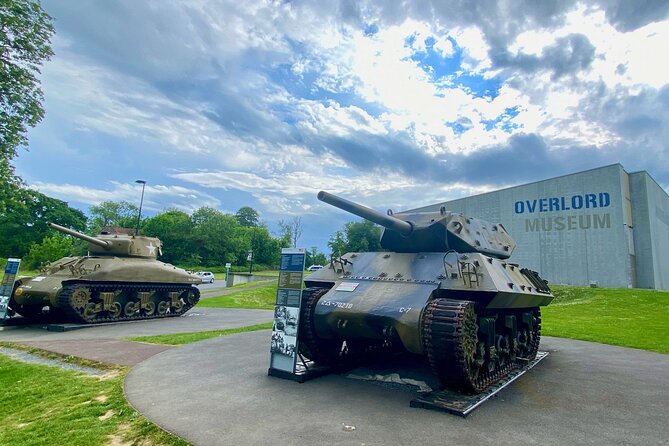
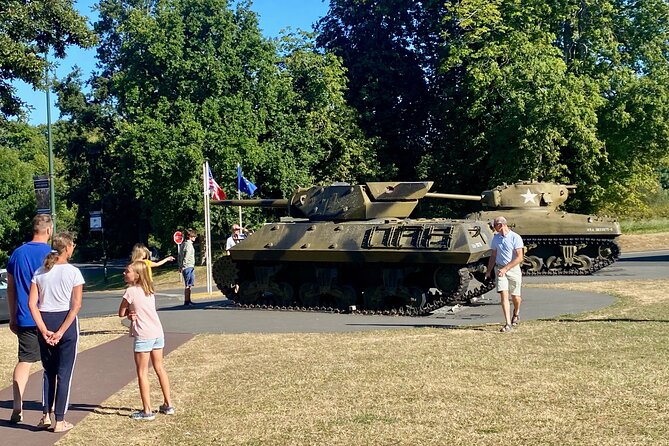
Then you’ll go to the Overlord Museum near Omaha. This is not just a “look at artifacts” stop. It’s built to give you a personal feeling through vehicles, tanks, weapons, installations, and battlefield objects, including things like a V-1 missile and personal belongings.
After that, it’s a short hop to Omaha Beach itself. There’s time to learn about the sacrifice of the 34,000 men who landed there on D-Day. This is also the kind of spot where being in a private car helps—because you can stop, take it in, and then move on without feeling like you’re in a crowd queue.
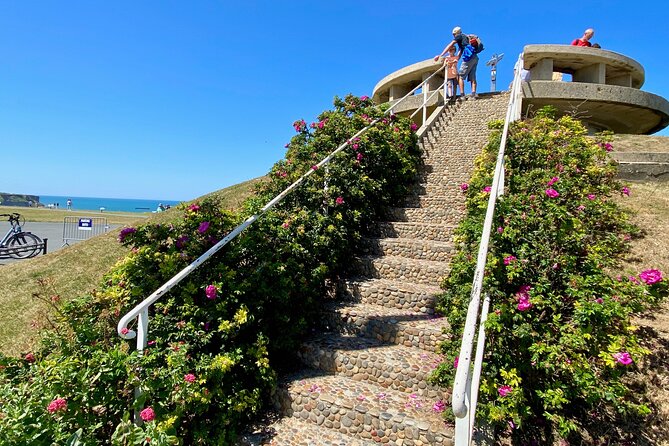
Finally, the day climaxes with Pointe du Hoc, the cliff between Omaha and Utah. It was part of the Atlantic Wall defenses and was important because it could fire upon both beaches. Visiting matters here because you can still see remnants like concrete casemates and gun pits. You’ll also learn about the 2nd Ranger Battalion and the fight to take that key battery—an episode that’s hard to understand from a map alone.
My practical tip: when you’re at Pointe du Hoc, don’t rush the sightlines. The most important lesson is what the terrain allowed—who could see, who could shoot, and why the defenders chose that height.
By the evening, you reach Bayeux for an overnight stay at a 3 or 4 hotel option (breakfast included as part of your tour package). Two nights of accommodation are included overall in double rooms with breakfast, so you’re not just doing day trips; you’re actually based in Normandy.
Utah Beach, Sainte-Mère-Église, and the Airborne Museum: the story with wings
Day two starts in Bayeux and goes to Angoville-au-Plain for a short stop at Saint-Come-et-Saint-Damien church. This quick church visit hits hard because of the field hospital story. During D-Day, medics Robert Wright and Kennith Moore from the 101st Airborne set up a field hospital using the church pews as beds. Blood stains reportedly remain on the pews, and the story also notes how German forces stormed the door but left after seeing both sides being treated and marked the door with a Red Cross.
You then move to Utah Beach and the Utah Beach Landing Museum. Utah’s role is next-door to Omaha, and it’s also one of the Five D-Day landing beaches. You’ll have time to study monuments and the wide, clear shoreline, which makes it easier to picture 6 June 1944. The tour highlights that Utah was stormed first by 23,000 American soldiers and that casualties were relatively light compared with Omaha, including 197 casualties with 60 missing. Even if you know the basics, seeing the place in person gives those numbers weight.
The Utah Beach Landing Museum is set on a former German bunker and includes historical artifacts and military vehicles. One point that stands out is the original B26 bomber—described as one of only six left in existence. That kind of detail is why museums here feel more like historical workshops than generic exhibit halls.
After Utah, you head to Sainte-Mère-Église, made famous by the parachute-drop story tied to John Steele of the 505th PIR. You’ll see the church steeple mannequin set as a tribute, and you’ll learn about Mission Boston and the town being among the first liberated. There’s also the “Milestone of freedom” marked as Borne 00, the spot where General Theodore Roosevelt Jr. landed.
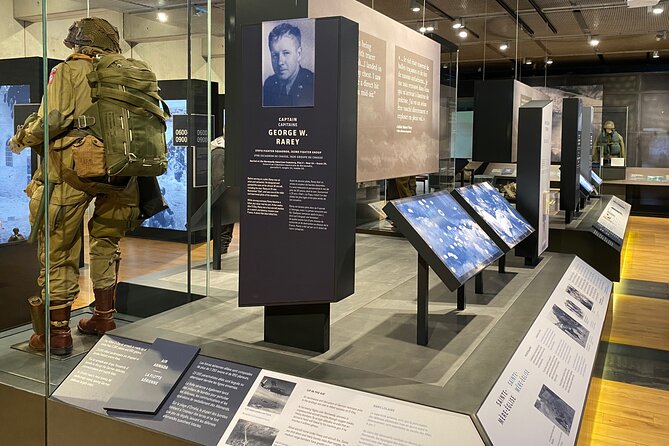
Then comes the heart of the day’s wow factor: the Airborne Museum. It focuses on U.S. paratroopers of the 82nd and 101st divisions and is built across five buildings, two resembling open parachutes. Inside, you’ll find aircraft and touchpad-based experiences, with specific mentions of the only WACO glider copy in France (in a WACO building) and the central C-47 with original legendary aircraft featured in a scenography with deployed parachutes and suspended mannequins.
Most importantly, you get the D-Day Night Jumps experience. The hyperrealist museography lets you join the nighttime embarkation of a C-47 in England, drop into the square of Sainte-Mère-Église during fighting, and follow what follows afterward—then you finish with an American reconnaissance plane, the Piper Cub.
This is the part where you stop treating it like history and start feeling it like a lived event. It’s not a reenactment film you watch from a distance. It’s staged to put you in the middle of the action.
Even with a simulator-style moment, the tour doesn’t ignore reality. It pairs experience with place: you visited Sainte-Mère-Église before, so the museum’s scenes connect to a real steeple and a real town square.
Day two ends with your return to Bayeux for another overnight, so you can rest before the final, longer day out to Mont Saint-Michel and Calvados.
Mont Saint-Michel Abbey plus Calvados: medieval awe, then apple brandy education
Day three is your big “France beyond beaches” day.
You drive from Bayeux toward Mont Saint-Michel. The travel time is about 1.5 hours over 130 km (highway). This stretch sets you up for a major visual shift: from military memorials to one of the most iconic medieval sites in the country.
You arrive around 09:30 and are designed to join the Abbey’s guided visit when possible. If the guided visit isn’t available, you’re provided audio-guides. Either way, you’ll be taken by your guide-driver up the medieval village’s narrow streets toward the top of the island.
From the top, the setting sells itself: panoramic views of the Atlantic Ocean and bay, plus the Abbey fortress dedicated to Saint Michael the Archangel. You’ll hear how it was first settled by humans in 709, and how the Benedictine Abbey construction began in the 700s and continued through the 1200s—then it keeps feeling strangely intact, the way it has since the Middle Ages, serving pilgrims from around the world.
After the Abbey, you get free time for Mont Saint-Michel city and lunch (the tour includes time for it, but meals aren’t included in the package).
Then the route shifts to the coast again, but in a calmer way: Cabourg. You stop there for about an hour, with a chance to stroll and reset your brain after the Abbey crowds and the medieval stair energy.
Next you head to Calvados Pere Magloire L’Experience in Pont-L’Évêque. This is where the tour changes tone once more. You’ll learn how Calvados is made for centuries, then get a Calvados tasting with explanations. It’s a nice way to end a Normandy trip with something that isn’t about war—but still feels rooted in the region.
Finally, you drive back to Paris, dropping you off at your hotel around 20:00.
You can also read our reviews of more tours and experiences in Paris




Price and value: what your money is really paying for
At $2,454.57 per person, this isn’t a budget add-on. But when I map the price against what’s included, it starts to look less crazy and more like “you’re buying time and control.”
Here’s what you’re getting for the cost, in practical terms:
- Door-to-door transfers in Paris plus private Mercedes transport across Normandy
- Live guidance (guide-driver, with guided elements at key museums)
- A set of major admissions included: Caen Memorial, Omaha-area stops, Utah Beach Landing Museum, Airborne Museum, Mont Saint-Michel Abbey, plus the Calvados experience
- Two nights of hotel accommodation in double rooms with breakfast (hotel choice depends on your option)
- A structured route that avoids the hardest part of DIY travel here: coordinating drives between multiple memorial sites and museums
If you’re the kind of traveler who hates hunting for parking, renting multiple vehicles, and piecing together museum hours, this package can feel like real value. You’re also saving energy for the emotional work of D-Day sites. That matters more than people think.
One caution: because it’s a private tour with lots of included stops, it’s best if your group is comfortable with a fast rhythm and long day segments. If you’re hoping for lots of slow wandering and optional detours, this trip may feel like it’s always moving.
Who this tour fits best (and who should think twice)
This is a strong match if you:
- Want a private, guided Normandy trip that hits both the big names and the deeper context stops
- Prefer car-based comfort over trains and carpooling
- Like when history is explained clearly, not just displayed
- Want a Normandy-to-Mont-Saint-Michel combo without extra planning headaches
It may be less ideal if you:
- Crave a relaxed pace with lots of free time between major stops
- Don’t enjoy memorial-heavy days (because the itinerary centers on them)
- Are very sensitive to long drives and early mornings
Should you book it?
If you want Normandy with structure and comfort, I’d say yes. The mix of Caen context, Omaha-area memorial intensity, Utah and the Airborne Museum night-jump experience, then Mont Saint-Michel and Calvados is a smart arc. And the private Mercedes setup plus hotel-base logistics are exactly the kind of thing that turns a stressful self-plan into a smooth trip.
If you’re unsure, decide based on pace. This is a high-contact, high-efficiency route. If that sounds like your style, you’ll likely come away with more than photos—you’ll come away with a clearer picture of how D-Day unfolded and why these places matter.
FAQ
Is hotel pickup in Paris included?
Yes. You’re picked up from the entrance door of your hotel, with an early start around 7:00–7:30am.
Is this a private tour?
Yes. It’s private, and only your group participates.
What vehicle do you use for transportation?
You travel by Mercedes E220 for 2 people, or by Mercedes minivan for 3 or more participants (up to 7).
Which museums or major sites are included?
Included highlights cover Caen Memorial and museum, Normandy American Cemetery & Visitor Center, Overlord Museum near Omaha, Omaha Beach and Pointe du Hoc stops, Utah Beach Landing Museum, Airborne Museum, and Mont Saint-Michel Abbey.
Are meals included?
No. Meals and drinks are not listed as included, though the schedule includes lunch breaks and free time for meals.
Do you get to experience the Airborne Museum night jumps?
Yes. The Airborne Museum visit includes a D-Day Night Jumps experience as a staged C-47 night-drop immersion.
Is Calvados tasting included?
Yes. You visit Calvados Pere Magloire L’Experience and include the Calvados tasting with explanations.