REVIEW · PARIS
Private Normandy D-Day Live guided Top 6 Sites trip from Paris
Book on Viator →Operated by Clewel Travel · Bookable on Viator
This is the fastest way to grasp D-Day. I like the door-to-door Mercedes pickup that keeps you out of rental-car stress, and I also like the quiet, on-your-own pacing at the most emotional sites. One fair heads-up: it is a long day with tight time windows at each stop, so you will not linger forever.
What makes the day work is the mix of big-picture storytelling and hands-on places you can stand in. I especially enjoyed how guides such as Valerie, Diana, Alexandra, Rustam, Jane, and Cyrus (plus their drivers) helped turn the route into a coherent Operation Overlord story, not just a list of stops. If your group is smaller, double-check how “live” your guide time will be, because a lot of the site experience is built for self-paced walking and films.
In This Review
- Key things to know before you go
- Mercedes-to-beach logistics: the real value is not driving
- Comfort note
- Entering the Caen Memorial: Sword Beach context in 90 minutes
- The drawback to consider
- Arromanches: lunch, Mulberry Harbour math, and 360 cinema
- Why Arromanches matters (it’s not just scenic)
- Lunch reality
- 360 Circular Cinema: documentary + viewpoint
- Omaha’s emotional order: American Cemetery first, then the museum
- What makes it feel right
- Omaha Museum: artefacts you can actually picture
- Omaha Beach time: the sacrifice in a short walk
- What I’d do in that 30 minutes
- Pointe du Hoc: cliff gun battery and the Ranger mission
- Why this stop gets the biggest emotional reaction
- Are you really getting a live guide? It depends on your group size
- How the day balances speed with meaning
- Price check: $738.86 per person, and what you’re really paying for
- Who should book this Normandy D-Day day trip?
- A few practical tips before you go
- Should you book this private D-Day trip from Paris?
- FAQ
- What time does pickup happen in Paris?
- How long is the trip from Paris to the first stop?
- What sites are included in the day?
- Is the tour guided in English?
- Are entrance tickets included?
- Are meals included?
- What transportation do you use?
- Is this a private experience?
- How long is the full day trip?
- What is the cancellation policy?
Key things to know before you go
- Mercedes round-trip from Paris: long-distance comfort without navigating northern France yourself.
- Caen Memorial’s film-led start: a fast way to understand the Battle of Normandy before you hit the beaches.
- Arromanches Mulberry Harbour story: a small seaside town tied to the massive logistics of D-Day.
- 360 Circular Cinema viewpoint: documentary footage plus a bay viewpoint over the artificial harbour.
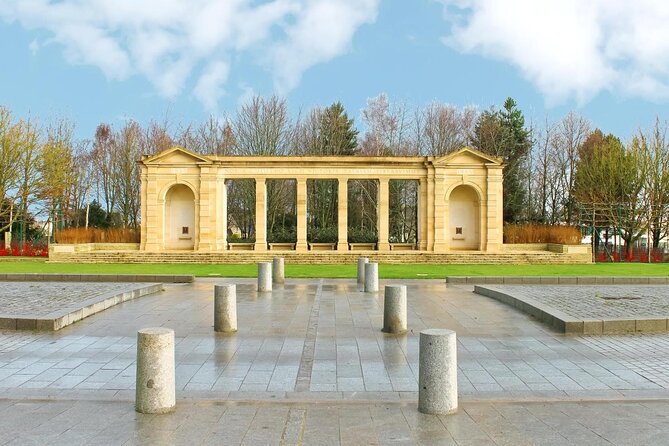
- American Cemetery + Visitor Center first: maps, names, and a museum before you walk Omaha.
- Pointe du Hoc cliffs and bunkers: the Ranger mission made physical on the Atlantic Wall remains.
Mercedes-to-beach logistics: the real value is not driving
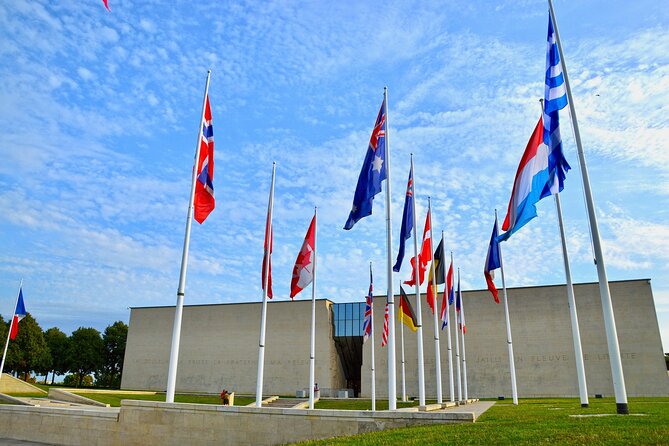
If you’ve ever tried to self-drive the Normandy coast from Paris, you already know the pain points: long highways, changing signage, and parking that can feel like a side quest. This private day trip solves the big one. You leave Paris with a Mercedes E220/E300 business-class car if you’re a smaller party, or a Mercedes minivan if you have more people, then you return the same way. You also get bottled water.
The day starts at 7:30 am with pickup from the reception desk of your hotel in Paris. The trip also notes pickup can be arranged from areas like Caen, Bayeux, or Honfleur, depending on your situation. Either way, you’re set up for an early start, because Normandy’s D-Day sites are time-and-light sensitive.
The route is designed to keep you moving efficiently. The drive from Paris to Memorial de Caen is about 3 hours (roughly 240 km), with one rest stop along the way. Then you do a sequence of sites with short transfers—some as quick as 5 to 10 minutes—before the return drive to Paris of about 3.5 hours (300 km). In practice, that means you’ll see a lot more in one day than if you were trying to do it piece by piece.
You can also read our reviews of more guided tours in Paris



Comfort note
Even when you’re busy, comfort matters. Multiple groups highlighted that the car was clean and felt built for a long day. That matters on this itinerary because you’re not doing one museum and calling it a win—you’re doing museums, beaches, and cliff fortifications.
Entering the Caen Memorial: Sword Beach context in 90 minutes
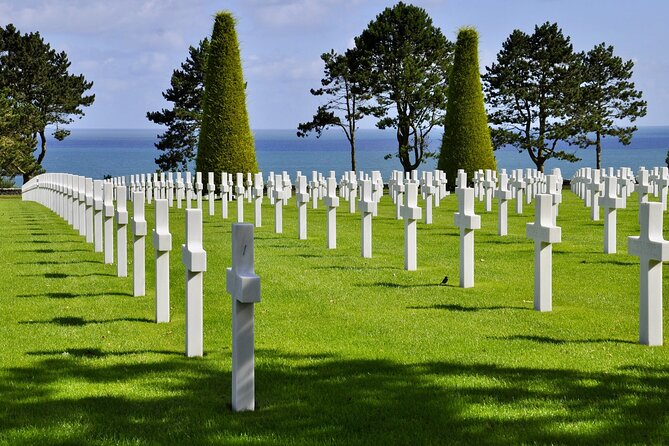
Your first major stop is the Memorial de Caen and its museum, in the British Sword Beach sector. You arrive around 10:30 am, with time until about 12:00 pm.
This is where the day gets its backbone. The museum gives an overview of the Battle of Normandy and also leans into personal lives—what the people experienced, not just the military movements. There’s a 19-minute film using original historic footage, which is a great way to get your bearings fast before you head toward the coast.
Here’s what I think you’ll like most: this stop gives you language for what you’ll see later. When you reach places tied to the British landing sector (and then the American sector), you’re not walking in blind. You’re mapping the “why” behind the “what.”
The drawback to consider
This is a compact first visit, so if you love museum time above all else, you may wish you had longer than the scheduled window. Still, that limited time is the trade you make to hit the rest of the Normandy D-Day highlights in one day.
Arromanches: lunch, Mulberry Harbour math, and 360 cinema
After Caen, you head toward Arromanches-les-Bains, about 30 km and roughly 30 minutes away on national roads. The timing is intentional: you land here around 12:30 pm.
You get two things at Arromanches:
1) A lunch break and town visit (about 1 hour), and
2) A planned cinematic stop on the hill with big views.
You can also read our reviews of more private tours in Paris






Why Arromanches matters (it’s not just scenic)
Arromanches is famous for the artificial Mulberry Harbour. The story is logistical, not just romantic coastal scenery. The Allies built a temporary harbour here to unload vehicles, materials, and people. The day’s information also includes a stark scale: by June 12, 1944, Mulberry Harbour was helping bring 300,000 men, 54,000 vehicles, and 104,000 tons of supplies to Europe.
That number is the kind of detail that makes D-Day click. You start to see it as a giant engineering and supply operation as much as a battle.
Lunch reality
Meals and drinks are not included in the tour price. You’ll be on your own for lunch during the Arromanches break. That’s a good thing if you prefer options, but it does mean you should plan for where you’ll eat within the time window.
360 Circular Cinema: documentary + viewpoint
Around 1:30 pm, you head to the 360 Circular Cinema. The cinema is on the top of the hill, with a viewpoint over the bay where the artificial harbour once operated. You watch a documentary about 100 days of the Battle of Normandy learning in detail about Operation Overlord.
If you’re the type who likes to “see it then understand it,” this is a strong pairing: you get the town context, then you get the wider narrative through film, and then you look back out at the harbour bay.
Omaha’s emotional order: American Cemetery first, then the museum
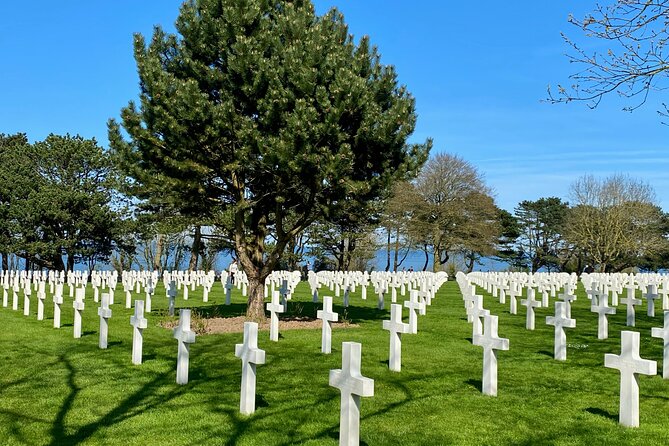
Next you transfer about 20 km to the Normandy American Cemetery & Visitor Center at Colleville-sur-Mer. You’re there roughly 3:00 pm, with time until about 4:10 pm.
This is one of the most moving parts of the entire day, for two reasons.
First, the scale is personal. The cemetery contains 9,387 U.S. soldiers, and there’s the Wall of the Missing with the names of 1,557 soldiers missing in action. It’s not abstract.
Second, the Visitor Center gives you context before you step onto Omaha-connected ground. There are large maps of military operations, a semicircular memorial colonnade, and the sculpture Spirit of American Youth Rising from the Waves. The small museum inside the Visitor Center is also described as having lots of information.
What makes it feel right
The itinerary schedules the cemetery before you go to the beach. That order helps. You absorb the names and maps first, then you walk into the physical geography tied to those losses.
Omaha Museum: artefacts you can actually picture
After the cemetery, you move to Overlord Museum around 4:10 pm and spend about 30 minutes there. This museum focuses on WW2 artefacts and installations, including tanks, weapons, guns, military vehicles, a V-1 missile, and personal belongings.
The point here isn’t to “collect facts.” It’s to make the war objects feel real. Once you’ve seen tanks and personal belongings in a museum setting, the beach landscape stops being a stage and starts being a place where people were carrying out impossible tasks under fire.
Omaha Beach time: the sacrifice in a short walk
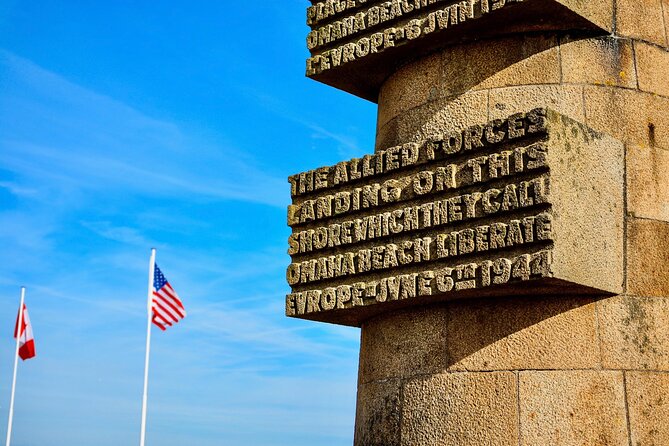
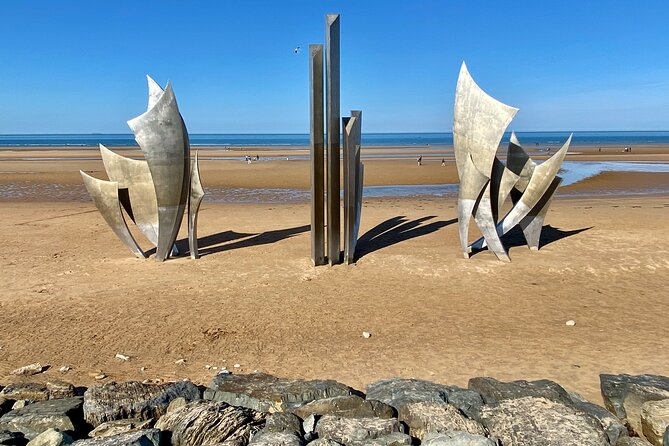
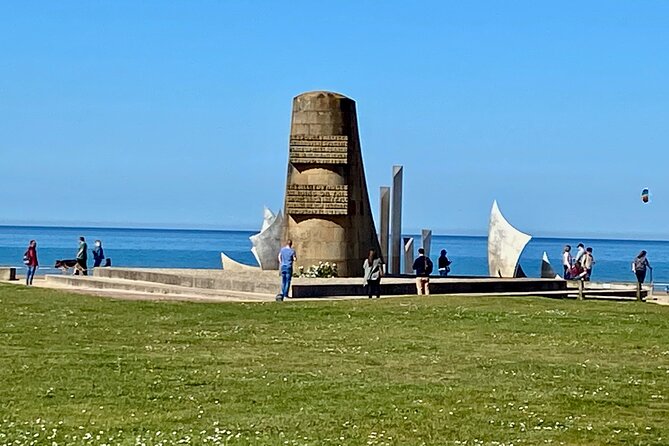
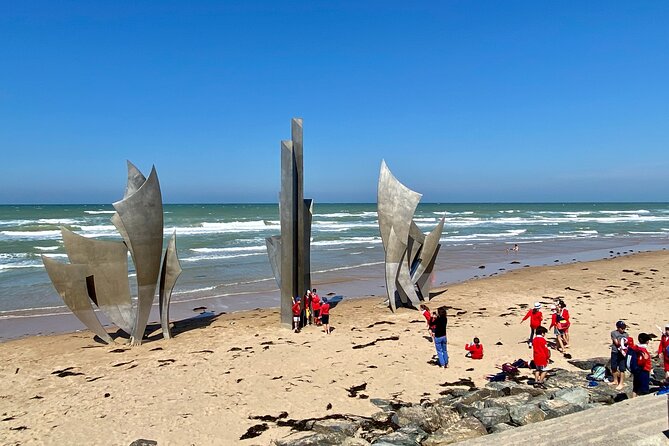
You then head to Omaha Beach, just 5 to 10 minutes away. You arrive around 4:50 pm and have about 30 minutes.
This time is short, but it’s designed for impact. You learn about the huge sacrifice made by the 34,000 men who landed here on D-Day. Omaha is also noted as one of the most popular traveller destinations of the D-Day beaches, so having an organized arrival window is useful. You’re not trying to guess when the best moments for photos and quiet walking will happen.
What I’d do in that 30 minutes
I’d do two things: walk slow for the first half, and then use what you saw in the cemetery and museum to interpret what you notice along the shore. The day has set you up to see cause and effect now—where defenses were, why certain areas mattered, and what “landed here” actually implies.
Pointe du Hoc: cliff gun battery and the Ranger mission
At about 5:20 pm, you leave Omaha area and drive roughly 10 km to Pointe du Hoc, arriving around 5:30 pm. You get about 1 hour here.
Pointe du Hoc sits on cliffs between Utah and Omaha beaches. The whole point of this site was height. It was the highest land between those sectors, meaning the gun battery could fire upon both beaches. The Atlantic Wall defenses included fortified concrete casemates and gun pits, and the site still has many of the original fortifications and bunkers open to the public.
This is where the day becomes very physical. You’re not just watching history on a screen. You’re looking at what the Rangers had to take, and you can see the defensive structure they fought.
You’re told about the 2nd Ranger Battalion sacrifice to capture this crucial gun battery on June 6, 1944. The fire control casemate on top has a monument to the 2nd Ranger Battalion.
Why this stop gets the biggest emotional reaction
In multiple guide-led moments, people flagged Pointe du Hoc as a standout because it’s dramatic in terrain and in mission purpose. If you want one place to feel the war’s tactical logic in your legs and eyes, this is it.
One practical note: cliff sites mean you’ll likely do more walking on uneven ground than you might expect from “a beach trip.” Wear shoes you trust.
Are you really getting a live guide? It depends on your group size
The biggest “fine print” for your expectations is how live the guiding will be. The tour description states English is offered, and it mentions live-guided format based on the number of participants (one part of the info says live guided from 4 participants, while the included feature list mentions live-guided from 2 people).
In plain terms: some parts of the day are built to be guided (like the narrative framing and timing), while other parts are designed for you to explore quietly. The Caen museum, the 360 cinema, and the Visitor Center all do heavy lifting with films and on-site media.
Also, one group noted that an English-language mismatch happened when they expected more live guiding at Pointe du Hoc. That doesn’t mean it will happen to you, but it is a reminder to confirm your exact guide setup in your booking message.
How the day balances speed with meaning
This is a “highlights” itinerary. You’re scheduled to move from Caen to Arromanches, then to the American Cemetery and Overlord Museum, then to Omaha Beach and Pointe du Hoc, and finally back to Paris. Some stops include tickets and timed windows, while others are about time to absorb.
You’ll get:
- museum and film context early (Caen),
- logistics and documentary storytelling mid-day (Arromanches + 360 cinema),
- emotional grounding before the beach (American Cemetery),
- objects that make the war feel physical (Overlord Museum),
- short but meaningful beach walking (Omaha),
- and the tactical cliff story (Pointe du Hoc).
That pacing is the trade-off for seeing so much in one day. If you’re the type who wants one site for 3 hours, you’ll feel rushed. If you want the best Normandy D-Day highlights without the stress of planning driving routes, you’ll likely feel satisfied.
Price check: $738.86 per person, and what you’re really paying for
At $738.86 per person, this is not a budget outing. But you are paying for several things that add up quickly on your own:
- Round-trip private transportation from Paris with a Mercedes (not a shared bus),
- long-distance driving handled for you (about 650 km total),
- admission tickets at major stops (Caen Memorial and Museum, 360 cinema, Normandy American Cemetery + Visitor Center, Overlord Museum, Omaha Beach, and Pointe du Hoc),
- and bottled water.
You’re also paying for less stress and more time on-site than you’d likely manage if you were juggling schedules, parking, and ticketing on your own. And because it’s private, it tends to feel more personal. Guides such as Alexandra and Valerie were described as making the day feel like a road trip with friends, not a scripted lecture.
So is it worth it? It usually depends on two things:
1) whether you value not driving yourself, and
2) whether you want the planning and ticket friction removed.
Who should book this Normandy D-Day day trip?
You’ll be a great match if you:
- want to see multiple D-Day sites in one day without a rental car,
- like structure—knowing you’re at the right places at the right times,
- care about both the story (films and museums) and the physical sites (cemetery, beaches, cliffs),
- and you’re willing to accept that it’s a long day.
It’s also a strong option for couples and small groups who want a more intimate experience than a big bus. Several guides and drivers were praised for timing and accommodating the group’s needs.
If you’re travelling with very young kids or you need lots of downtime, this schedule may feel heavy. The day is long, and the stops include walking.
A few practical tips before you go
- Start time is 7:30 am. Plan for an early morning in Paris.
- Bring comfortable walking shoes. Pointe du Hoc is cliff territory.
- Meals aren’t included. Use the Arromanches break to plan your lunch.
- Expect emotional moments at the cemetery and Omaha Beach. This isn’t a casual photo stop.
- If you’re relying on live guidance, confirm your guide setup in advance because the info indicates live guiding depends on participant count.
Should you book this private D-Day trip from Paris?
If you want the big Normandy D-Day hits—Caen’s museum context, Arromanches’ Mulberry Harbour story, the American Cemetery’s names and maps, Omaha’s shoreline, and Pointe du Hoc’s cliff gun battery—this private day trip is built for you. You’re buying comfort, timing, and ticket coverage, and you’re not wrestling with northern France driving stress.
Skip it only if you know you want a slower pace at one or two sites, or if you know you won’t tolerate a long, packed day. Otherwise, this is one of the more practical ways to understand Operation Overlord without turning your trip into a logistics project.
FAQ
What time does pickup happen in Paris?
Pickup starts at 7:30 am from the reception desk of your hotel in Paris.
How long is the trip from Paris to the first stop?
It takes about 3 hours (around 240 km) to reach the Memorial of Caen, with one rest area stop.
What sites are included in the day?
You visit Memorial de Caen, Arromanches-les-Bains (including the 360 Circular Cinema), the Normandy American Cemetery & Visitor Center, Overlord Museum, Omaha Beach, and Pointe du Hoc.
Is the tour guided in English?
The experience is offered in English, and it is described as live-guided depending on the number of participants.
Are entrance tickets included?
Tickets are included for Caen Memorial and Museum, Arromanches 360 Circular Cinema, Normandy American Cemetery & Visitor Center, Overlord Museum, Omaha Beach, and Pointe du Hoc. (Lunch town admission in Arromanches is listed as free.)
Are meals included?
No. Meals and drinks are not included, though there is a lunch break in Arromanches.
What transportation do you use?
You travel in a Mercedes E220/E300 business-class car for 2 people, or a Mercedes minivan for 3 to 7 people.
Is this a private experience?
Yes. Only your group participates.
How long is the full day trip?
It runs about 14 hours.
What is the cancellation policy?
You can cancel for a full refund up to 24 hours before the experience’s start time. If you cancel less than 24 hours before, the amount paid is not refunded.