REVIEW · PARIS
Private cruise with Paris water way
Book on Viator →Operated by Paris Water Way · Bookable on Viator
Seine views get better when you steer clear of crowds. This private cruise turns the big Paris sights into a calm, guided 1.5-hour ride with an English-speaking guide.
You’ll enjoy your own group and English narration, plus the simple pleasure of watching Paris slide by from the water.
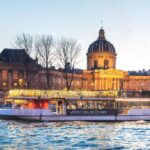
I love the pacing: you go from the quieter Île Saint-Louis to the power-packed Île de la Cité, then keep rolling under iconic bridges toward the Louvre, Orsay, the National Assembly, and the Eiffel Tower area. It’s also family-friendly, with explanations kept clear even for kids (I’m looking at you, Diego). One drawback to plan for: it’s sightseeing from the water, so you won’t be entering museums or churches.
In This Review
- Key highlights you’ll care about
- The value: a private Seine loop that feels like a guided walk, not a tour stampede
- Where it starts: Quai François Mitterrand and what to expect when you board
- Ile Saint-Louis first: a quieter Paris island with big big-city texture
- Then comes Île de la Cité: the ancient heart you can feel in the river bends
- Palais de Justice and the Conciergerie area: power by the water
- Pont Neuf: the oldest existing bridge and your first big bridge underpass moment
- Pont des Arts and the love-lock story: what the city chose after the trend ended
- Louvre from the river: a pass that still gives you art context
- Musée d’Orsay: the station conversion you can feel from the water
- National Assembly pass: where democracy meets the river
- Pont Alexandre III and the grand finale energy
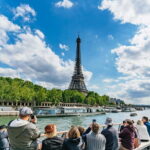
- Eiffel Tower pass: the classic symbol at boat speed
- Price and value: when $94.63 feels fair
- Who this cruise is best for (and who may want a different option)
- Tips to make your cruise day smoother
- Should you book this Seine cruise?
Key highlights you’ll care about
- Private-only group: your time isn’t diluted by strangers, and the guide can keep the pace right for you.
- English narration on a tight route: you see a lot of Paris in about 90 minutes.
- Iconic bridge moments: Pont Neuf, Pont des Arts (love-lock era and its aftermath), and Pont Alexandre III are all built into the ride.
- Art stops without museum tickets: you pass the Louvre and Musée d’Orsay from the river.
- Family-ready explanations: the guide approach can work well for kids, not just adults.
The value: a private Seine loop that feels like a guided walk, not a tour stampede
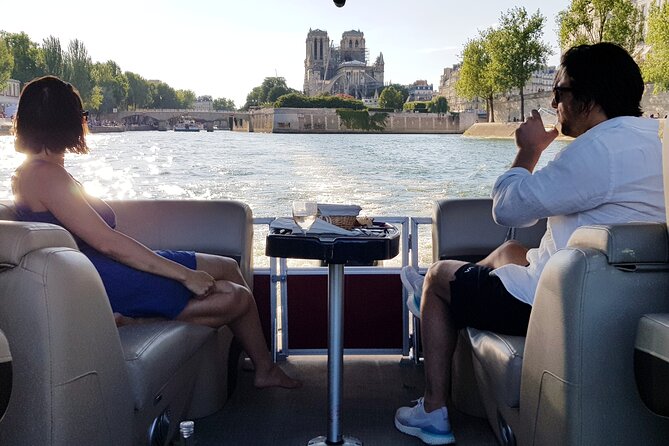
A private Seine cruise sounds fancy, but the real win is practical. You’re moving through central Paris in a straight line, and you’re not stuck in lines, detours, or slow crosswalks. In about 1 hour 30 minutes, you get a stitched-together view of the city’s most recognizable “you can’t miss it” spots.
At about $94.63 per person, the price makes sense when you compare it to what you’d spend on multiple public-transport trips plus the time costs of chasing views on foot. You’re basically paying for: (1) a private boat experience, (2) an English guide, and (3) an efficient route that hits both the medieval core and the classic monuments. If you want a high-confidence sampler of Paris without turning your day into a sprint, this is a strong match.
You can also read our reviews of more boat tours in Paris
Where it starts: Quai François Mitterrand and what to expect when you board
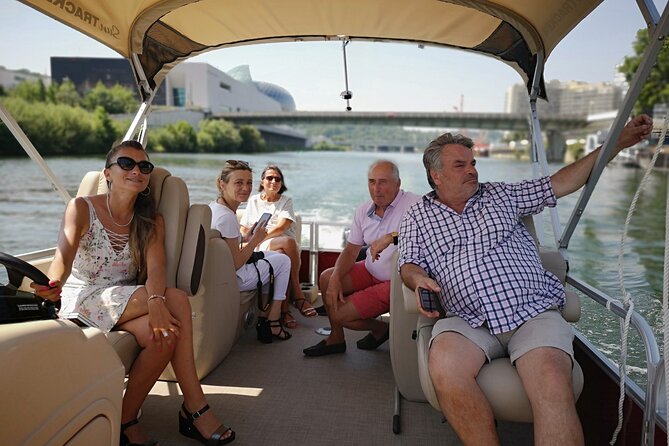
You meet at 14 Quai François Mitterrand, 75001 Paris, and the cruise ends back at the same meeting point. That out-and-back setup helps. You’re not guessing where you’ll end up, and you’re not forced into an extra scramble for transit at the end.
You’ll get a mobile ticket, and the tour is offered in English. The operator is set up for real groups—this is a private tour/activity, meaning only your group is on the boat. Service animals are allowed, and it’s listed as being near public transportation, so you’re not marrying yourself to a single mode of getting there.
Ile Saint-Louis first: a quieter Paris island with big big-city texture
The cruise begins with a passage in front of Île Saint-Louis. This island is one of two natural islands of the Seine still existing in Paris (Île de la Cité is the other). It’s smaller—about 11 hectares—so from the water you tend to get a more intimate view than you might expect for something so central.
What I like about starting here is the mood shift. Île Saint-Louis has that “almost-classic postcard” feel, but it’s also grounded in real Paris geography: it sits just upstream from Île de la Cité. The island’s current name dates from 1725, linked to King Louis IX, nicknamed Saint Louis. Even the legend attached to it—praying in the area and the tragic end of the Eighth Crusade—gives the waterfront a sense of time depth.
You’ll also pass the Lambert hotel, described as one of the most beautiful private mansions on the island. It was bought by Abdallah Ben Abdallah-Al-Thani from Qatar’s princely family, and it suffered a major fire in July 2013. From the Seine, these details matter because they explain why the buildings feel both refined and very much part of modern Paris stories—not just old stone.
Small practical note: because you’re watching from the boat, you won’t be able to stop for photos at exactly the angle you want. Still, this is the kind of stop where the view is good enough to get your shots early, before the cruise moves into the louder monuments.
Then comes Île de la Cité: the ancient heart you can feel in the river bends
Next up is Île de la Cité, the island in the heart of Paris and often described as the ancient cradle of the city—formerly Lutèce. It sits in the 1st and 4th arrondissements, and it’s considered the fortified core of Paris as it existed at the end of Antiquity, reduced down to one island.
A useful way to think about this stop: you’re no longer seeing Paris as “a collection of sights.” You’re seeing Paris as one old idea—power, law, faith, and city life compressed into a single chunk of land in the Seine.
The chronicler Gui de Bazoches even described it in 1190 as the head, heart, and marrow of Paris. That’s poetic, but it also lines up with what you’ll see next: the riverfront around Île de la Cité naturally funnels your attention toward the governance structures you pass downstream.
Palais de Justice and the Conciergerie area: power by the water
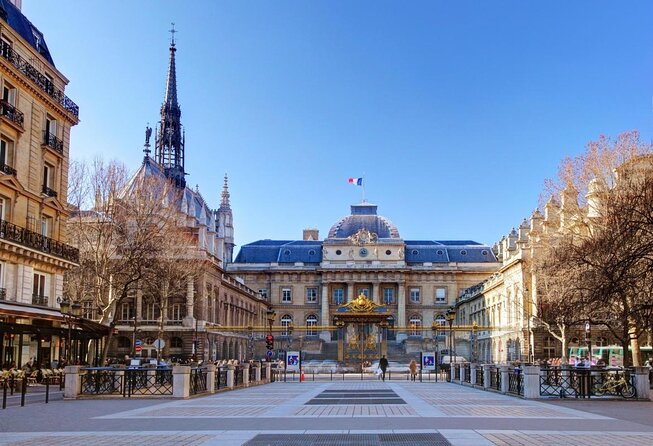
As your route continues, you pass in front of the courthouse area, including the concierge at the courthouse (the Conciergerie is part of the Palais de Justice complex). The Palais de Justice traces back to the Curia Regis, the seat that fed the legal and administrative structure of Paris over centuries.
This is where the cruise stops being purely scenic and turns educational. The Palais de Justice has housed major institutions over time, from sovereign jurisdictions associated with the Parliament of Paris to current high courts. The key point for you: from the Seine, this is a rare chance to see how Paris’ modern civic identity sits on top of medieval power centers.
The complex has been located since its inception in the Palais de la Cité, the royal residence and seat of power from the 10th to the 14th centuries, with vestiges still present such as the great hall and its kitchen, the Conciergerie, the Sainte Chapelle, and several towers.
This matters because the cruise gives you a “where were the decisions made?” view, not just “what famous building is this?”
You can also read our reviews of more private tours in Paris



Pont Neuf: the oldest existing bridge and your first big bridge underpass moment
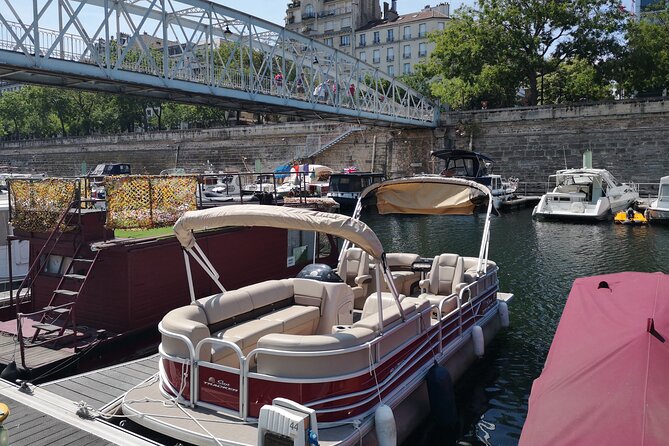
Then you go under Pont Neuf, the oldest existing bridge in Paris. Despite the name, it’s not new at all—this bridge crosses the Seine at the western tip of Île de la Cité.
Pont Neuf was built at the end of the 16th century and completed in the beginning of the 17th. The name comes from what was unusual at the time: it was a bridge without houses, with sidewalks meant to protect pedestrians from mud and horses. It was also the first stone bridge in Paris to cross the Seine entirely.
Two fun practical takeaways:
- You’ll get a clear sense of scale—Pont Neuf feels “engineered” even today.
- It’s a strong anchor point. Once you’ve seen Pont Neuf from the water, it’s easier to orient yourself later on foot.
The bridge has been classified as a historical monument and was listed as part of the UNESCO World Heritage Site that includes the Seine’s quays in Paris.
Pont des Arts and the love-lock story: what the city chose after the trend ended
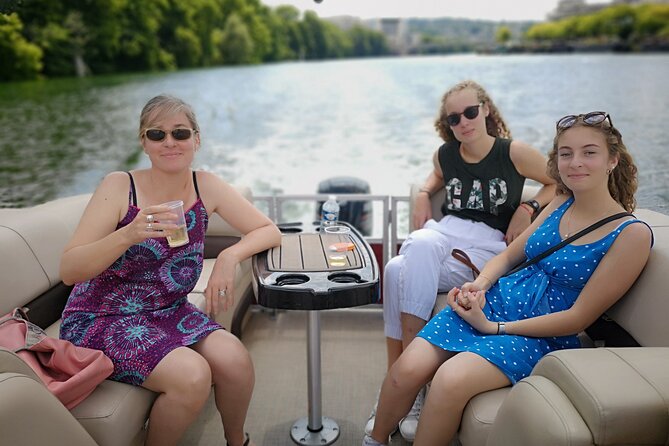
Passing under Pont des Arts is your bridge-and-culture moment. The love-lock craze started in 2008. Wire mesh parapets became the place where couples hung their padlocks, and the practice spread to other nearby bridges too.
The story here isn’t just romance. It’s about how a city handles popular trends. There was controversy over heritage degradation and concerns about appearance and potential structural load. In response, the mayor of Paris decided to end the lock tradition in September 2014. The fences were definitively removed on June 1, 2015, first replaced by temporary street art works, and later by glass panels from autumn 2015.
Why you should care: when you pass here from the Seine, you’re not just seeing a pretty bridge. You’re seeing a real example of how Paris manages change—keeping the symbolic charm of the river while regulating what ends up on it.
From a photo angle, bridges like this also give you a different “framing device” for Paris. You’ll capture the skyline in slices, not just single landmarks.
Louvre from the river: a pass that still gives you art context
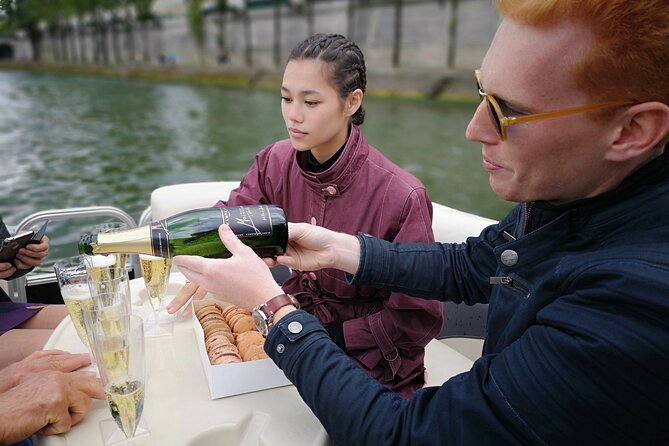
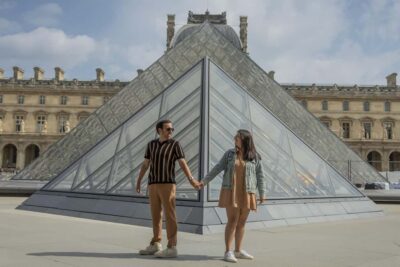
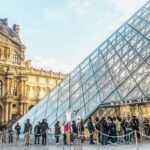
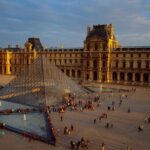
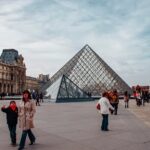
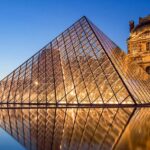
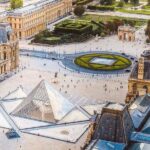
As the cruise continues, you pass in front of the Louvre Museum. Even without entering, you get a strong sense of how the Louvre sits as a center of gravity in the city’s museum universe.
The Louvre’s museum history in your time window: it was inaugurated in 1793 under the name Muséum central des arts de la République. Today it’s described as the largest museum of art and antiques in the world, with an exhibition area of 72,735 m² (as listed). It has collections from the Middle Ages to 1848, plus ancient civilizations before that.
You’ll also pass with a broad lens: Western art from the Middle Ages to 1848, plus Eastern, Egyptian, Greek, Etruscan, Roman influences, and the arts connected to early Christianity and Islam. That’s a lot to process from a boat, but the value is that the guide narration can connect what you see outside to what’s inside.
If you’re the kind of person who wants to know what matters before you buy tickets later, this is a good setup.
Musée d’Orsay: the station conversion you can feel from the water
Next, you pass Musée d’Orsay along the left bank of the Seine. The museum is in the 7th arrondissement and is housed in the former Orsay station.
The station was built by Victor Laloux from 1898 to 1900 and later converted into a museum. The collections cover Western art from 1848 to 1914, across painting, sculpture, decorative arts, graphic art, and photography. And if Impressionism is your priority, this is one of the big reasons people come: it has nearly 1,100 Impressionist and Post-Impressionist canvases out of more than 3,650 total.
From the river, you’re not seeing galleries, of course. But you are seeing the setting—the idea that Paris built a train station here, then repurposed it into a museum when the city moved on.
That kind of “time layering” is one of the quiet joys of Seine cruising.
National Assembly pass: where democracy meets the river
You’ll also pass in front of the National Assembly. Even from outside, this stop adds a political map to your mental picture of Paris.
The data points you can hold onto are simple: the National Assembly’s history links to democratic representation over two centuries, with changes in powers and appointment methods depending on political eras. The name National Assembly was chosen in the fervor of 1789 and reappeared only in certain intervals afterward.
From a traveler’s view, the cruise benefit is that you see how the city’s institutions sit among monuments and cultural sites. This is Paris beyond postcard view.
Pont Alexandre III and the grand finale energy
After that, you pass under Pont Alexandre III, one of the most recognizable bridges for sheer presence. It was inaugurated for the Universal Exhibition of Paris in 1900, built to symbolize Franco-Russian friendship after the alliance signed in 1891 between Emperor Alexander III and President Sadi Carnot.
The bridge’s build story reads like pageant material: the first stone was laid on October 7, 1896 by Tsar Nicolas II, Empress Alexandra Fedorovna, and President Félix Faure. Construction was entrusted to engineers Jean Résal and Amédée Alby, with architects Cassien-Bernard and Gaston Cousin.
The bridge also aligns with the axis of the Esplanade des Invalides and leads you toward the Petit and Grand Palais, which were built for the same Universal Exhibition.
Why this matters for your cruise experience: Pont Alexandre III is the moment when the river ride feels like it’s in a movie set. You’ll understand why this area is a favorite for photos later—your boat gives you clean sightlines and a steady pace.
Eiffel Tower pass: the classic symbol at boat speed
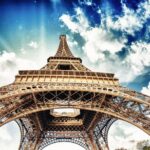
Finally, you pass in front of the Eiffel Tower. It’s a puddled iron tower reaching 324 meters high, built by Gustave Eiffel and collaborators for the Universal Exhibition of Paris in 1889, celebrating the centenary of the French Revolution.
It was initially named tower of 300 meters and later became the symbol of Paris. Since opening, it has welcomed more than 300 million visitors and was the third most visited French cultural site in 2015 with 5.9 million visitors in 2016.
From the water, the Eiffel Tower can look both massive and strangely delicate. And because this cruise is timed as a 90-minute highlight route, it works as a satisfying closer: you end with the landmark most people came for, without needing to rush straight into the lines.
Price and value: when $94.63 feels fair
Let’s do the straight math in plain language. You’re paying $94.63 per person for:
- a private experience (your group only),
- an English-offered narration,
- and about 1 hour 30 minutes of guided sightseeing centered on the densest monuments along the Seine.
If you’re visiting in a busy season or traveling with family, the cost can feel even better because you’re buying time and sanity. One guide explanation can replace a lot of solo reading and guessing. The route also avoids the common Paris trap: spending half your day crossing from one side of town to the other for a single photo.
In short: this is value when you want a lot of big sights in one smooth run, with less walking and less decision fatigue.
Who this cruise is best for (and who may want a different option)
This private Seine cruise is ideal if you:
- want a structured route through Paris’ central landmarks,
- prefer the calm of the water over crowded sidewalks,
- need something that works for mixed ages (I’m using that Diego example because the approach was described as kid-friendly),
- and would rather pass key museums from outside before deciding whether to go inside later.
It may not be your perfect fit if you’re:
- looking for a long, stop-everywhere tour where you exit and explore in depth,
- expecting museum tickets or guided museum time,
- or hoping to do a quick “grab coffee and keep walking” style itinerary.
Because you’re staying on the boat, you get speed and comfort, not deep entry-level exploration.
Tips to make your cruise day smoother
You’ll enjoy this most if you plan for the boat reality: you’re watching from a fixed seat. I’d recommend:
- dressing in layers (river air can shift fast),
- keeping your phone camera ready before each bridge pass,
- and using the guide narration to pick one or two spots you want to revisit on foot later.
Also, since the experience requires good weather, keep your schedule flexible if you can. A clear day makes the light on the water look much more like the photos.
Should you book this Seine cruise?
If your goal is a private, English-guided snapshot of classic Paris landmarks in about 90 minutes, I think it’s an easy yes. The best part isn’t just the big names—it’s that the cruise stitches them together into a route you can understand, with narration that can work for families too (and yes, Diego-style explanations are exactly the kind of thing that makes a difference).
Book it when you want comfort, timing, and a guided view. Skip it if you’re chasing hands-on museum time or want to get off and explore at every stop.