REVIEW · PARIS
Normandy Omaha, Utah Landing Beaches Small-group Trip from Paris
Book on Viator →Operated by Clewel Travel · Bookable on Viator
One morning. Three D-Day sites.
This small-group Normandy day trip packs Omaha Beach, Utah Beach, and Pointe du Hoc into one coach-free schedule, with hotel or Airbnb pickup that keeps you from wrestling with Paris logistics. I especially like the small group size (up to 7) because the guide can actually answer questions, and you get time to absorb what you’re seeing. The main downside is that it’s a long, focused day, so a few stops can feel brisk if you want extra time to read every sign slowly.
You’ll start early from central Paris and ride out in a Mercedes E220 (for 2 people) or a Mercedes minivan (for 3–7). You’ll get bottled water, an English-speaking guide experience (live-guided when the group is larger), and included admissions at the key sites. Meals are not included, so you’ll want to plan for that before you leave.
In This Review
- Key points to know before you go
- Why this Normandy D-Day day works better than a big-bus plan
- Morning logistics: pickup, Mercedes comfort, and what the schedule really means
- Overlord Museum by Omaha Beach: get the context before you walk the grounds
- Normandy American Cemetery and Visitor Center: the view plus the names
- Omaha Beach stop: sacrifice in context, not just sightseeing
- Pointe du Hoc: the cliff gun battery and the Rangers’ climb
- Utah Beach: a different kind of landing story
- Utah Beach Landing Museum and the B-26 bomber you can actually see
- Timing, pace, and the small-group tradeoff
- Value for money: what you’re really paying for at $419.94
- Who should book this tour (and who should skip it)
- Final call: should you book?
- FAQ
- What D-Day sites does this trip include?
- Is hotel pickup offered from Paris?
- How large is the group?
- Are admission tickets included?
- Is the tour in English?
- Does the tour include meals?
- How long is the full trip and what time do you return?
Key points to know before you go
- Hotel or Airbnb pickup at 07:30 saves time and stress in Paris
- Up to 7 people means a more personal pace than bus tours
- Overlord Museum + Normandy American Cemetery + Omaha Beach gives you context before you stand on the sand
- Pointe du Hoc focuses on the cliff gun battery and the Rangers’ mission
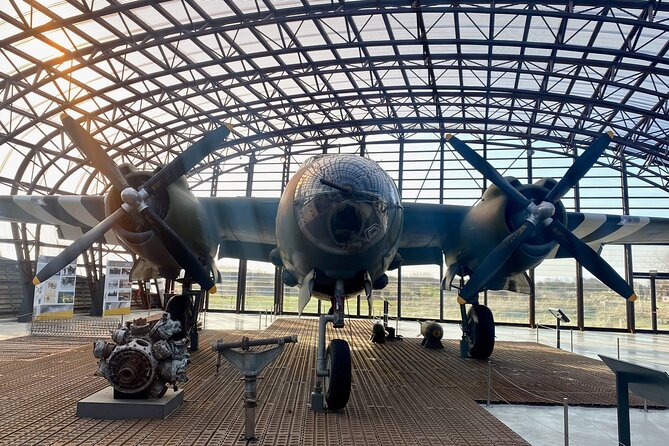
- Utah Beach Landing Museum has a rare B-26 bomber (one of only six left in existence)
- Long day, fixed timing: you’re seeing a lot, not lingering everywhere
Why this Normandy D-Day day works better than a big-bus plan
Normandy from Paris is one of those trips where the biggest risk isn’t just the distance. It’s how the day gets squeezed by traffic, huge groups, and long transfers.
This tour is built around the idea that you keep moving in a Mercedes and keep the group small. That matters because every minute you save on the highway translates into more time at the actual memorials. The operator also notes that these Mercedes vehicles can move faster than large buses on highways, which can help protect your site time.
The small-group format is also the reason the emotional parts of the day land harder. The Normandy American Cemetery isn’t the kind of place where you want to be shuttling in and out while a crowd pushes past you. With fewer people, you’re more likely to have the mental space to read the names and maps and then look out toward Omaha Beach.
You can also read our reviews of more tours and experiences in Paris.



Morning logistics: pickup, Mercedes comfort, and what the schedule really means

Your day starts early. Pickup happens at 07:30 from your hotel entrance door or Airbnb address, then the drive goes west toward Normandy (about 3.5 hours / 280 km to the Normandy American Cemetery area). You’ll have one rest-area stop along the way.
The entire trip runs about 13 hours, with the return drive taking around 4 hours (about 370 km). You arrive back in Paris around 20:30.
Two practical notes here:
- Wear comfortable shoes. The sites have outdoor viewing areas and pathways where you’ll do more walking than you might expect from a day that feels “mostly scenic.”
- Bring snacks or plan breakfast carefully. Meals and drinks are not included, and the schedule has gaps that are short rather than meal-friendly.
Overlord Museum by Omaha Beach: get the context before you walk the grounds
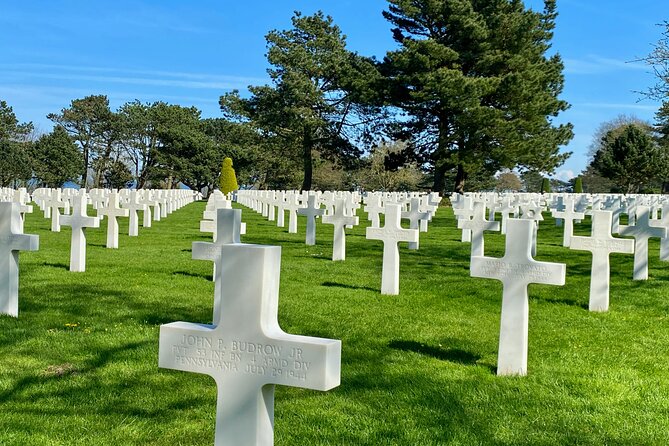
Your first major stop is the Overlord Museum near the Normandy American Cemetery. It’s scheduled for about 30 minutes, starting around 11:00.
What I like about this museum timing is that it works like a primer. You’re not yet staring at the cliffs and beachline. You’re learning what those sites looked like and why D-Day played out the way it did, using tangible objects and scale models.
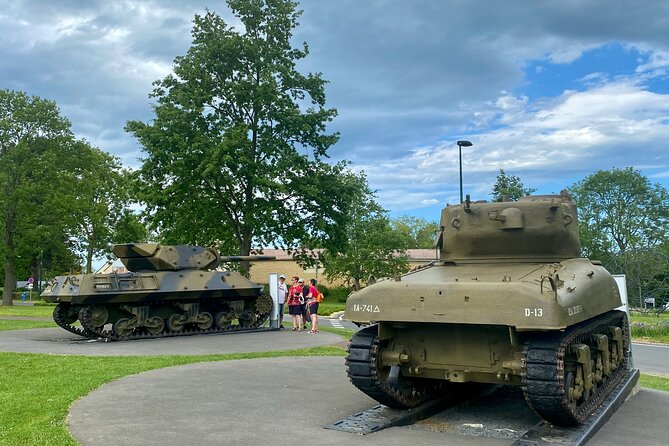
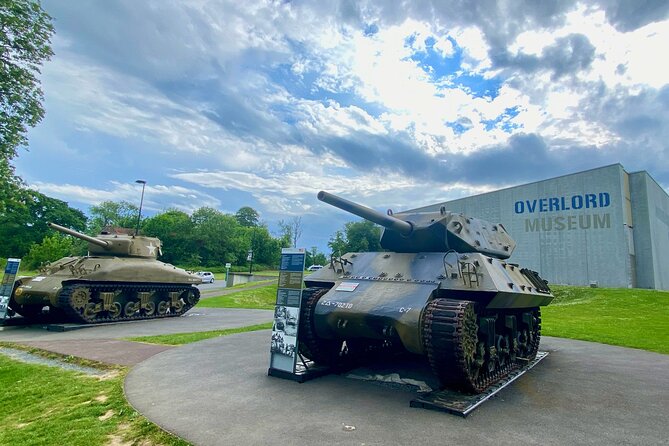
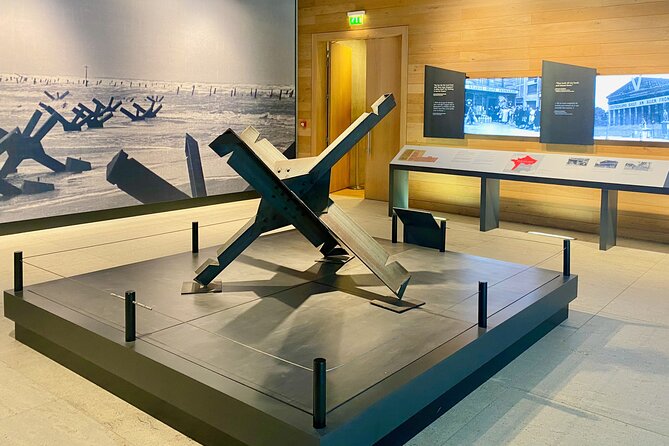
You’ll see WWII artifacts and installations such as tanks, weapons, guns, military vehicles, and even items like a V-1 missile, plus personal belongings and exhibits that help explain what people faced. This is the point in the day where the story clicks into place, so later the cemetery and the beach viewpoints feel more specific, not just symbolic.
The museum is also very close to the cemetery, so you aren’t losing time on extra transfers. Admission is included.
Normandy American Cemetery and Visitor Center: the view plus the names
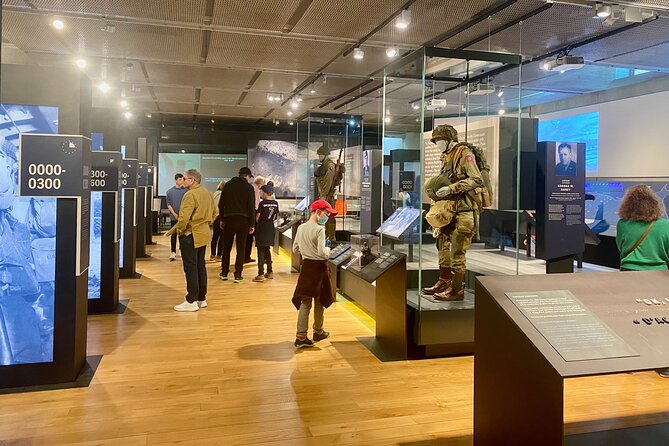
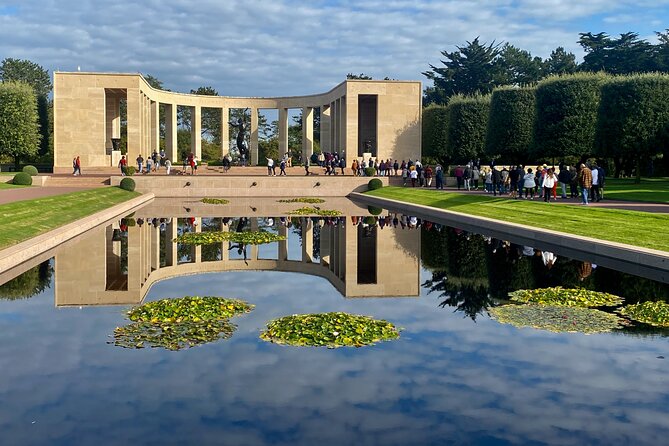
Next comes the emotional center of the trip: the Normandy American Cemetery & Visitor Center overlooking Omaha Beach. You’ll be there about an hour (arrival around 11:40).
This cemetery has:
- 9,387 U.S. soldiers interred
- The Wall of the Missing listing 1,557 names
- Concrete remnants of German defenses in the cliffs, including casemates and memorials
- A semicircular memorial colonnade featuring the sculpture Spirit of American Youth Rising from the Waves
- Large maps explaining military operations
The Visitor Center also matters. It includes a small museum with lots of information about the Battle of Normandy. If you only ever see battlefield sites from viewpoints, it’s easy to miss the bigger picture. The visitor center gives you a framework—who fought where, why, and how the plan unfolded.
One small but real consideration: the cemetery is not a place to rush. Even if your schedule says an hour, you’ll want to use that time wisely—read at least one section carefully, then look out toward Omaha Beach so the geography matches what you just learned.
Admission is included.
Omaha Beach stop: sacrifice in context, not just sightseeing
After the cemetery, the tour heads to Omaha Beach, about 10 minutes away. The time here is around 30 minutes (roughly 12:45–13:15).
This is the most “classic” stop of the trip because Omaha Beach is the most popular D-Day beach for visitors. You’ll learn about the huge sacrifice of the 34,000 men who landed here on D-Day.
Here’s how I’d approach your time at Omaha Beach if you want it to feel meaningful rather than checklist-like:
- Look for how the coastline and cliffs line up with what you learned at the cemetery.
- Pay attention to the kinds of defenses and terrain features the exhibits hinted at.
- Take a slower minute or two before moving on, especially if the crowds are light or you find a quiet angle.
Also, the tour includes a Memorial Signal element here as part of the included admissions, so the beach stop isn’t only “stand and look.” You get at least one curated memorial touchpoint.






Pointe du Hoc: the cliff gun battery and the Rangers’ climb
Then you jump to Pointe du Hoc Memorial, around 13:30–14:20. This site sits on a cliff area between Utah and Omaha beaches, and it was strategically crucial because it was the highest land between those points—making it able to fire on both.
At Pointe du Hoc, you’re looking at a former gun battery fortified with concrete casemates and gun pits. Part of what makes this place powerful is that you’re not seeing a restored site with everything “explained away.” You’re seeing the real bones of the Atlantic Wall defenses, and many original fortifications remain open to the public.
You’ll focus on the 2nd Ranger Battalion and the June 6, 1944 mission to take that gun battery on the cliffs. There’s also the fire control casemate area, with a monument to the 2nd Ranger Battalion on top.
This is the stop that tends to stick with people. One moving aspect is how the story turns into physical space: cliffs, concrete, and the kind of odds that feel impossible to picture until you’re standing close enough to see scale.
Admission is included.
Utah Beach: a different kind of landing story
After Pointe du Hoc, you drive roughly 40 minutes (the schedule lists about 400 km distance time-wise as part of the long return arc) to Utah Beach around 15:00–15:30.
You get a shorter stretch of time here—free time for learning—but the story behind Utah is distinct. Utah Beach was stormed by 23,000 American soldiers on June 6, 1944, aimed at capturing the town of Cherbourg and its deep-water port. Casualties were relatively light compared with other landing areas: 197, including 60 missing.
The tour also names the units involved, including the 82nd Airborne Division, 101st Airborne Division, VII Corps, the 4th Infantry Division, 90th Infantry Division, 4th Cavalry Regiment, and the 70th Tank Battalion.
Admission for Utah Beach itself is listed as free for this stop, so your main paid time contribution here is really what comes next: the museum.
Utah Beach Landing Museum and the B-26 bomber you can actually see
The best payoff late in the day is the Utah Beach Landing Museum, scheduled 15:30–16:30. It’s built atop a former German bunker, which makes the whole visit feel grounded in the real military setting.
Inside, you’ll find:
- A big collection of historical artifacts
- Military vehicles and displays
- And the highlight: an original B-26 bomber, one of only six left in existence
This is the kind of detail that turns a memorial stop into a hands-on historical visit. Even if you’ve read about the planes, seeing a rare aircraft in person adds a different kind of clarity—what equipment meant and how air power and landing operations fit together.
Admission is included for this museum stop.
Timing, pace, and the small-group tradeoff
This trip is designed for people who want to see the major D-Day anchors in one sweep. The tradeoff is time pressure.
One past experience highlighted a concern: it can feel rushed, and if you want lots of deep commentary, you may feel you’re missing some details you’d get in a larger-group format. That makes sense. When you only have a set window at each site, the guide has to balance reading time, walking time, and question time.
Here’s the practical way to decide:
- If you want a well-run day with emotional, meaningful stops and a guide keeping the story coherent, this small-group format fits.
- If you’re the type who needs 2–3 hours at a cemetery or wants to study every map marker without any sense of a clock, you might want a slower, longer-format tour instead.
If you do go, ask your guide early where they suggest you spend your time. Many guides will tell you what to look for so you get the best payoff before the next stop starts.
Also, the operator experience includes live guidance when the group is larger (listed as from 4 people). With a smaller headcount, you may get the driver’s guidance and direction more than a fully guided walkthrough at every stop.
Value for money: what you’re really paying for at $419.94
At $419.94 per person, the price isn’t cheap, especially for a one-day format. But value here isn’t only the sightseeing. It’s what’s included that would add up separately if you built this day yourself.
What’s included:
- Hotel or Airbnb pickup and drop-off
- Transportation in a Mercedes (E220 for 2, minivan for 3–7)
- Bottled water
- Visits with admissions covered for major stops, including Overlord Museum, Normandy American Cemetery & Visitor Center, Pointe du Hoc Memorial, and Utah Beach Landing Museum
- A schedule that combines context + key locations (museum first, cemetery second, beach sites after)
Add in the small group cap (max 7), and you’re paying for comfort, timing, and less friction. If you’ve ever tried to make D-Day stops work from Paris on your own—transport, ticketing, driving stress, and time lost—it’s easy to see why this is priced the way it is.
The best “value” factor for me is this: the trip is set up so you’re not just sightseeing. You’re receiving enough structure to understand why each site matters before you reach it.
Who should book this tour (and who should skip it)
I’d point this trip at travelers who:
- Want a one-day D-Day overview from Paris without the headache of local transport
- Prefer small-group attention and a more personal pace at memorials
- Like museum-and-memorial storytelling rather than only beach viewpoints
- Care about seeing rare objects like the B-26 bomber in person
I’d think twice if you:
- Want unhurried time at each site for reading and self-guided wandering
- Plan to spend a lot of energy photographing and studying details for hours (the schedule will move you along)
- Need a full lunch plan from the tour itself (meals are not included)
Final call: should you book?
Yes—if you want a focused Normandy D-Day day that’s emotionally grounded and logistically easy. The mix of Overlord Museum, the Normandy American Cemetery, and the paired cliff-and-beach logic (Pointe du Hoc between Omaha and Utah, then Utah’s museum with the B-26) makes the day feel connected, not random.
Book it with the right expectations: it’s long, it’s structured, and it’s not a “slow read everything” tour. If you bring comfortable shoes, a snack plan for meals, and a willingness to accept some time limits, you’ll get a day that’s both practical and deeply moving.
FAQ
What D-Day sites does this trip include?
You’ll visit Omaha Beach, Pointe du Hoc Memorial, and Utah Beach, plus key stops at Overlord Museum, Normandy American Cemetery & Visitor Center, and the Utah Beach Landing Museum.
Is hotel pickup offered from Paris?
Yes. Pickup is offered from your hotel entrance door or Airbnb address at 07:30, and you’ll travel by Mercedes (E220 or a minivan depending on group size).
How large is the group?
The tour has a maximum of 7 travelers, which helps keep the experience more intimate than large bus tours.
Are admission tickets included?
Admission tickets are included for Overlord Museum, Normandy American Cemetery & Visitor Center, and the major memorial/museum stops. Utah Beach is listed as free, and the Utah Beach Landing Museum has admission included.
Is the tour in English?
Yes. The tour is offered in English.
Does the tour include meals?
No. Meals and drinks are not included.
How long is the full trip and what time do you return?
The tour runs about 13 hours. You leave Paris at 07:30 and are scheduled to return around 20:30.